Procurement Advisory Services: What They Cost, What They Deliver, and Where Software Replaces Them
That does not make advisory a bad purchase. It makes it a purchase that deserves the same scrutiny as any other category, which is the one category most companies never put through a sourcing process.
This guide covers what advisory firms actually sell, what the 2026 market charges for it, where the work is genuinely irreplaceable, and where a source-to-pay platform now produces the same output continuously rather than once. If you are earlier in the question, the broader overview of what procurement consulting involves is a useful starting point.
What Are Procurement Advisory Services?
Procurement advisory services are paid engagements in which an external firm diagnoses, designs, or executes part of a company’s buying function. Typical scopes include maturity assessment, spend analysis, category strategy, sourcing execution, operating model redesign, and interim leadership. Fees are charged by day rate, fixed project fee, or retainer.
The word “advisory” does a lot of quiet work in that sentence. Some engagements stop at recommendation. Others run the negotiation, sign nothing, and hand back a signed contract someone else has to administer. The two are priced similarly and deliver very different things.
The market for buying procurement expertise from outside is growing rather than shrinking. Grand View Research put the global procurement-as-a-service market at USD 7.43 billion in 2025, with an estimate of USD 8.05 billion for 2026, and strategic sourcing was the largest component at 31.5% of 2025 revenue. Demand is not the question. Fit is.
What Types of Procurement Advisory Services Can You Buy?
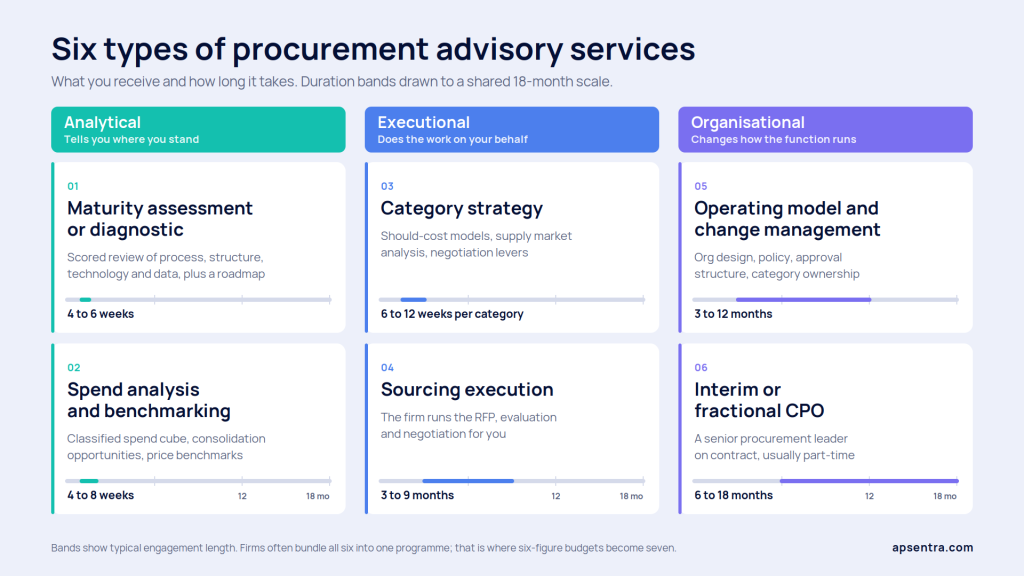
Six scopes account for most of what firms sell. Knowing which one you are buying matters more than knowing which firm you are buying it from, because the duration, the price, and the failure mode are different for each.
| Service type | What you receive | Typical duration | Buy it when |
|---|---|---|---|
| Maturity assessment / diagnostic | Scored review of process, org structure, technology, and data against a maturity model, plus a prioritised roadmap | 4 to 6 weeks | You need an independent view before committing a transformation budget |
| Spend analysis and benchmarking | Cleansed and classified spend cube, supplier consolidation opportunities, price benchmarks by category | 4 to 8 weeks | Nobody can answer “what do we spend with this supplier group” in under a week |
| Category strategy | Should-cost models, supply market analysis, negotiation levers for one category | 6 to 12 weeks per category | A single category is material and has never been market-tested |
| Sourcing execution | The firm runs the RFP, evaluation, and negotiation on your behalf | 3 to 9 months | You have the strategy but not the bandwidth to execute it |
| Operating model and change management | Org design, policy, approval structure, category ownership, training | 3 to 12 months | The function works by relationship rather than by rule |
| Interim or fractional CPO | A senior procurement leader on contract, usually part-time | 6 to 18 months | There is no procurement leader, or the seat is empty mid-transformation |
The first two are analytical. The next two are executional. The last two are organisational. Firms will happily sell all six as one programme, and that is where budgets go from six figures to seven.
How Much Do Procurement Advisory Services Cost?
Procurement advisory services are priced through four models: a day rate, a fixed project fee, a monthly retainer, or a share of validated savings. Day rates in 2026 range from roughly USD 500 for an independent specialist to USD 8,000 and above for a partner at a global strategy firm.
The four pricing models
- Day rate. Transparent and easy to compare, but it prices input rather than outcome. Ask how many days are partner days and how many are analyst days before comparing two proposals.
- Fixed project fee. The default for diagnostics and category work. The risk sits in the scope definition, not the number.
- Monthly retainer. Standard for interim and fractional leadership, and for ongoing category support. Usually 10 to 15 percent cheaper than the equivalent day count.
- Share of savings (gainshare). Attractive to CFOs because it looks risk-free. It is not. The entire commercial outcome depends on how the baseline is defined, and the firm helps define it.
Market ranges by firm tier
| Firm tier | Typical day rate | Typical engagement | What you are paying for |
|---|---|---|---|
| Global strategy firms (MBB) | USD 3,500 to 8,000+ | USD 250k to 1m+ | Board credibility, cross-industry benchmark data, a leveraged delivery team |
| Big Four | GBP 800 to 1,500 junior, GBP 3,500 to 6,000 partner | USD 150k to 600k | Scale, audit-adjacent assurance, global delivery coverage |
| Procurement boutiques | USD 800 to 2,000 | USD 40k to 200k | Senior practitioners on every engagement, category depth, fewer people |
| Independent / fractional | USD 500 to 2,500 | USD 10k to 90k | One experienced operator, no overhead, fast start |
Ranges compiled from 2026 consulting rate benchmarks published by Scopecreeper and 2026 consulting fee data from ConsultingDemand. Rates vary by geography: London sits 20 to 30 percent above the rest of the UK, and Scopecreeper reports that the average billed day rate across the German market slipped about 2 percent in 2025 to roughly EUR 1,300, with strategy the only discipline that raised rates that year.
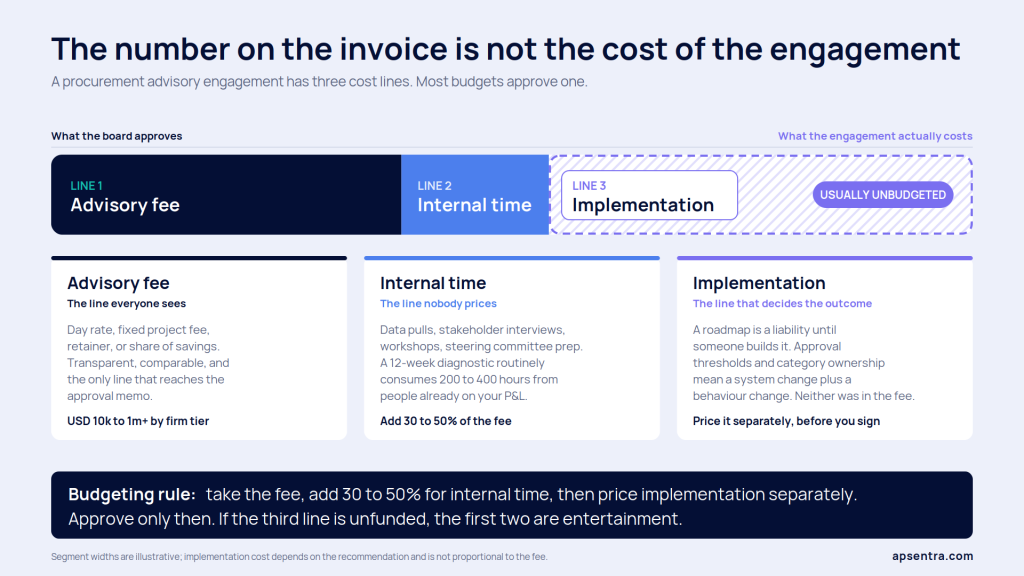
The number on the invoice is not the cost of the engagement
The fee is the first of three lines. The second is internal time: data pulls, stakeholder interviews, workshop attendance, steering committee preparation. A twelve-week diagnostic routinely consumes 200 to 400 hours from people whose salaries are already on your P&L.
The third line is implementation. A roadmap is a liability until someone builds it. If the recommendation is “introduce approval thresholds and category ownership,” the cost of the recommendation is a system change plus a behaviour change, and neither was in the advisory fee.
A practical rule when budgeting: take the advisory fee, add 30 to 50 percent for internal time, then price the implementation separately before you approve the engagement. If the third line is unfunded, the first two are entertainment.
Why Do CFOs Still Pay for Advisory When They Already Have a Procurement Team?
Four reasons, and only one of them is about expertise.
- Independent validation. A savings number produced by the team being measured is a number the board discounts. An external opinion is bought partly as evidence, which is a governance purchase rather than an analytical one.
- Capacity, not capability. Most procurement teams know what should be done. They are running renewals, escalations, and audit requests, and a 12-week category project never survives contact with the day job.
- Category-specific market knowledge. For a category bought once every three or four years, an internal team cannot hold current supply market intelligence. A firm that ran nine similar negotiations last year can.
- Political neutrality. Challenging a specification owned by engineering, or a supplier relationship owned by a business unit head, is easier for someone with no career exposure in the building.
There is a structural reason the validation problem keeps recurring. Deloitte’s 2025 Global Chief Procurement Officer Survey, based on responses from more than 250 CPOs across 40 countries, found that around 81 percent of organizations have at least half of their spend under formal management. Roughly half of procurement functions report into finance. Read those two together, and a pattern emerges: a large minority of companies are reporting savings on a spend base they only partially control, to a finance function that is only sometimes their own.
That is a measurement problem before it is an advice problem. Advisory can describe it. It cannot fix it, because the fix is a permanent record of what was committed and what was paid.
“If you do not control your business, it is not a business. It is gambling.”
— Natalie Eksi, CEO, APSentra, on the Behind Procurement Podcast
The credibility gap is covered in more depth in our analysis of why procurement ROI fails CFO scrutiny.
Where Procurement Advisory Services Are Irreplaceable
Software does not compete with judgement under uncertainty. These are the scopes where a firm earns its rate.
- Complex category strategy in technical categories. Should-cost modelling for a machined component or a contract manufacturing agreement requires engineering economics, not spend data. No platform derives a cost breakdown from an invoice.
- M&A carve-outs and post-merger integration. Standing up a supplier base before a transitional services agreement expires is a deadline-driven exercise with no historical data to work from. It is the clearest case for interim capacity.
- Negotiation in concentrated supply markets. When three suppliers serve the whole market, leverage comes from relationships, timing, and knowledge of what those suppliers accepted elsewhere. That is human, and it is often the single highest-return line an advisor delivers.
- Highly regulated or niche industries. Pharmaceutical qualified-supplier requirements, defence offset obligations, and utility regulatory frameworks reward people who have navigated the specific regime before.
- Redesigning something nobody internally has done before. A first centralisation, a first category management model, a first global tender. Pattern recognition from twenty prior attempts is genuinely worth paying for.
Our view on how to combine these strengths is set out in how APSentra approaches procurement consulting through a platform and certified partners, and the market landscape is compared in our review of procurement consulting firms.
Where Procurement Software Already Covers the Advisory Scope
Four of the most commonly sold advisory deliverables are now outputs a platform produces continuously, at no marginal cost per repetition.
| Advisory deliverable | What the engagement produces | What a platform produces |
|---|---|---|
| Spend analysis and benchmarking | A classified spend cube, accurate on the extract date | Spend classified as it is committed, with category and supplier views that never go stale |
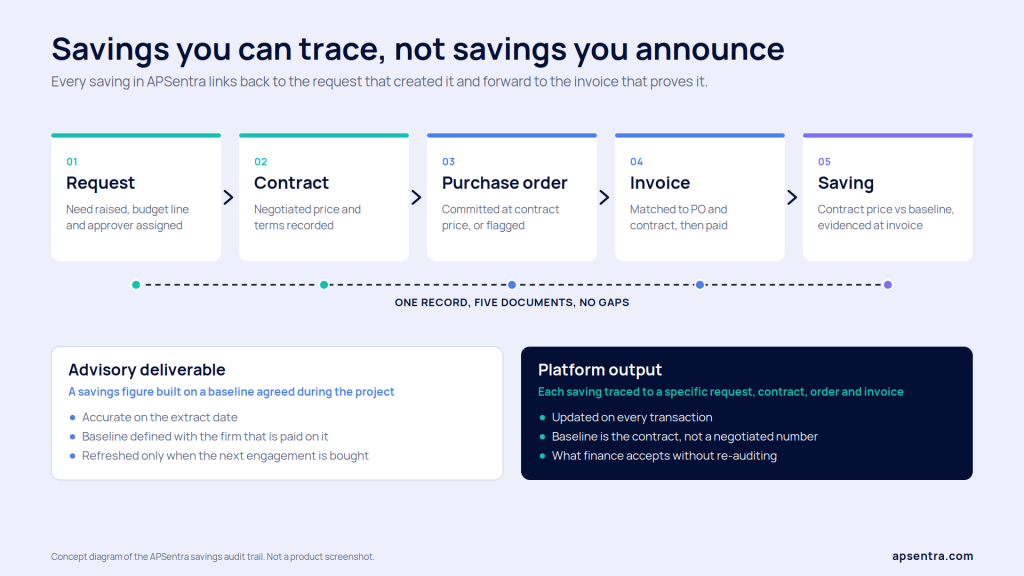
| Savings validation | A savings figure built on a baseline agreed during the project | Each saving traced to a specific request, contract, purchase order, and invoice, which is what finance accepts |
| Maturity assessment | A scored snapshot against a maturity model, once | Cycle time, policy compliance, contract coverage, and approval adherence measured every month |
| Operating model design | A target org chart, policy set, and approval matrix in a deck | Legal entities, thresholds, decision rights, and approval routes configured and enforced in the workflow |
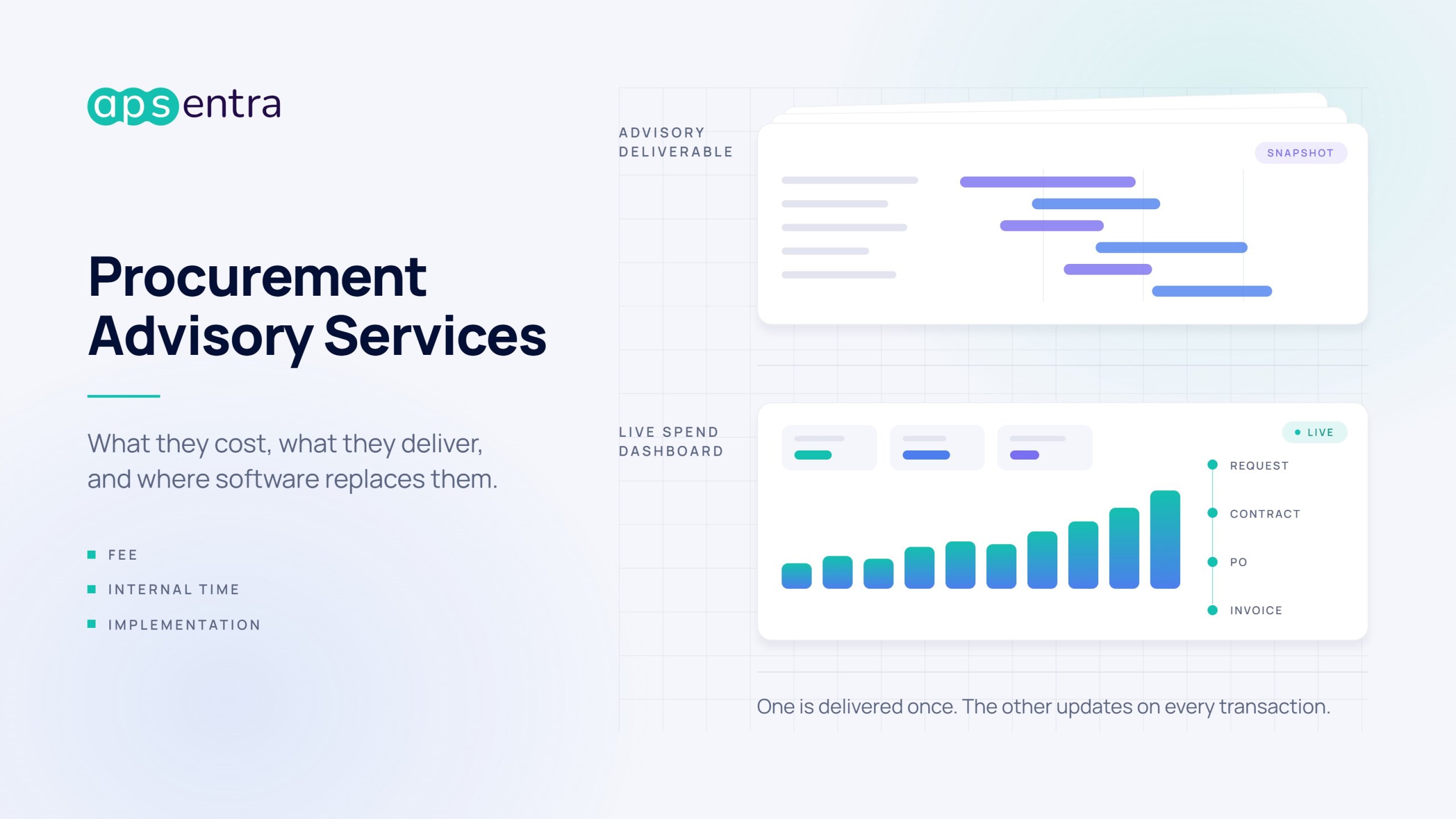
The useful distinction is not consulting against software. It is one-off analysis against standing instrumentation. Advisory answers what a company should do. A system answers what the company is doing right now, and keeps answering after the invoice is paid.
That difference determines what happens to a recommendation. A roadmap decays from the day it is delivered, because the organisation it describes keeps moving. A control does not decay, because it is applied to every transaction that passes through it.
This is the practical test: if a deliverable would be more valuable refreshed monthly than delivered once, it belongs in a system rather than a scope of work. Spend visibility, savings evidence, compliance measurement, and approval governance all fail that test as projects.
The pattern shows up consistently across APSentra client cases, where growth in transaction volume stopped translating into growth in operational load once governance moved into the workflow. The same trade-off is examined from the buyer’s side in when your team needs a consultant and when it needs a better system.
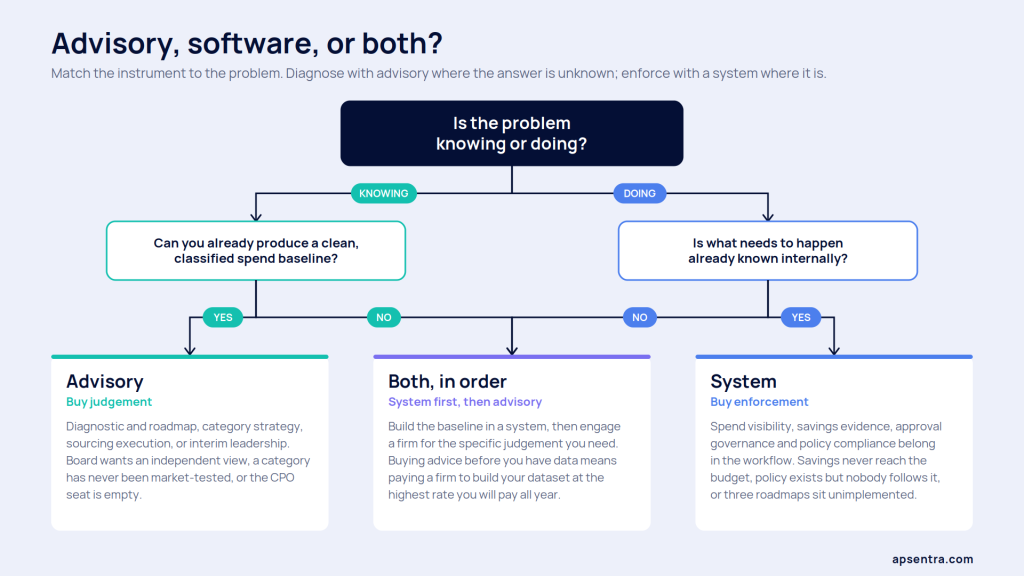
Advisory, Software, or Both? A Decision Checklist
Match the situation to the instrument. Most companies need both, in a specific order.
| If this is your situation | Buy this first |
|---|---|
| You cannot produce a clean, classified spend baseline | System. Paying consultants to assemble your dataset means buying data entry at consulting rates |
| The board wants an independent view before releasing a transformation budget | Advisory. Diagnostic and roadmap, four to six weeks |
| One category is a large share of addressable spend and has never been market-tested | Advisory. Category strategy, then sourcing execution |
| Savings are announced every quarter but never appear in the budget | System. The gap is evidence, not analysis |
| A carve-out closes in nine months and the supplier base does not exist yet | Advisory. Interim capacity plus sourcing execution |
| Policy exists, everyone knows it, nobody follows it | System. Enforcement is a workflow property, not a training outcome |
| There is no procurement leader and hiring will take six months | Advisory. Fractional or interim CPO |
| Three consulting roadmaps have been delivered and none were implemented | System. The constraint is execution capacity, and more advice will not relieve it |
Sequence matters more than the choice. Diagnose with advisory where the question is genuinely unknown. Enforce with a system where the answer is already known and the failure is in execution. Buying advice before you have data means paying a firm to build your dataset first, at the highest rate you will pay all year.