Procurement BPO: What It Is, What It Costs, and Its Hidden Trade-Offs
This guide sets out what a procurement BPO engagement typically covers, how providers price it, the trade-offs that do not appear in the sales deck, and the decision framework for weighing BPO against in-house automation or a hybrid of the two.
What Procurement BPO Covers
Procurement BPO is the outsourcing of procurement operations, whether transactional processing, sourcing execution, or supplier management, to a third-party provider that runs the work with its own staff and, in most cases, its own tooling. Scope ranges from narrow transactional support to full end-to-end procurement management.
Engagements typically fall into one of three tiers:
- Transactional processing. Purchase order creation, invoice processing, and helpdesk support for requesters: the highest-volume, most standardized layer of the work.
- Sourcing execution. RFx management, supplier negotiation support, and category sourcing carried out by the provider’s category specialists.
- Full end-to-end. The provider runs procurement operations across sourcing, purchasing, and supplier management under a managed-service model, often with the client retaining only policy and strategic category decisions.
Most engagements start at the transactional layer and expand scope over time, which is also where the pricing conversation usually starts. Growth in this market has been steady: recent industry market research tracks the global procurement outsourcing sector expanding at a double-digit compound annual growth rate through the early 2030s, with BPO-style transactional and managed-service delivery accounting for the largest share of that spend.
Common Pricing Models
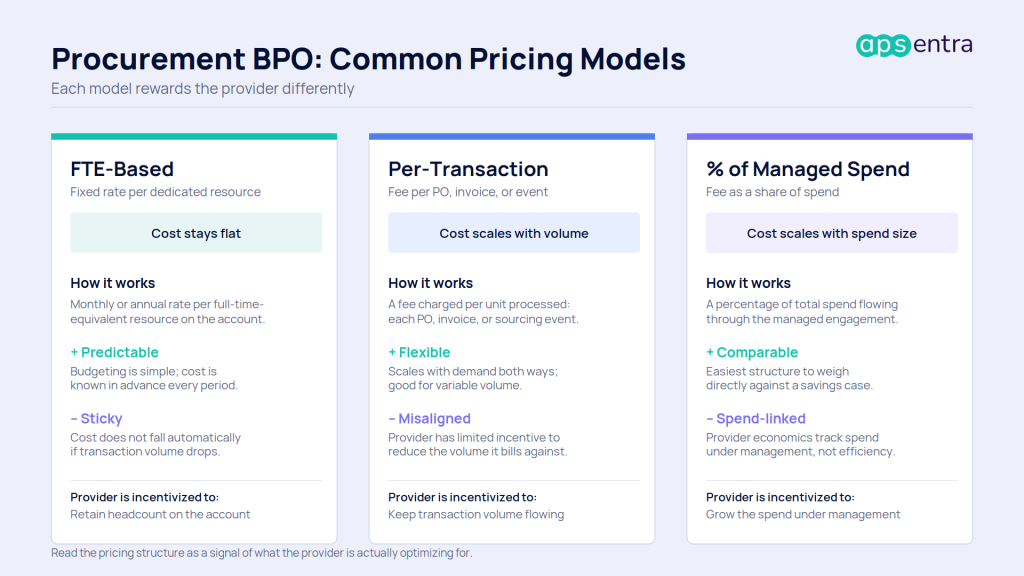
Procurement BPO providers price engagements in a small number of recognizable structures, each with a different risk profile for the buyer:
- FTE-based pricing. A fixed monthly or annual rate per full-time-equivalent resource dedicated to the account. Predictable, but the cost does not fall automatically if transaction volume drops.
- Per-transaction pricing. A fee per purchase order, invoice, or sourcing event processed. Scales with volume in both directions, which makes it attractive when demand is variable, but it also means the provider has limited incentive to reduce transaction volume through process improvement.
- Percentage of managed spend. A fee calculated as a share of the total spend flowing through the engagement. Common in full end-to-end arrangements and easiest to compare against a savings case, but it ties provider economics directly to the size of spend under management rather than to efficiency gained.
Each model rewards the provider differently, and it is worth reading the pricing structure as a signal of what the provider is actually incentivized to optimize.
Why Companies Choose Procurement BPO
Three reasons account for most BPO decisions, and they are legitimate reasons on their own terms:
- Cost arbitrage. Labor cost differentials between the buyer’s home market and the provider’s delivery location can make transactional processing materially cheaper on a per-unit basis.
- Scalability without headcount growth. Expanding transaction volume, entering new markets, or absorbing an acquisition without a proportional increase in internal procurement staff.
- Lack of internal capability. Organizations without a mature procurement function sometimes reach for BPO as a way to access process discipline and category expertise they do not yet have in-house.
The first two reasons are durable. The third is worth examining more closely, because it is often the case where BPO becomes a long-term dependency rather than a bridge. For a closer look at how a consulting engagement can close that internal-capability gap directly, see our guide to end-to-end procurement consulting.
The Trade-Offs Providers Do Not Lead With
Procurement BPO engagements carry structural trade-offs that are rarely front and center in a proposal:
- Reduced control. Category and supplier decisions made by a third party, even under agreed policy, move the organization one layer away from direct oversight of its own spend.
- Slower change cycles. Adjusting a workflow, adding a category, or changing an approval rule typically requires a change order with the provider, not a configuration change made internally.
- Data and IP ownership questions. Spend data, supplier records, and sourcing history generated during the engagement need contractual clarity on ownership and portability, particularly if the relationship ends.
None of these trade-offs disqualify BPO as an option. They do mean the decision should be made with the same rigor as any other multi-year operating commitment, not treated as a purely tactical staffing fix.
“Automation reduces the transaction volume that requires outsourced labor in the first place. That is exactly the volume BPO providers price by.”
— Eugene Ponomarov, Co-Founder, APSentra
Where BPO Makes Sense vs Where It Creates Dependency
BPO tends to hold up well in specific conditions and to create long-term dependency in others.
- Makes sense: highly standardized transactional volume, seasonal or acquisition-driven spikes, or entry into a market where the organization has no established procurement presence.
- Creates dependency: when BPO becomes the substitute for building an internal data and workflow foundation, so the organization stays as reliant on outsourced labor every year, with no path to reducing the transaction volume that requires it.
The distinguishing question is whether the engagement is closing a temporary capability gap or permanently replacing a capability the organization never built internally.
How Automation Changes the BPO Cost Equation
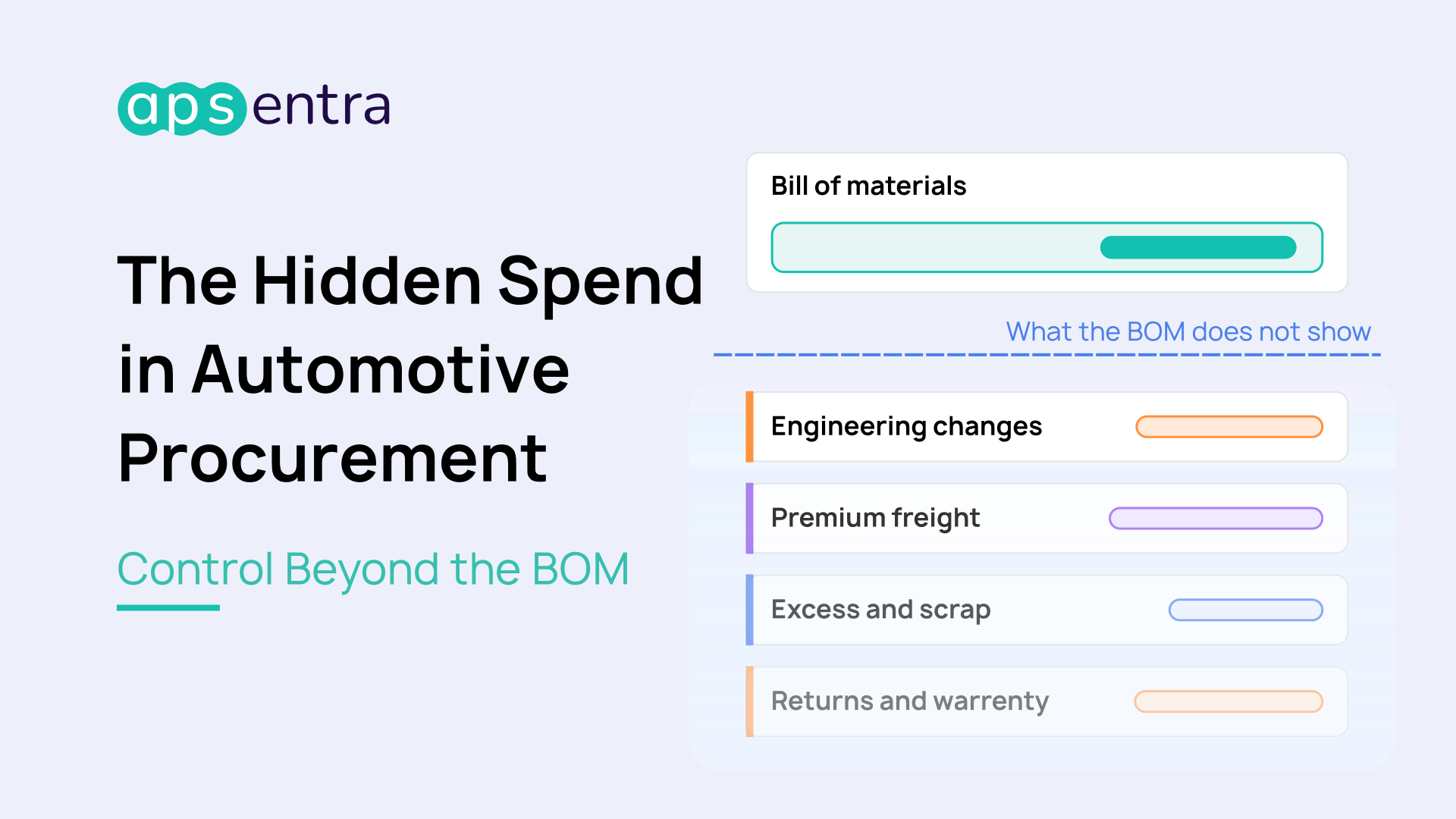
Automation reduces the transaction volume that requires outsourced labor in the first place. Purchase order generation, three-way invoice matching, and routine approval routing are exactly the tasks BPO providers price by volume, and exactly the tasks a governed procurement workflow can remove from the labor pool entirely.
This changes the calculation in a way that is easy to miss when BPO and automation are evaluated as separate line items:
- Per-transaction and FTE-based pricing both scale with the volume of manual work required. Automating the highest-volume, lowest-judgment steps shrinks that volume before any outsourcing conversation happens.
- A managed-service, percentage-of-spend engagement priced against a pre-automation transaction baseline can leave an organization paying provider economics on work the workflow no longer requires a human to do.
- Organizations that automate first and outsource what remains typically find the residual scope for BPO is narrower and more strategic: sourcing execution and category expertise, rather than transactional processing.
This does not make automation a universal substitute for BPO. It does mean the sequencing question, automate first, then decide what is left to outsource, changes the size and shape of the decision. See our companion guide on procure-to-pay automation for how that transactional layer typically gets automated in practice.
Decision Framework: BPO vs In-House Automation vs Hybrid
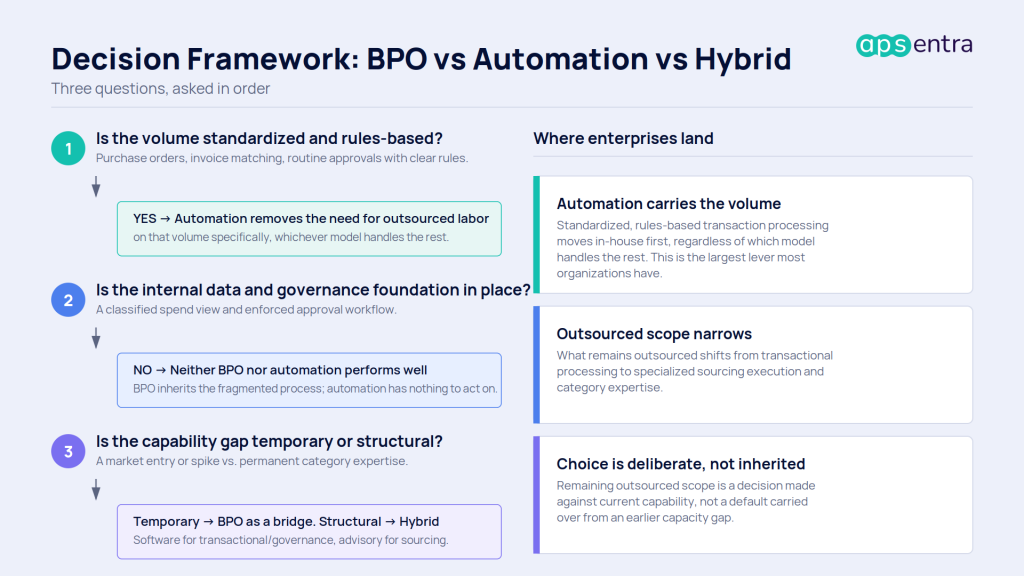
Three questions, asked in order, cover most of the decision:
- Is the volume standardized and rules-based? If yes, automation typically removes the need for outsourced labor on that volume specifically, regardless of which model is chosen for the rest of the function.
- Does the organization have, or plan to build, the internal data and governance foundation? Without it, neither BPO nor automation performs well: BPO inherits the same fragmented process, and automation has nothing reliable to act on.
- Is the gap temporary or structural? A temporary capacity gap (a market entry, an acquisition, a seasonal spike) favors BPO as a bridge. A structural gap in category expertise or process design favors a hybrid: a software platform for the transactional and governance layer, with outsourced or advisory support for the specialized sourcing work that genuinely benefits from external expertise.
Most enterprises land on a hybrid over time. Automation carries the volume, and any remaining outsourced scope is narrow and deliberately chosen rather than inherited from an earlier capability gap. For a broader view of how ROI should be tracked across either path, see our guide to why procurement ROI figures fail CFO scrutiny.