AI in Procurement Decision-Making: A CPO Interview with Mike Simms
🎙 BEHIND PROCUREMENT | EPISODE 7 RECAP
AI + Human Judgment: The Procurement Decisions Machines Shouldn’t Own
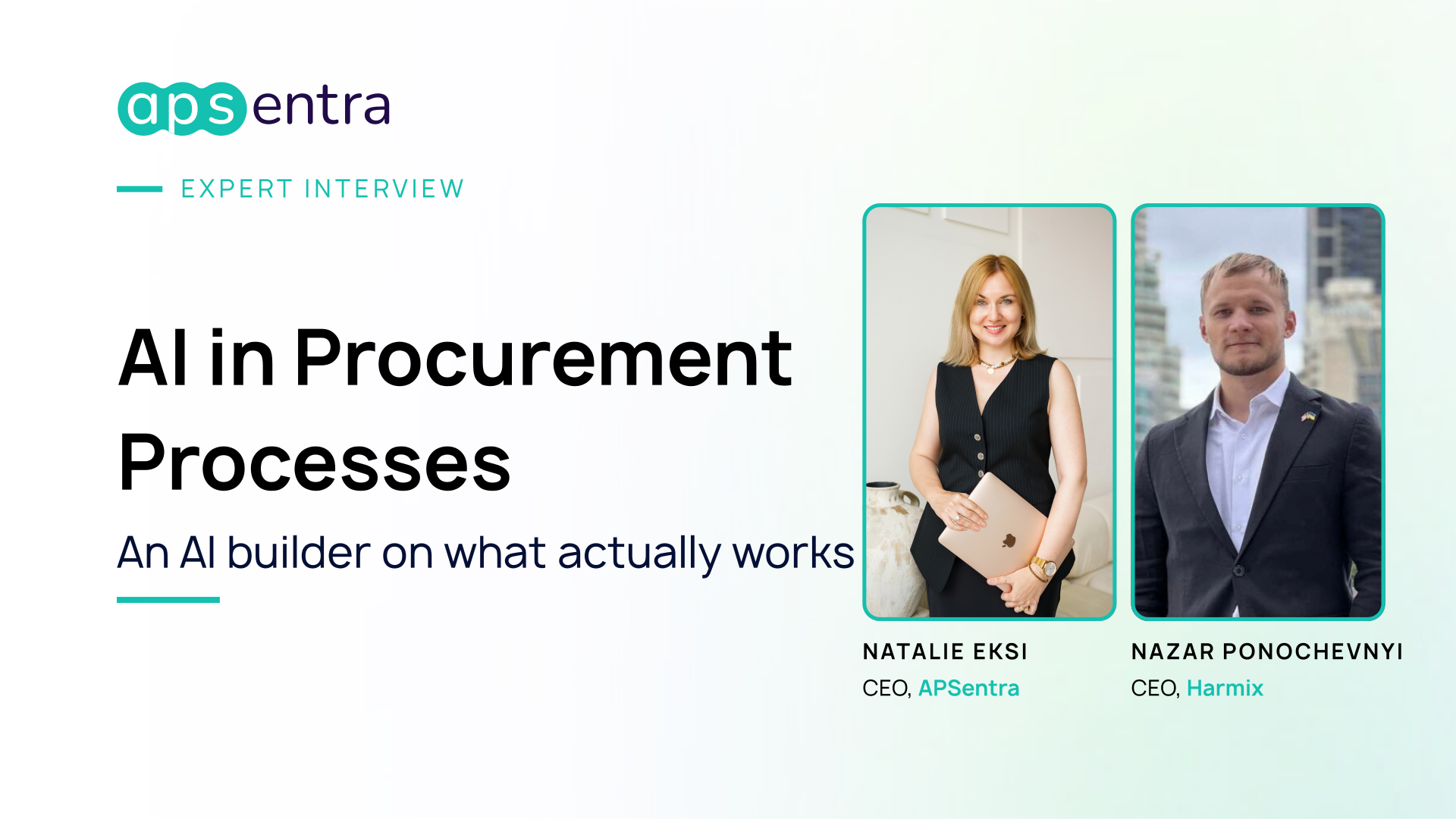
September 10, 2026 | Hosted by Natalie Eksi, with guest Mike Simms.
An edited transcript and analysis of the live conversation. Watch the full replay on YouTube. ⬇️
Every organization implementing AI in procurement eventually runs into the same question, and it rarely gets asked directly: which decisions is the machine actually allowed to make. Not which tasks. Not which workflows. Which decisions.
On the seventh episode of Behind Procurement, APSentra CEO Natalie Eksi put that question to Mike Simms, who spent six years as chief procurement officer at Microsoft and now advises CPOs on AI transformation as founder and CEO of The Simms Group. What follows is the edited interview, organized by theme rather than by the order the questions were asked live.
Meet Mike Simms: Six Years as Microsoft’s CPO
Mike Simms led procurement at Microsoft for six years, with more than thirty years of leadership across procurement, operations, and enterprise transformation. He is now founder and CEO of The Simms Group, advising procurement organizations on AI implementation.
He opened the interview with a disclaimer worth repeating before any of his views on AI:
That framing matters. Everything that follows is an operator’s view of where AI belongs in procurement decisions, not a vendor’s pitch or a technologist’s forecast. For the structured, decision-by-decision version, see our AI governance framework for procurement.
The Decisions Mike Simms Never Delegated, and Whether AI Changes That
Natalie Eksi: You spent six years as chief procurement officer at Microsoft. What decision did you never delegate, and does AI change that answer?
Mike Simms: Critical hires, at any level. They’re strategic, they fill a gap, they bring a new perspective, and they’re too important to delegate to anything or anybody. Big strategic supplier awards, and I’d put terminations in that same bucket. And key infrastructure tool decisions, though at Microsoft that one’s sensitive. It’s procurement’s call, but IT has a big vote too.
Natalie Eksi: And does AI change that answer?
Mike Simms: It doesn’t really change my view of what I wouldn’t delegate. But it massively changes everything below that line, everything I would delegate. Delegation has historically been constrained by capacity. My team could generally only work the top slice of spend, data, and suppliers. AI pushes that further down. Tail-spend negotiation management is a good example. It’s being used today, and I’d have used it a lot more at Microsoft.
The LinkedIn Poll: Where Procurement Leaders Think AI Should Never Own a Decision
Before the interview, Natalie ran a poll on LinkedIn asking procurement professionals: what should AI never own in procurement? The results were lopsided toward one answer, and Mike Simms disagreed with the majority.
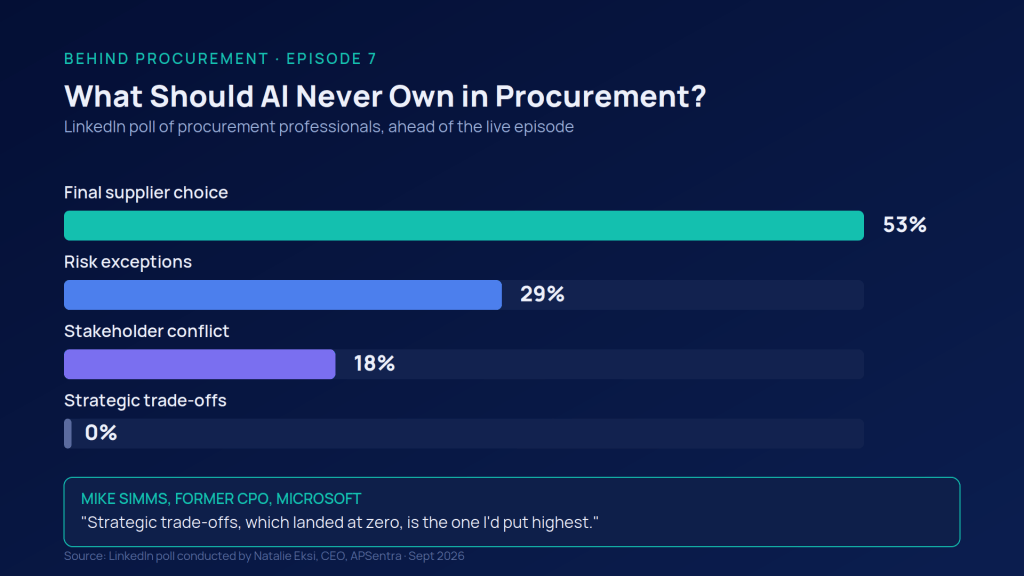
“I don’t think AI should ever own decisions you either can’t undo, can’t check before they bind, or whose stakes the machine can’t see. Supplier choice, especially in the tail, is actually one of the most delegable decisions there is. And strategic trade-offs, which landed at zero, is the one I’d put highest. AI is genuinely good at framing trade-offs. Making the call is a separate question, but framing it is squarely AI’s sweet spot.”
— Mike Simms, Founder & Managing Director, The Simms Group
The gap between what the audience feared most (losing control of supplier choice) and what an operator flags as the real blind spot (strategic trade-offs, which respondents barely registered as decisions) is the clearest signal in the conversation that procurement’s AI anxiety is currently misplaced.
Agentic vs. Autonomous AI: A Distinction Procurement Leaders Keep Getting Wrong
Natalie Eksi: Everyone in this market says “agentic” now. What does it actually mean, and how is it different from “autonomous”?
Mike Simms: I view agentic as a capability: a system that can plan multi-step actions toward a goal. Autonomous is about permission: it can act without a human checkpoint. AI vendors sell you the first, but you have to grant the second.
He also named a pattern worth watching for in vendor conversations: “agent washing,” where the word “agentic” gets applied loosely to justify a sale. “This is a problem of marketing. You cannot sell if you don’t use the buzzwords. Many people use the word without understanding what it means.”
Why Only 5% of Organizations Get AI in Procurement Decision-Making Right
Midway through the conversation, Natalie introduced a data point from Deloitte’s 2026 Global Human Capital Trends report, in the chapter “AI and the future of human decision-making.” Deloitte’s 2026 survey found that 64% of leaders consider AI’s implications for decision-making very important, and 62% say efforts are underway. Only 5% consider themselves to be leading the way.
64% call it very important. 62% have efforts underway. Only 5% report they are leading the way, a 59-point execution gap, per Deloitte’s 2026 Global Human Capital Trends survey.
Natalie Eksi: What is happening to the other 95%? What’s preventing efficient AI implementation?
Mike Simms: People tend to want to start with the tool instead of the data. They bolt agents onto fragmented, dirty, decentralized data, and everything stalls. They deploy without granting proper permissions. Most organizations have delegation matrices defining who owns what, and moving too fast without redefining that for AI is a critical miss. And expectations get set by marketing. People buy the keynote and the pitch, and the tool doesn’t live up to it. The sequence matters: visibility into your data first, then process discipline, and only then what I’d call bounded autonomy.
Where AI Genuinely Improves Procurement Judgment
Natalie Eksi: Where does AI really make procurement judgment better, and where does it quietly make it worse?
Mike Simms: Spend analytics is a clearly great implementation case for AI. Sourcing, bid, and evaluation, absolutely. And tail-spend management is really the most visible win I’d point to. Interestingly, none of those are about AI making a better decision. Every one of them is about AI making the process better. Garbage in, garbage out was true when I was cutting my teeth on Six Sigma decades ago, and it’s more applicable today than ever. Clean data is the foundation for any AI implementation.
The Three-Question Test Behind Mike Simms’ “Judgment Line”
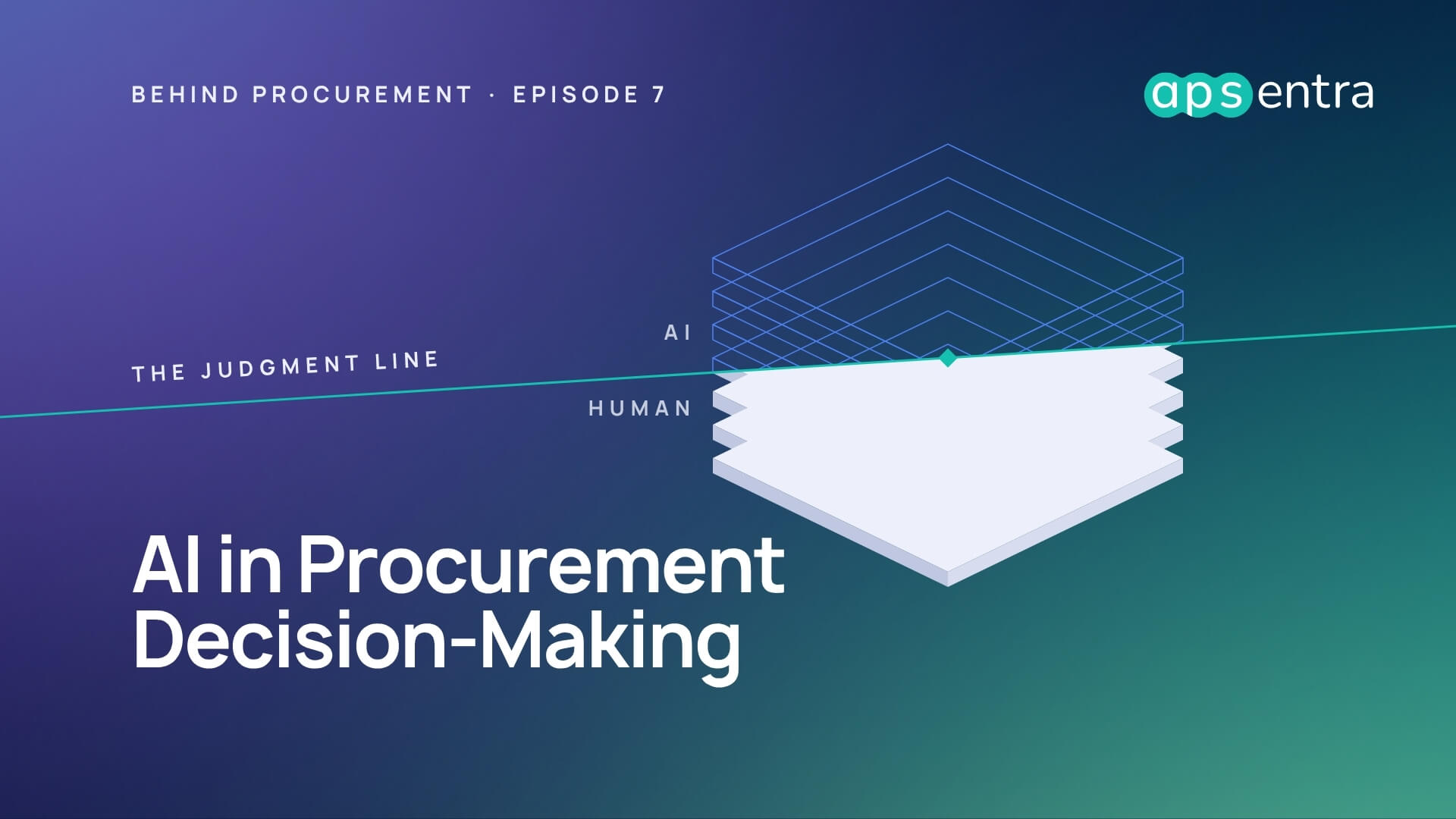
Mike Simms uses a simple, repeatable test to decide which procurement decisions belong to AI and which stay with a human. He calls the resulting boundary the judgment line, a sorting tool: “You decide, decision by decision, what the machine owns and what we own.”
The three questions:
- Can you undo it cheaply?
- Can you check it before it commits you?
- Can the machine see everything that’s genuinely at stake: relationships, revenue, reputation?
A “no” to any one of those questions pushes the decision away from AI and back to a human.
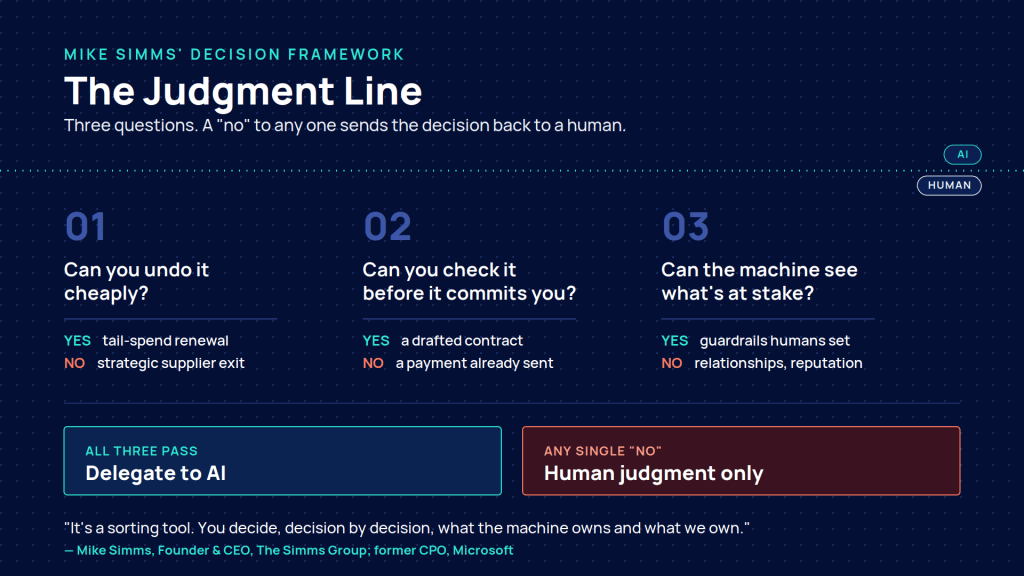
Mike Simms: Tail-spend negotiation is a great application for AI because it passes all three tests. Humans write the requirements and set the guardrails: price ranges, term trade-offs. Legal can pre-approve it, and AI implements it.
Should an AI Agent Be Allowed to Negotiate With a Supplier?
Natalie Eksi: You’ve said autonomous agents can negotiate with suppliers. Why do you believe that?
Mike Simms: It’s already happening, so the question isn’t really hypothetical anymore. Do I think it’s smart? I do, as long as a human signs the mandate. I’d apply it mostly to non-strategic suppliers. So the line isn’t big versus small, it’s transactional versus strategic. Transactional categories like MRO are a great opportunity for autonomous negotiation.
He also pointed to a factor procurement leaders tend to overlook entirely: the negotiating agent’s “character.” A 2026 large-scale study from MIT Sloan and MIT’s Initiative on the Digital Economy, published in PNAS, analyzed more than 180,000 AI-to-AI negotiations and found that warmth (agents that used positivity, gratitude, and questions) was consistently associated with better overall outcomes and a higher rate of reaching a deal at all. Dominant, aggressive agents claimed more value when a deal did close, but were more likely to push the negotiation to an impasse.
Mike Simms: How do you choose the agent’s character? That’s the influence question nobody’s really asking yet. It’s AI taking on the anthropomorphic side of a human negotiator, and we’re responsible for shaping that.
When an AI-Influenced Decision Goes Wrong, Who Is Accountable?
Natalie Eksi: When AI is responsible for negotiations, sometimes even relationship-building, and an AI-influenced decision goes wrong, who is accountable, and what do you need in place beforehand?
Mike Simms: This is an easy one for me. You are. Full stop. AI doesn’t have a salary, and that doesn’t hold up in court. There’s a well-known case of an airline whose AI agent committed to a refund that never came through. The airline argued in court that the AI had made an uninformed commitment and should be held accountable. The court disagreed and held the airline liable.
So you need a few things in place. A named owner: decision matrices, RACI, responsibility graphs, and these days we have to pour AI into those too. An audit trail. And, most important, a kill switch. You need to know when things are going wrong and be able to arrest the situation, pause it, or redirect it. But ultimately, humans are accountable for the outcome.
Agent Meets Agent: What Happens When Both Sides of a Deal Are AI
Natalie Eksi: What happens when a negotiation agent meets a supplier’s negotiation agent? Is that hypothetical, or is it already happening?
Mike Simms: Gartner projects that by 2028, AI agents will intermediate 90% of B2B purchasing, channeling more than $15 trillion in spend through agent-to-agent exchanges. That turns your question from a hypothetical into a “not if, but when.”
The character question resurfaces here too. Warm, collaborative agents build longer-term, more profitable relationships; aggressive agents win better single-deal prices but are more likely to stall the negotiation entirely. Natalie’s read on where this settles: at some point, price becomes the dominant factor on both sides, agents lean aggressive to compete, and a human has to step back in just to move the deal forward.
A CPO’s Monday Morning Playbook for AI in Procurement
Natalie Eksi: Instead of a farewell message, what should every chief procurement officer do on Monday morning?
Mike Simms: Start with your data. Garbage in, garbage out: clean data is the foundation for any AI implementation. If you’re not ready to go that far, start by scrubbing your decision matrices and policies for where AI should be included. Put the machine in the loop as a formal part of your process, not just an add-on. Build in audits around the human side of that equation too; it’s easy to take for granted.
And think about training. Activities like tail-spend negotiation used to be where people cut their teeth, learning negotiating tactics, procurement fundamentals, practices and procedures. A lot of that is moving to AI now, so start thinking about how you’ll train people to be the human in the loop, and how your talent mix shifts as a result.
Natalie closed the conversation with the line that framed the whole episode: “It’s not AI versus HI. HI is supposed to be responsible for whatever AI is doing on your behalf.”
Key Takeaways
- Don’t delegate by category. Delegate by test. Mike Simms’ three questions (undo cheaply, check before it commits, machine can see what’s at stake) sort decisions better than spend size or supplier tier.
- Procurement leaders and the data disagree on where the risk is. A LinkedIn poll of procurement professionals put final supplier choice as the decision AI should never own; an operator with six years as a Microsoft CPO puts strategic trade-offs higher.
- Process gets better before decisions get better. Every AI win Mike Simms named, spend analytics, sourcing, tail-spend, improved the process, not the decision quality itself.
- Execution is lagging intent industry-wide. Deloitte’s 2026 survey shows 64% call AI-and-decision-making very important, but only 5% say they’re leading on it.
- Accountability doesn’t transfer to the machine. A named owner, an audit trail, and a kill switch are the minimum before any AI-influenced decision goes live.
- Agent-to-agent negotiation is now a “when,” not an “if.” With Gartner projecting 90% of B2B purchasing agent-intermediated by 2028, the character an organization builds into its negotiating agents is becoming a governance decision, not a technical one.
Governance questions like these aren’t unique to AI. Our companion piece on procurement in capital projects covers the same accountability logic applied to committed spend and change orders on multi-year builds.