AI in MRO Procurement: Use Cases, Benefits & Implementation
MRO procurement is a strong match for AI because so much of it runs on pattern recognition under uncertainty: predicting which part will fail, which supplier will deliver late, which invoice does not match the purchase order. This article covers what AI actually does inside MRO procurement today, where generative AI and machine learning apply differently, the real benefits and risks, and how to implement it without repeating the mistakes most procurement teams make.
What Is AI in MRO Procurement?
AI in MRO procurement covers a range of applications, from machine learning models that predict equipment failure, to generative AI tools that draft RFQs or summarize supplier documents, to automation that matches invoices against purchase orders. What ties these applications together is the goal: turning MRO buying from a reactive, calendar-based process into one driven by real signals from equipment and spend data.
Why MRO Procurement Is a Good Use Case for AI
MRO procurement generates exactly the kind of data problem AI is well suited to: high volume, repetitive decisions, with patterns too subtle or too numerous for a person to track manually across thousands of SKUs.
Three characteristics make it a strong fit specifically:
- Volume and repetition. Reorder decisions, invoice matching, and supplier scoring happen constantly and follow learnable patterns.
- Sensor-rich equipment. Modern machinery already generates the vibration, temperature, and usage data that failure-prediction models need.
- High cost of error. A missed signal leads to unplanned downtime, so the payoff for a correct prediction is large relative to the cost of running the model.
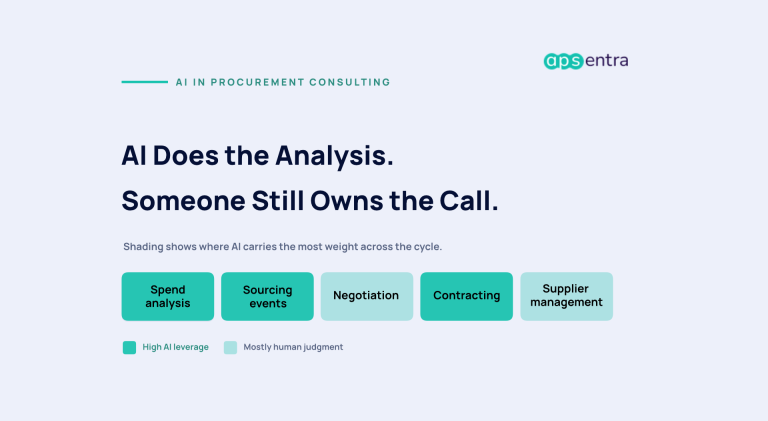
Not every part of MRO procurement fits this pattern. High-stakes supplier negotiations and first-time sourcing decisions for unfamiliar categories still call for human judgment, which is why the highest-value AI applications sit in specific, well-scoped tasks rather than across the whole function at once.
Generative AI in MRO Procurement
Generative AI plays a narrower, more assistive role than predictive machine learning. Inside MRO procurement, it is most useful for:
- Drafting RFQ and RFP documents from a set of technical specifications
- Summarizing supplier compliance documents and certifications for faster qualification
- Extracting structured data, such as part numbers, quantities, and delivery terms, from unstructured supplier invoices and emails
- Answering procurement policy questions for maintenance staff at the point of request
Generative AI does not decide which supplier to select or which part is critical. It reduces the manual work around those decisions, drafting, summarizing, extracting, so the people and the predictive models further upstream can move faster.
Machine Learning in MRO Procurement
Machine learning does the predictive and pattern-recognition work that generative AI does not. The most common applications are:
- Failure prediction. Models trained on sensor and maintenance history data flag equipment likely to fail within a defined window.
- Demand forecasting. Consumption patterns, adjusted for seasonality and production schedules, set smarter reorder points than static min/max thresholds.
- Supplier risk scoring. Delivery time, quality rejection rates, and financial signals combine into a continuously updated risk score per supplier.
- Spend anomaly detection. Invoice and purchase order data is scanned for pricing drift, duplicate payments, and maverick buying outside approved channels.
These models improve with more historical data, which is why organizations with clean, structured spend and maintenance records see faster returns than those still consolidating fragmented systems.
AI Use Cases in MRO Procurement
Bringing generative AI and machine learning together, the practical use cases fall into a handful of categories.
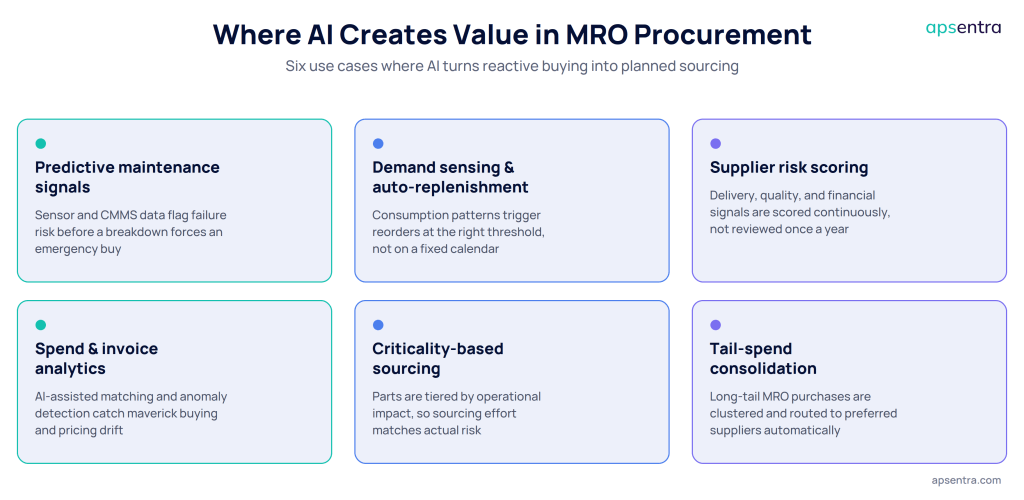
| Use case | What it replaces | Primary technology |
|---|---|---|
| Predictive maintenance signals | Calendar-based part replacement | Machine learning |
| Demand sensing & auto-reorder | Static min/max stock levels | Machine learning |
| Supplier risk scoring | Annual supplier reviews | Machine learning |
| RFQ drafting & document summarization | Manual document preparation | Generative AI |
| Invoice & spend anomaly detection | Period-end spend review | Machine learning |
| Criticality-based sourcing routing | Uniform sourcing effort per part | ML + business rules |
Benefits of AI-Powered MRO Procurement
Organizations that get the foundation right, clean data and clear ownership, before deploying AI tend to see benefits across three areas.

Fewer unplanned failures

Lower carrying and expediting costs

Faster, more defensible decisions
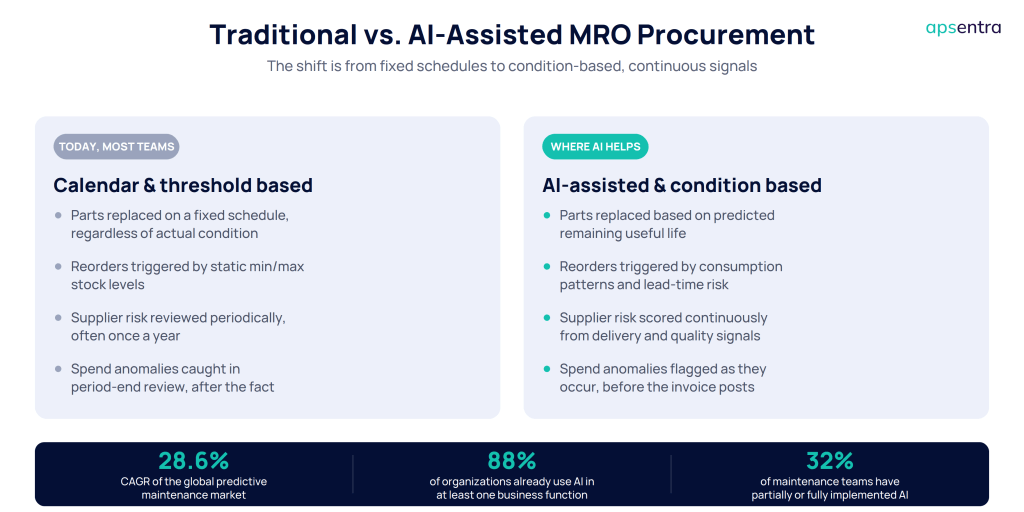
The broader market data backs this direction. The global predictive maintenance market reached $14.29 billion in 2025 and is growing at a 28.6% compound annual rate, according to Grand View Research. Adoption is still early, though: MaintainX’s 2026 Maintenance Trends Report found that only 27% of manufacturers actively use predictive maintenance today, even as two-thirds say they plan to adopt AI by year’s end.
Challenges & Risks
AI in MRO procurement fails for predictable reasons, and most of them have nothing to do with the model itself.
- Bad data in, bad decisions out. Fragmented spend records, duplicated SKUs, and inconsistent part descriptions undermine any model built on top of them.
- Governance gaps. ProcureAbility’s 2026 ProcureCon CPO-CIO Report found that while most procurement and IT teams collaborate to some degree, over half are not collaborating specifically on AI governance, exactly where manual overrides tend to go unchecked.
- Skills and change management. Maintenance and procurement staff need to trust a system’s recommendations enough to act on them, which takes deliberate change management, not just a software rollout.
- Over-automation of low-value work. Automating a report nobody needed is not transformation. The highest-value use cases are decisions, not dashboards.
None of these are reasons to avoid AI in MRO procurement. They are reasons to sequence the work: fix the data and define the rules before scaling the model.
How to Implement AI in MRO Procurement
Map the process before touching a system
Audit and standardize MRO spend data
Start with one well-scoped use case

Define governance and override rules up front

Measure against a baseline, not a vendor promise

Scale only after the first use case holds up
AI-Powered MRO Procurement Software
Most organizations do not build these capabilities from scratch. They implement them through a procurement platform that already connects purchasing to production data, so predictive and automation features have a structured foundation to run on rather than a spreadsheet.
APSentra’s manufacturing and industrial procurement platform applies AI to invoice scanning, purchase order matching, and spend analysis, while keeping every purchase tied to the bill of materials and production schedule it supports. That connection matters more than the AI feature list on its own. A model that flags a supplier risk or a demand shift is only useful if the recommendation reaches an approval workflow that can act on it immediately.
For a broader look at how procurement teams are sequencing AI adoption across categories beyond MRO, see the state of AI adoption in procurement in 2026 and AI procurement workflows that improve decision quality.
Future of AI in MRO Procurement
The near-term direction is toward tighter integration rather than new categories of capability. Predictive maintenance signals feeding directly into automated purchase orders, without a manual step in between, is already technically possible and will likely become the default in facilities with the data maturity to support it.
The harder shift is cultural, not technical. Deloitte’s 2025 Global CPO Survey found that 57% of CPOs cite siloed working as the top barrier to realizing AI value, ahead of any single technical constraint, a pattern covered in more depth in the state of AI adoption in procurement in 2026. Most organizations that struggle with AI in MRO procurement are not missing the technology. They are missing the data foundation and the cross-team governance that makes the technology trustworthy enough to act on automatically.