AI in Procurement Consulting: What It Actually Changes
Here is the short version. AI has already taken over most of the analysis layer of procurement work, convincingly and permanently. It has not taken over the judgment layer, and the gap between those two facts is where most failed AI programs live. This guide covers what shifts, what does not, and what has to be true before any of it is safe to automate.
What AI in Procurement Consulting Actually Means
AI in procurement consulting refers to the use of machine learning, generative AI, and autonomous agents to perform work that consultants and procurement teams previously did manually: classifying spend, extracting contract terms, scanning supply markets, drafting sourcing documents, and flagging risk. It changes the cost and speed of analysis, not the ownership of decisions.
That last sentence is the whole argument, and it is worth being precise about why. A consulting engagement has historically bundled two very different things: the labor of assembling and analyzing information, and the judgment of deciding what to do about it. Clients paid for both in a single fee because they arrived together.
AI has unbundled them. The analysis half is now fast, cheap, and increasingly commoditized. The judgment half is not, because it depends on organizational context, relationship history, risk appetite, and accountability, none of which live in the data a model can see.
This reframes what you should be buying. If a firm’s value was mostly in producing the analysis, that value is eroding quickly. If it was in the judgment applied to the analysis, it is holding. The distinction matters when comparing proposals, which is the same evaluation problem covered in our guide to procurement consulting firms and how to compare them.
The Adoption Gap: Everyone Uses It, Few Have Deployed It
The most misleading statistic in this category is personal adoption. It is extremely high, and it tells you almost nothing about whether an organization has changed how it works.
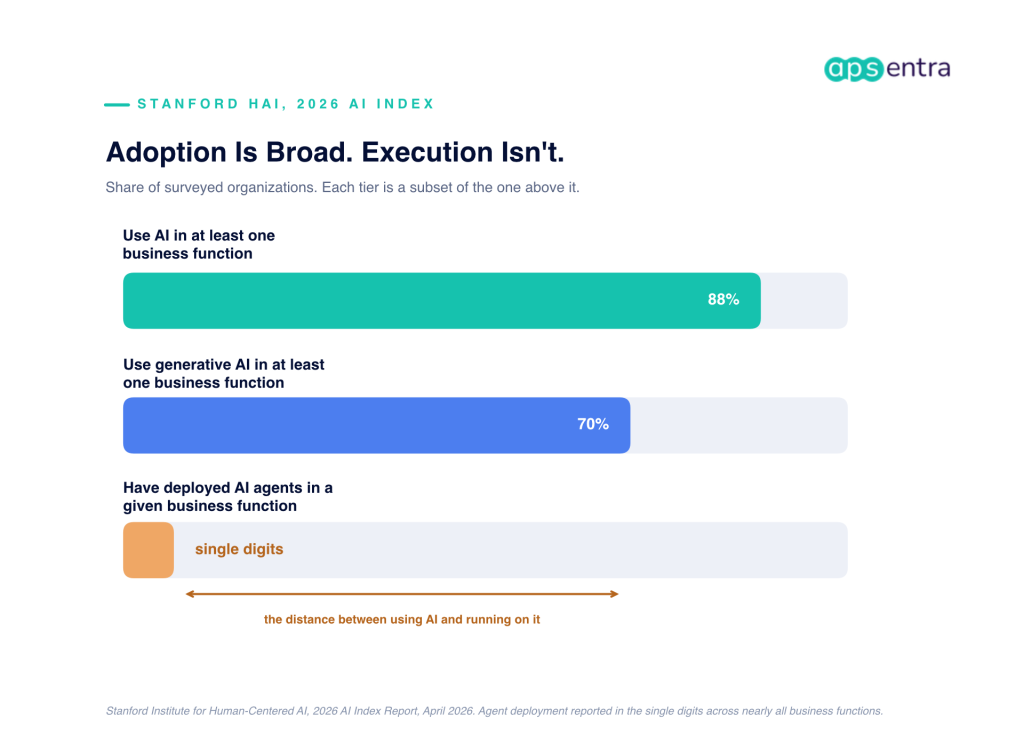
Stanford’s Institute for Human-Centered AI publishes the AI Index, the most comprehensive independent measurement of AI in the economy. Its 2026 edition found that 88 percent of surveyed organizations now use AI in at least one business function, and 70 percent use generative AI in at least one function. Both figures rose again in 2025.
The same report contains the number that matters more for procurement, and it gets far less attention: AI agent deployment was in the single digits across nearly all business functions. Adoption is close to universal. Autonomous execution is close to absent.
That gap is not a contradiction, and it is not a sign that the technology disappoints. It is a description of where enterprises actually are. Generative AI reached 53 percent population-level adoption within three years, faster than the personal computer or the internet, which means the tools arrived far ahead of the governance, data quality, and integration work required to let them act unsupervised.
The practical reading is that individual usage has raced ahead of organizational deployment. A category manager using a chatbot to draft an RFP section is real productivity and it is not a deployed capability. It is not governed, not repeatable, not auditable, and it disappears when that person changes jobs.
That distinction, between something a person does and something the organization does, is the same one that separates a documented procurement policy from an enforced one, covered in our guide to the procurement operating model.
Which Tasks Shift, and Which Do Not
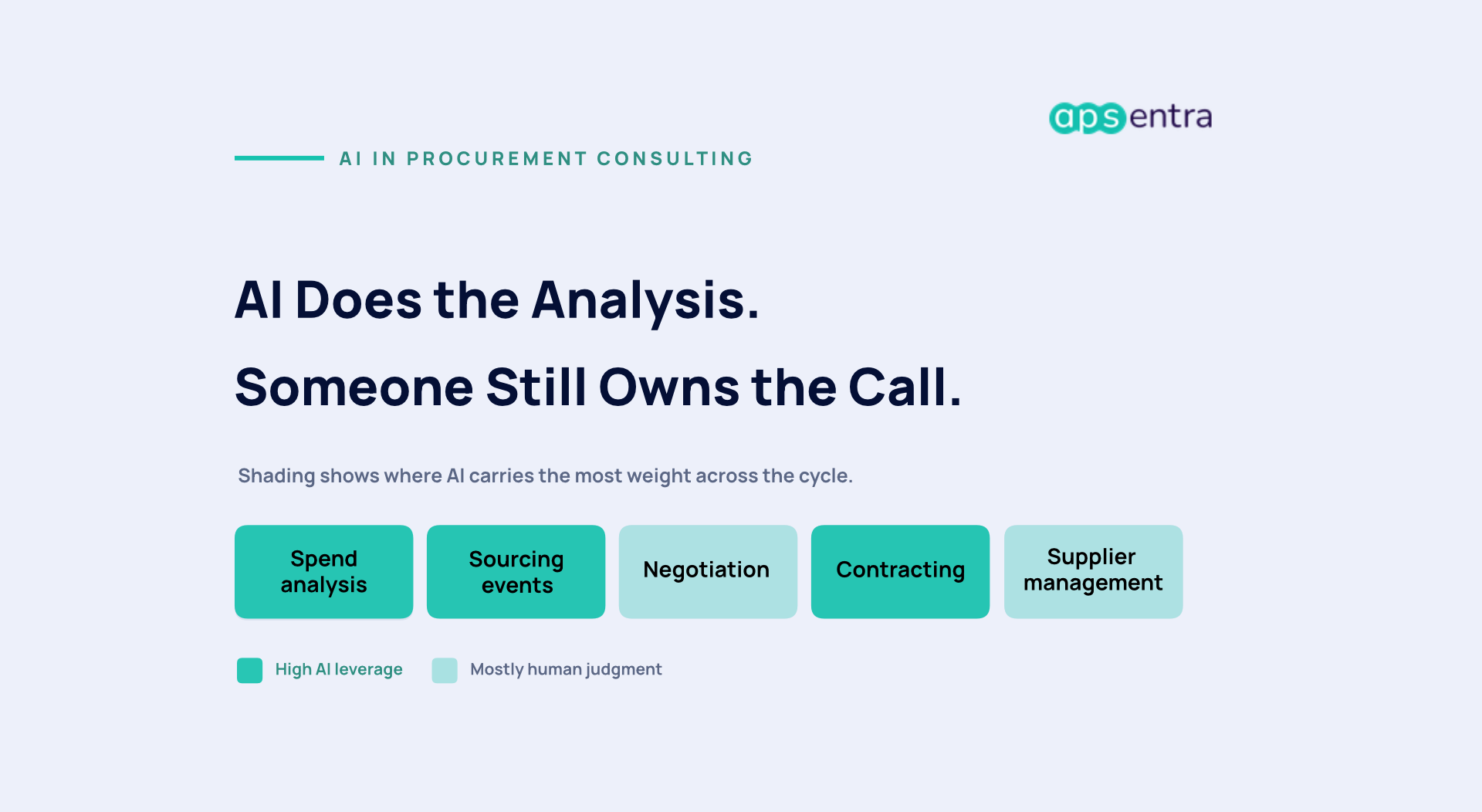
The useful way to think about AI in procurement is task by task, not function by function. Some work moves almost entirely. Some barely moves at all. Averaging them produces a number that describes nothing.
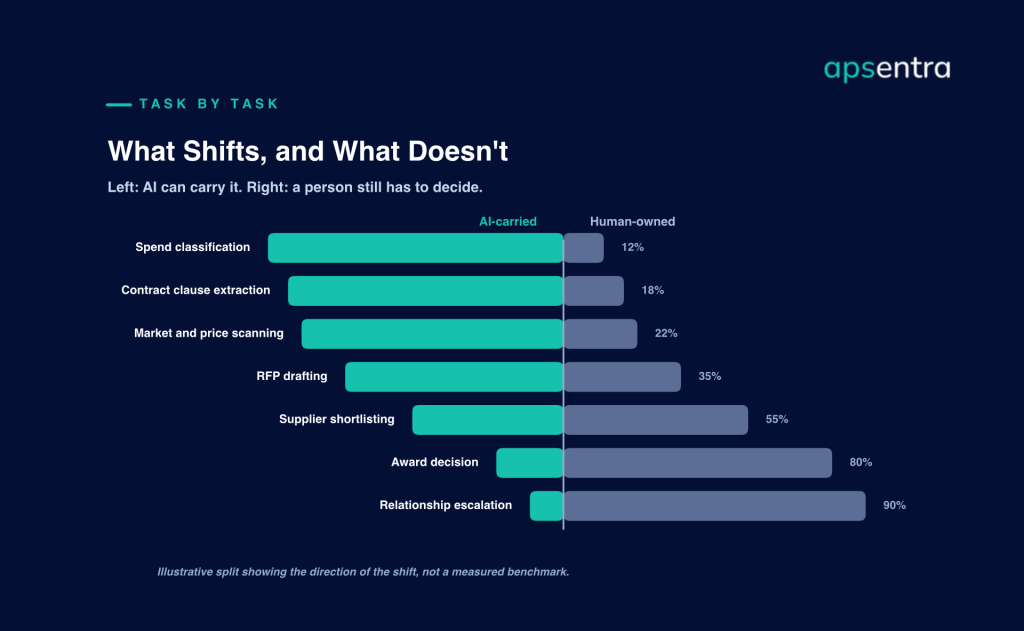
Three patterns explain the ordering above.

Structured, high-volume, verifiable work moves first
Drafting moves, but review does not

Anything with a relationship attached barely moves
There is a sharper version of this point for cost programs specifically. AI accelerates the identification of savings, which was never the bottleneck. The bottleneck is realization, and savings leak through maverick buying, contract noncompliance, and unmanaged price creep, none of which a better analysis fixes. That mechanism is set out in procurement cost reduction strategies. A faster identification engine pointed at an unenforced process produces a longer list of savings that still do not arrive.
Agentic AI: From Assistant to Operator
The meaningful change in 2026 is not better chatbots. It is software that acts without being asked.
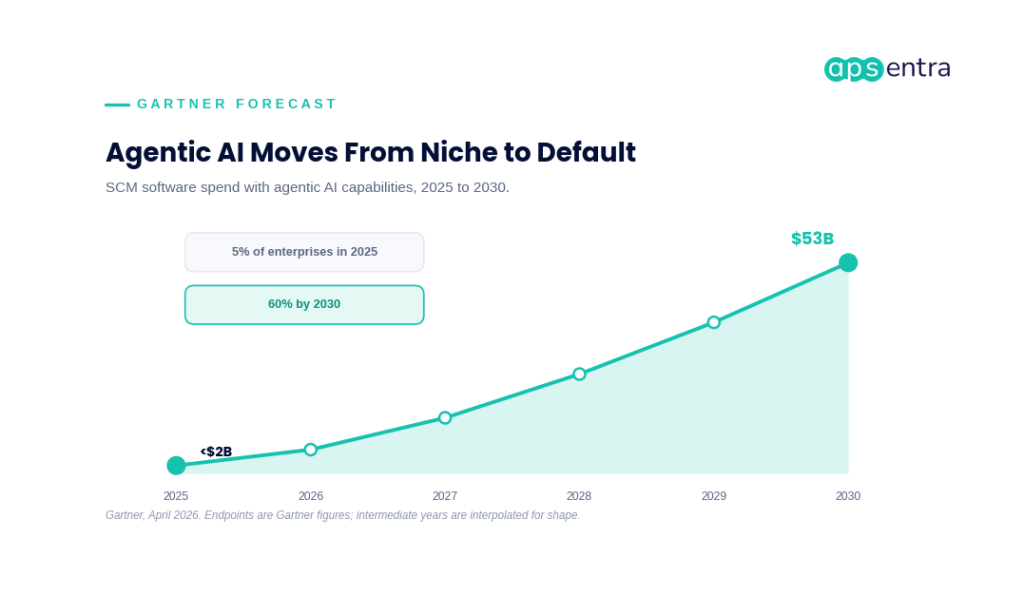
Gartner forecasts that supply chain management software with agentic AI capabilities will grow from less than $2 billion in 2025 to $53 billion in spend by 2030, with the share of enterprises using SCM software that have adopted agentic features rising from 5 percent in 2025 to 60 percent by 2030. Gartner also notes that AI assistant features are becoming a mandatory requirement in software selection, with AI agents a common one.
The distinction between an assistant and an agent is worth holding onto, because vendors blur it constantly. An assistant answers when asked. An agent monitors a condition and acts when the condition is met: flagging a price anomaly, triggering a reorder, opening a renewal negotiation ninety days out. The first is a productivity tool. The second is a participant in your process, and it needs the same governance any other participant would get.
Gartner’s own caution is the part worth quoting to an over-eager sponsor: enterprise deployment will lag the availability of these features, because data management, operations management, workforce readiness, and network design all have to evolve alongside. In other words, the constraint is not the model. It is everything the model touches, which is a procurement maturity problem wearing a technology costume.
What This Does to the Consulting Engagement
If analysis is cheap and judgment is not, the shape of a sensible engagement changes.
| Engagement component | Before AI | Now |
|---|---|---|
| Spend baseline and classification | Four to six weeks of analyst time, billed | Days, largely automated; pay for validation, not production |
| Market and price research | Billed research hours per category | Compressed; the differentiator is proprietary data the model cannot see |
| RFx drafting | Template plus customization, billed | Near-instant first draft; value moves to specification quality |
| Negotiation strategy | Senior time, billed | Largely unchanged; this is judgment and relationship work |
| Award recommendation | Senior time, billed | Unchanged; accountability cannot be delegated to a model |
| Capability transfer | Often skipped | The main thing worth paying for, and now the easiest to verify |
The practical negotiating consequence: if a proposal still prices the analysis phases as if they took the same effort they did three years ago, that is a legitimate question to raise. Not an accusation of bad faith, simply a pricing conversation that the market has not universally caught up to yet.
The flip side is equally true. A firm that has genuinely rebuilt its delivery around AI can do more in a shorter engagement, and paying for that competence is rational. What you should not pay for is the old effort model with an AI label attached. The broader question of when outside help is the right instrument at all is covered in when your team needs a consultant and when it needs a better system, and the category-level version in category management consulting.
The Governance Sequence Nobody Wants to Do First
Most failed AI programs in procurement did not fail because the model was bad. They failed because the organization automated on top of data and rules that were not ready to carry it.
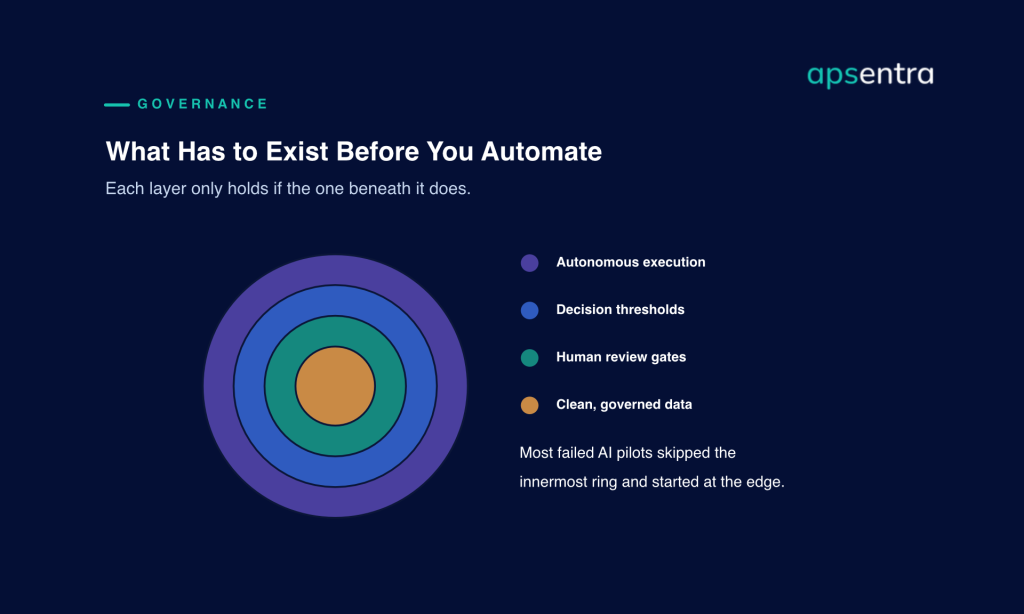
- Clean, governed data. Spend classified consistently, suppliers deduplicated, contracts machine-readable. Agents trained or operating on fragmented data will produce fluent, confident, wrong output faster than a human ever could.
- Human review gates. Explicit points where a person must confirm before the process continues. These should start wide and narrow only as accuracy is demonstrated, not the reverse.
- Decision thresholds. Written rules for what an agent may do unsupervised, by value, risk, and category. Undefined thresholds are the mechanism by which a pilot quietly becomes an unaudited production system.
- Autonomous execution. Only here, and only for the cases the three inner layers have already made safe. This is the last ring, not the first.
The uncomfortable part is that the innermost ring is the least exciting work in the entire program and the one most likely to get skipped in favor of a visible pilot. The controls that make it auditable afterward are the same ones set out in our procurement audit checklist, and the data groundwork underneath it is covered in spend analytics consulting.
How to Buy AI-Enabled Procurement Support
Four questions separate a serious AI capability from a repackaged one.
What does the model see, and what does it not?
What happens when it is wrong?
Who is accountable for the output?

What remains after the engagement ends?
That last question is the one with the longest tail. An AI-accelerated engagement that leaves nothing behind is a faster version of a problem this cluster has covered repeatedly, most directly in strategic sourcing consulting and procurement advisory services. Speed does not fix a transfer problem. It just gets you to the same place sooner.