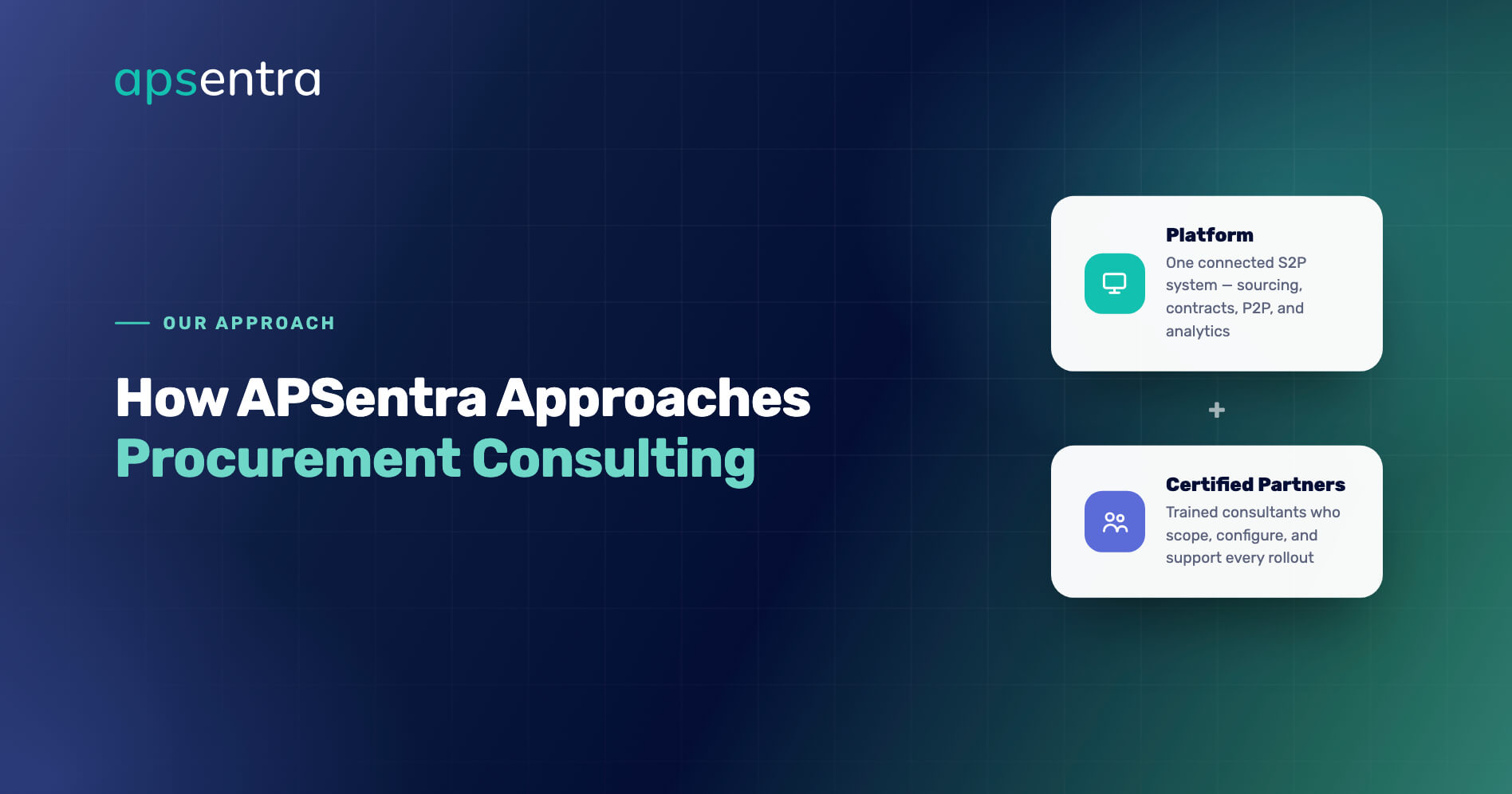
How APSentra Approaches Procurement Consulting: Platform + Certified Partners
This isn’t bad luck. It’s the default outcome. A widely cited figure — popularized by McKinsey’s research on why transformations fail, which puts the corporate transformation failure rate at roughly 70 percent — has held remarkably steady across industries and decades. Procurement transformations are not exempt. If anything, they’re more exposed, because they sit at the intersection of two things that are each hard on their own: complex, cross-functional process change, and equally complex enterprise technology.
At APSentra, we think the 70-percent failure rate isn’t really about bad software or bad consultants. It’s about a structural gap between the two.
Who Is This Best For?
This model is built for organizations that need both a working system and the expertise to make it stick. It’s a strong fit if:
- You’re a mid-to-large enterprise running procurement through a legacy ERP, spreadsheets, or several disconnected point tools.
- You operate across multiple entities, regions, or regulatory regimes and need policy logic that reflects real local nuance, not a generic template.
- You’ve tried a pure consulting engagement before and ended up with a strategy document that never fully got built.
- You’ve tried a software-only rollout before and ended up with licenses nobody adopted.
- You want implementation advice that isn’t quietly steering you toward more of the vendor’s own services.
It’s likely overkill if:
- You run a small, single-entity procurement function with simple, low-complexity buying processes.
- You need a narrow, one-time tooling fix rather than an operating-model change.
Problem 1 — Consulting without an execution engine
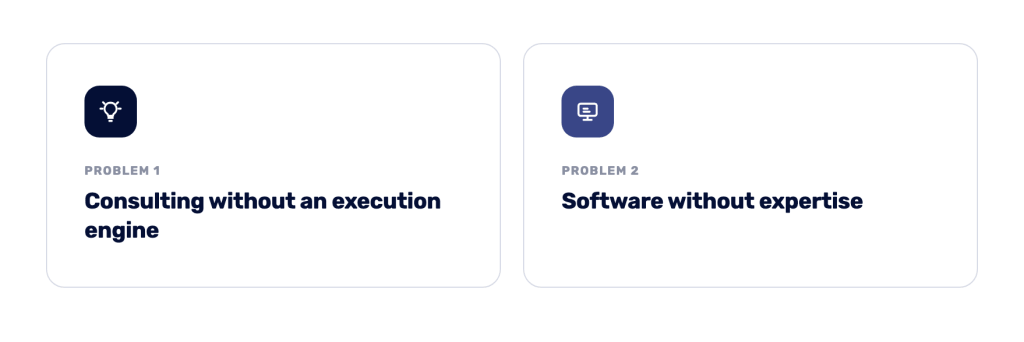
Bring in a pure consulting firm, and you’ll get a beautifully mapped “To-Be” process: clean workflows, clear governance, well-defined approval matrices. The problem shows up the moment someone tries to build that To-Be state inside a legacy ERP, a patchwork of spreadsheets, or three disconnected point tools. The strategy is sound. The execution takes years, if it ever finishes at all.
Problem 2 — Software without expertise
Buy a procurement platform instead, and you get the opposite failure mode. The vendor sells you licenses, runs a technical onboarding, and hands you the keys. What’s missing is everything that makes a system actually stick: an honest audit of how your organization really buys today, policies rewritten for your specific industry and regulatory environment, and a change management effort that gets skeptical stakeholders to actually use the new process instead of quietly working around it.
Both failure modes come from the same root cause: treating technology and expertise as substitutes for each other, when they’re actually complements.
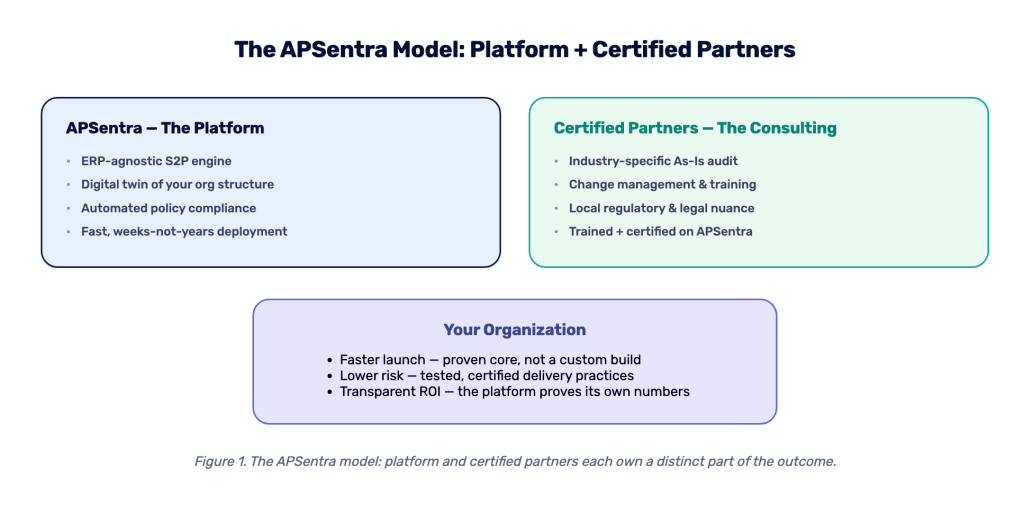
That’s the thinking behind how APSentra is built. We provide the technological core — a digital twin of your procurement processes, a full source-to-pay (S2P) engine, and automation that runs on top of it — and we work through a network of certified partners who bring deep industry expertise, regulatory adaptation, and change management on top of that core. Platform and partner are not competing for the same job. They’re doing two different jobs that both have to get done.
The Trade-Off Every Procurement Software Vendor Faces
Once you understand why transformations fail, a related question comes up naturally: why doesn’t the software vendor just do the consulting too, and save everyone the coordination overhead?
Some vendors do exactly that, bundling strategy, implementation, and managed services under one roof. It can work — but it introduces a trust problem that’s hard to engineer away. When the same organization sells you the software and advises you on how to use it, it’s reasonable to wonder whether the advice is actually independent, or whether it quietly points back toward more of the vendor’s own product and services. That’s not a knock on any specific company; it’s a structural tension that shows up whenever advice and product come from the same source.
APSentra’s answer is to keep those two roles separate on purpose. The platform team is accountable for the platform. The consulting is delivered by outside experts who have no incentive to inflate scope or steer you anywhere except toward what actually works for your business. You get vendor-grade product depth and consultant-grade independence, instead of a diluted version of both.
How the APSentra Model Compares
The market for procurement transformation help generally breaks into four approaches. Each optimizes for something different — here’s how they compare on the dimensions that tend to matter most.
| Traditional Software Vendor | Systems Integrator | Pure Consulting Firm | APSentra (Platform + Certified Partners) | |
|---|---|---|---|---|
| Primary focus | Selling and onboarding software | Custom-building your target process | Designing your target process | Working platform + expert delivery, together |
| Typical timeline | Fast to license, slow to real adoption | Long — often multi-year builds | Fast to a strategy doc, slow to execution | Weeks to a live, configured system |
| Independence of advice | Limited — advice tends to favor more product | Moderate — tied to the build they’re delivering | High, but no execution engine behind it | High — partners are independent of platform revenue |
| Ongoing accountability | Support tickets, not outcomes | Project-based, ends at go-live | Ends at the recommendation | Platform team owns the product; partner owns adoption |
| Best for | Teams that already have in-house expertise | Highly bespoke, one-off builds | Strategy-only engagements | Enterprises that need both a system and expert delivery |
The APSentra Model: Synergy of Technology and Expertise
Here’s how the roles actually split in practice.
What APSentra Provides — The Platform
A ready-made S2P core that's ERP-agnostic
A digital twin of your organizational structure
Automated policy compliance, spend analytics, and tender management
Fast deployment with a measurable time-to-value
What Certified Partners Provide — The Consulting
An honest As-Is audit and niche-specific policy customization

Team training and change management
Local compliance and legal nuance
Neither side is trying to do the other’s job. That’s precisely the point.
Why This Benefits Enterprise Buyers
This division of labor isn’t just a tidy org chart — it produces three concrete advantages for the organizations actually buying and deploying the platform.
| ⚡ Faster Launch You’re not building a system from scratch to match a consultant’s custom blueprint — deployment starts from a proven, working core. Partners configure and adapt; they don’t construct from zero. | ✓ Lower Risk Certified partners are trained and evaluated against APSentra’s own architecture and delivery methodology, so they implement tested best practices instead of experimenting on your organization’s dime. | 📈 Transparent ROI The platform generates precise, real-time savings and compliance metrics on its own. Consultants use that data to help you hit the numbers it’s already showing you, instead of constructing an ROI story after the fact. |
What “APSentra Certified Partner” Means
The word “certified” is doing real work in that phrase, and it’s worth being specific about what it requires.
- Deep knowledge of APSentra’s architecture. Partners go through formal training on the platform itself — its modules, its data model, its integration patterns — so they’re not learning on your deployment.
- A proven track record in procurement consulting. Certification isn’t handed out to any systems integrator that asks; it requires demonstrated experience actually running procurement transformations, not just general change-management credentials.
- Access to methodology and direct vendor support. Certified partners aren’t operating at arm’s length. They have a direct line to APSentra’s own technical teams and access to the delivery methodology the platform is built around, so there’s no gap between what the software can do and what the partner knows how to do with it.
How Certification Is Earned and Maintained
Certification is a standing requirement, not a one-time badge:

Application and vetting.
Formal training and assessment.

Supervised early engagements.
Periodic re-certification.
What This Means for Your Organization
Put simply: you get best-in-class procurement software and genuinely independent expert guidance, without paying a “vendor lock-in tax” on the advice you receive. You’re not choosing between a platform and a consultant. You’re getting both, built to work together rather than compete with each other — and each one accountable for the part of the job it’s actually best at.