MRO Procurement Consulting: What It Fixes, What It Costs, and When to Skip It
MRO spend is small per transaction and large in aggregate. A bearing costs forty dollars. The line it stops costs considerably more, and the storeroom holding nine similar bearings under four part numbers costs something every month in capital nobody counts.
That is the problem MRO procurement consulting exists to solve. This guide covers what an engagement actually includes, what it costs, and the cases where hiring a consultant is the wrong move.
What MRO Procurement Consulting Covers
MRO procurement consulting is advisory work focused on how a company buys maintenance, repair, and operations supplies: spare parts, consumables, tooling, safety equipment, and the services around them. It typically covers spend analysis, item master and taxonomy cleanup, supplier rationalization, storeroom and inventory policy, and the approval rules that govern day-to-day ordering.
What separates it from general indirect sourcing is transaction volume and urgency. A plant may place thousands of MRO orders a year, most of them small, many of them raised by maintenance staff under time pressure while a machine is down. Any solution that adds steps to that moment will be ignored.
So the work is rarely about negotiating harder. It is about making the compliant option the fastest one: a catalog that contains the part, a supplier agreement that covers it, and an approval rule that does not stop a forty-dollar order for three days.
The analytics side of this problem, including how to spot duplicate parts and consumption patterns at scale, is covered separately in AI in MRO procurement.
The Spare Parts Paradox
The clearest symptom of an unmanaged MRO function is a contradiction that shows up in almost every plant.
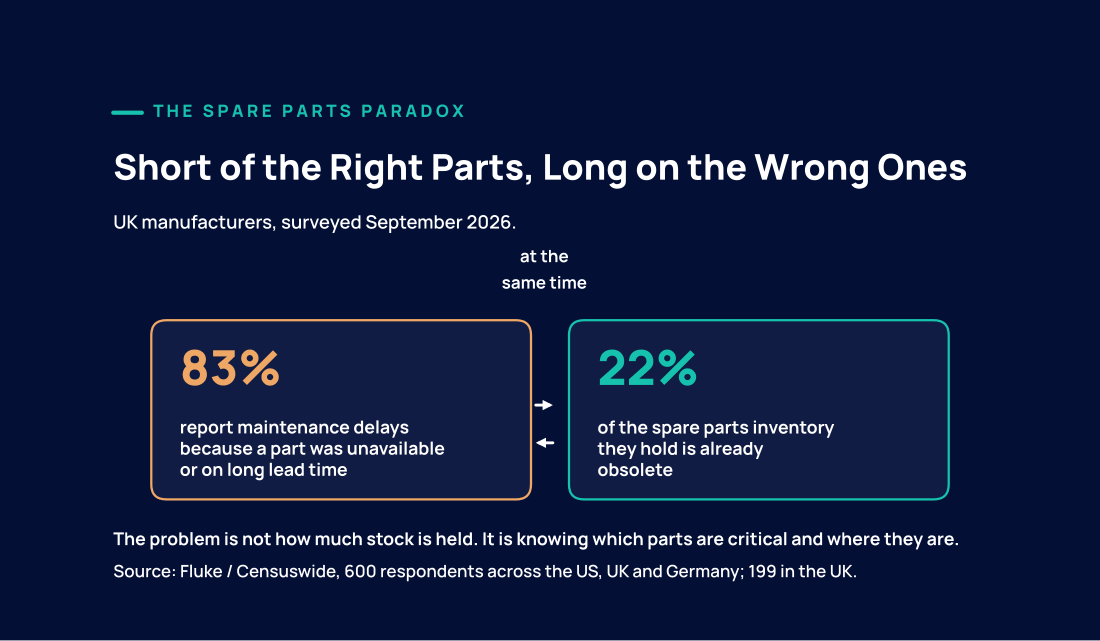
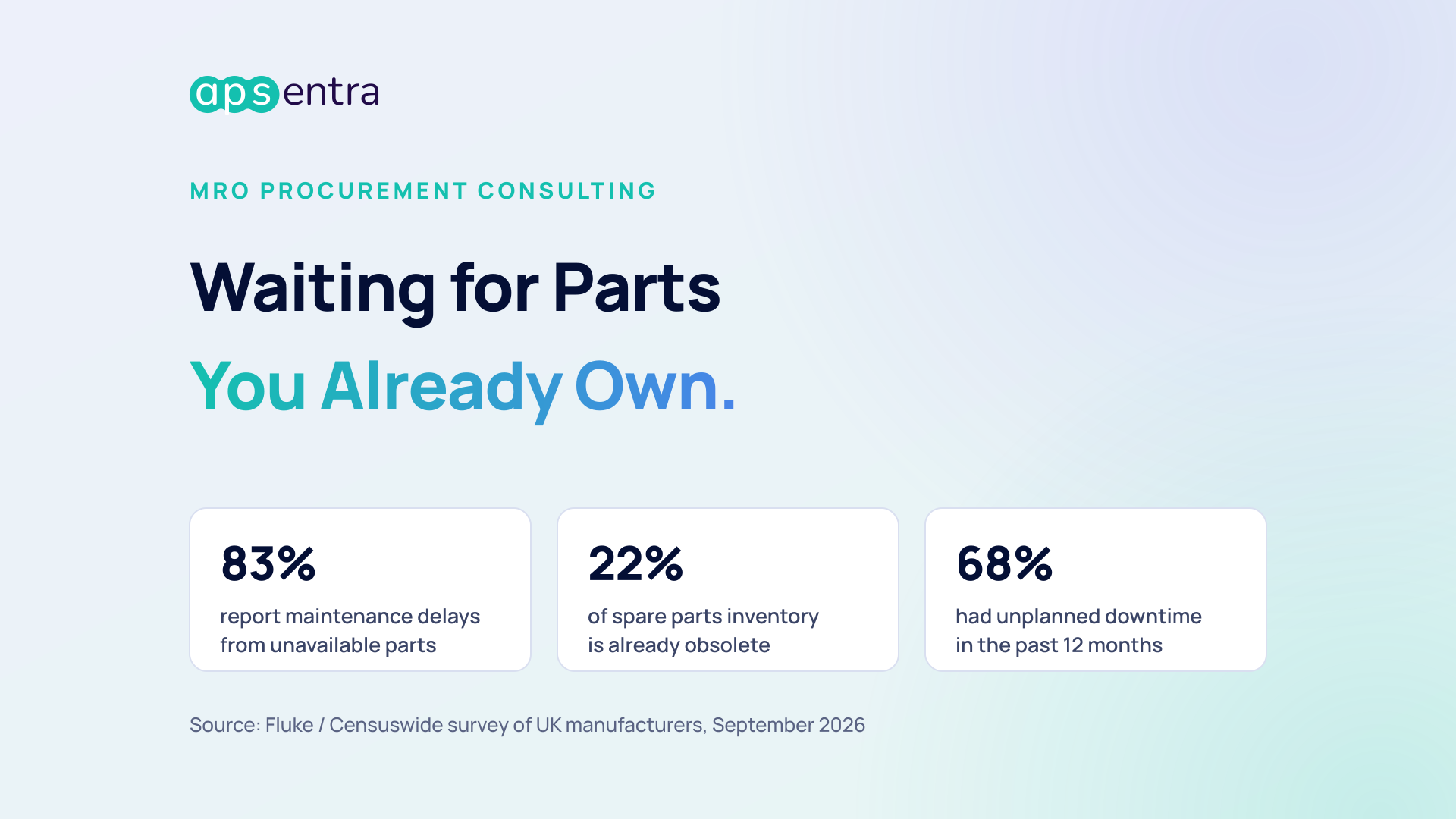
Research from Fluke, conducted by Censuswide and published on September 2, 2026, found that 83 percent of UK manufacturers reported maintenance delays caused by unavailable or long-lead-time parts, with one in five experiencing those delays regularly. The same respondents reported that, on average, 22 percent of the spare parts inventory they already hold is obsolete. Sixty-eight percent had experienced unplanned downtime in the previous twelve months. The survey covered 600 respondents across the US, UK and Germany, of whom 199 were in the UK.
Both halves of that are true at once, which is the point. These plants are not short of inventory. They are short of the right inventory, and they are paying to store the rest.
The cause is almost never a bad buying decision in isolation. It accumulates: a part is superseded but the old one stays on the shelf, a machine is retired and its spares are not, an engineer orders a variant under a new part number because the existing one was hard to find in the system. Every one of those is reasonable on the day. The result is a storeroom nobody fully trusts.
The survey also found supplier concentration adding to the exposure, with one in five UK manufacturers single-sourcing critical components per region. Notably, only 11 percent thought diversifying or reshoring suppliers would most improve their resilience, which matches the argument in our guide to multi-tier supply chain risk: adding suppliers without adding visibility adds complexity, not resilience.
Where MRO Spend Actually Leaks
A first assessment usually finds the same four leaks, in roughly the same order.
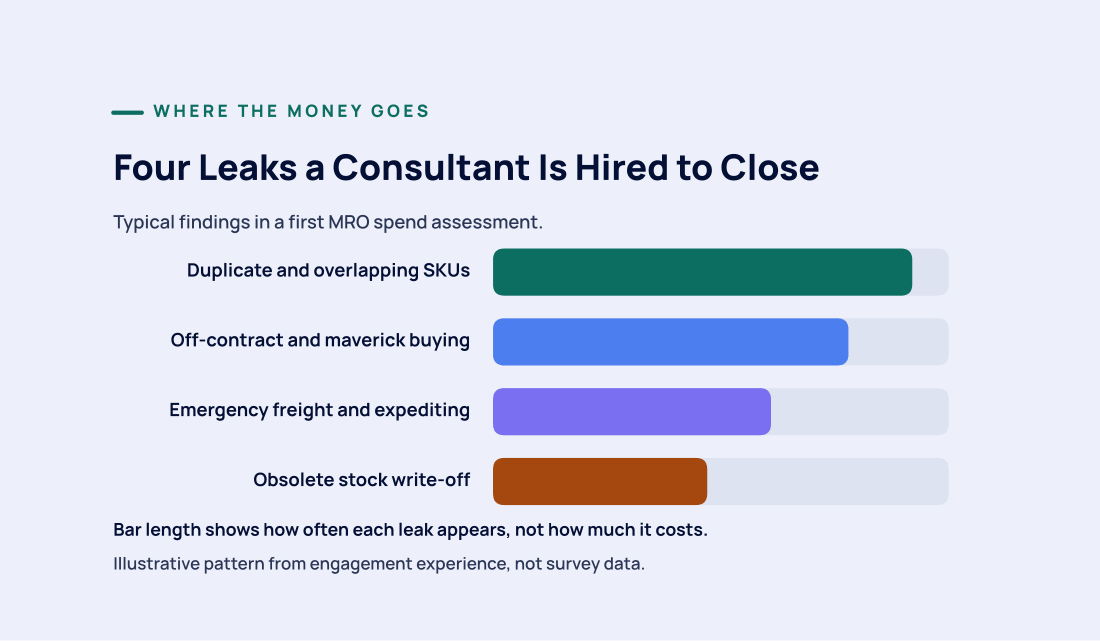
- Duplicate and overlapping SKUs. The same physical item carried under several part numbers, often with different descriptions, suppliers, and prices. It inflates inventory, hides real consumption, and makes every spend analysis wrong until it is fixed.
- Off-contract and maverick buying. An order placed outside the agreed supplier because the catalog did not have the part, or the buyer did not know the agreement existed, or the compliant route was slower than the breakdown allowed.
- Emergency freight and expediting. The cost of not having the part. Usually invisible because it is booked as freight rather than against the category that caused it.
- Obsolete stock write-off. The accumulated cost of the first three, eventually recognized.
The order matters for sequencing. Fixing maverick buying before the catalog is clean just redirects orders to a catalog that does not have what people need, which teaches them to bypass it again.
External cost pressure makes the freight leak worse than it used to be. In the NAM Q3 2026 Manufacturers’ Outlook Survey, published September 15, 77.3 percent of manufacturers cited freight rates as a challenge and 74.1 percent cited fuel costs, with 98.6 percent relying on trucks to move goods. Expedited shipping on a part that should have been in stock is a more expensive mistake in 2026 than it was two years ago.
What an Engagement Looks Like
A credible MRO engagement follows roughly the same shape regardless of who delivers it.
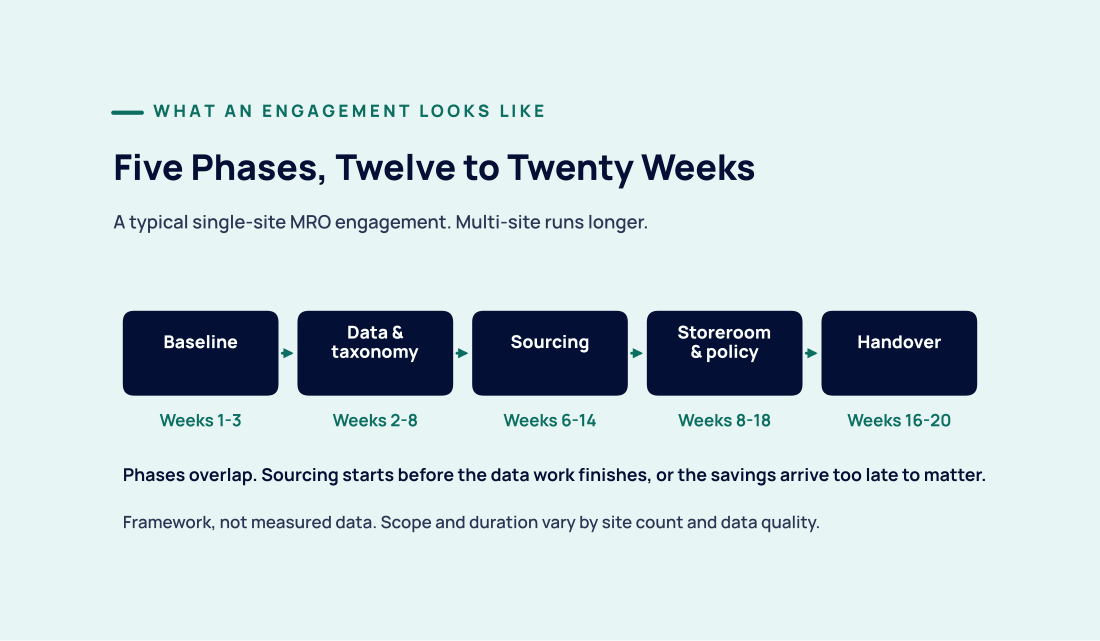
- Baseline. Pull two to three years of MRO transactions, suppliers, and inventory. The output is a number everyone agrees on, which is harder than it sounds and is the foundation for every savings claim later.
- Data and taxonomy. Normalize descriptions, identify duplicates, and classify spend to a consistent structure. The least glamorous phase and the one that determines whether anything else holds.
- Sourcing. Consolidate suppliers where it helps, renegotiate where volume justifies it, and build catalogs for repeat items.
- Storeroom and policy. Set criticality classifications, reorder points, and min and max levels, and write the approval rules that let routine orders flow.
- Handover. Move the rules into whatever system will enforce them after the team leaves. Skipping this is why the same engagement gets bought again in three years.
Phases should overlap. A firm that insists on finishing the data work before starting any sourcing will deliver savings after the budget year they were promised for.
What It Costs
MRO engagements price below strategic sourcing work of the same duration, because the categories are less technical and the savings are easier to attribute.
| Engagement type | Typical cost | Typical duration |
|---|---|---|
| MRO spend assessment and opportunity diagnostic | $35K–$90K | 3–6 weeks |
| Single-site MRO program | $80K–$220K | 12–20 weeks |
| Multi-site MRO program | $250K–$700K | 6–12 months |
| Storeroom and inventory optimization only | $60K–$150K | 8–14 weeks |
| Gain-share arrangement | 15–30% of validated savings | 12–24 months, typical |
Gain-share is common here and worth scrutinizing. MRO savings are easy to claim and hard to verify, because baselines move with production volume. A quiet quarter reduces MRO spend without anyone doing anything, and that reduction will appear in the savings number unless the baseline is normalized for activity.
Settle the definition of validated savings before the percentage: what baseline, adjusted for what volume, measured over what period, and who adjudicates a disagreement. The broader version of that problem is covered in procurement cost reduction strategies.
Consultant, Platform, or In-House
The honest answer is that most MRO programs need all three, and the common mistake is buying them in the wrong order.
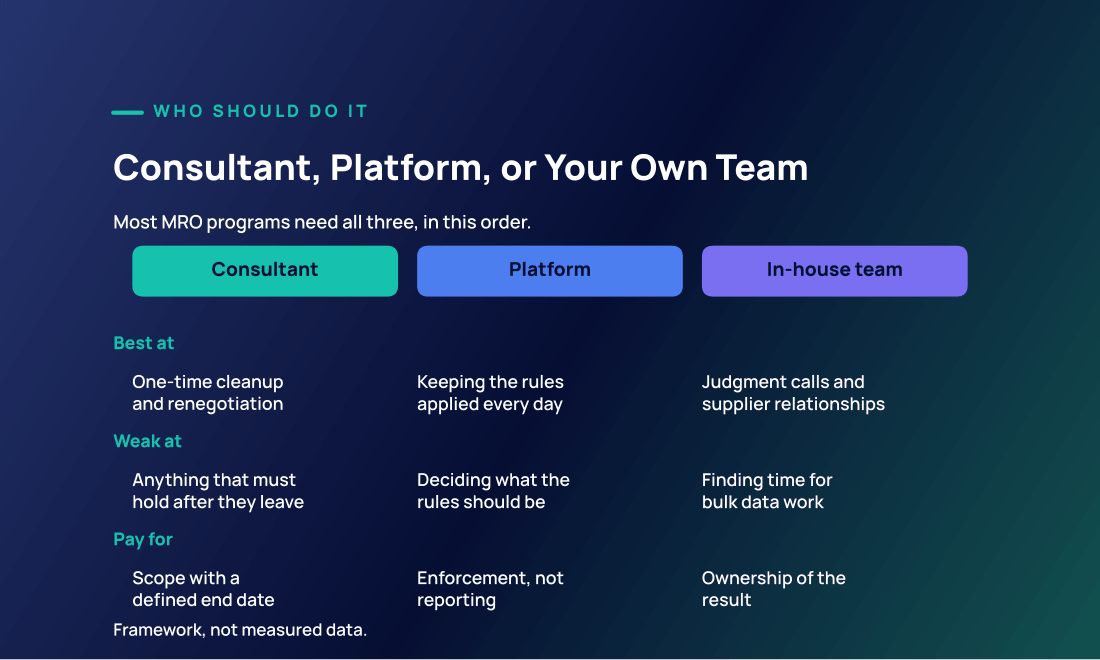
A consultant is the right instrument for a one-time cleanup: the duplicate SKU analysis, the first supplier consolidation, the initial criticality classification. This is bounded work with a defined end, and most internal teams cannot clear enough time to do it while also running the plant.
A platform is the right instrument for everything that has to happen every day afterward: catalog enforcement, approval routing, reorder points, and the spend visibility that shows when behavior drifts. No consultant can be present for the ten thousandth requisition.
An internal owner is what makes either worth buying. Someone has to decide what the rules should be, maintain supplier relationships, and notice when a rule no longer fits. That judgment does not outsource well.
There are cases where a consultant is the wrong first call. If the item master is reasonably clean and the real problem is that nobody enforces the catalog, the gap is enforcement, not analysis, and the general version of that question is set out in when your team needs a consultant and when it needs a better system. Platform options are compared in best procurement software platforms.
What Should Survive the Engagement
The test of an MRO engagement is not the savings number at the close. It is what is still true eighteen months later.
- A clean item master with an owner. Deduplicated, classified, and with a named person responsible for keeping it that way as new parts are added.
- Catalogs that actually contain what people need. Coverage matters more than price here. A catalog missing common items trains everyone to buy around it.
- Criticality classifications tied to stocking rules. A classification that does not change reorder points or approval thresholds is a spreadsheet, not a control.
- Approval rules proportionate to value. Routine consumables should move in minutes. Capital spares and single-source items should get real review.
All four depend on a clean, classified view of spend by category and supplier, which is covered in spend analytics consulting. For a regulated-industry version of the same problem, where critical spares carry qualification requirements as well, see OEM procurement consulting.