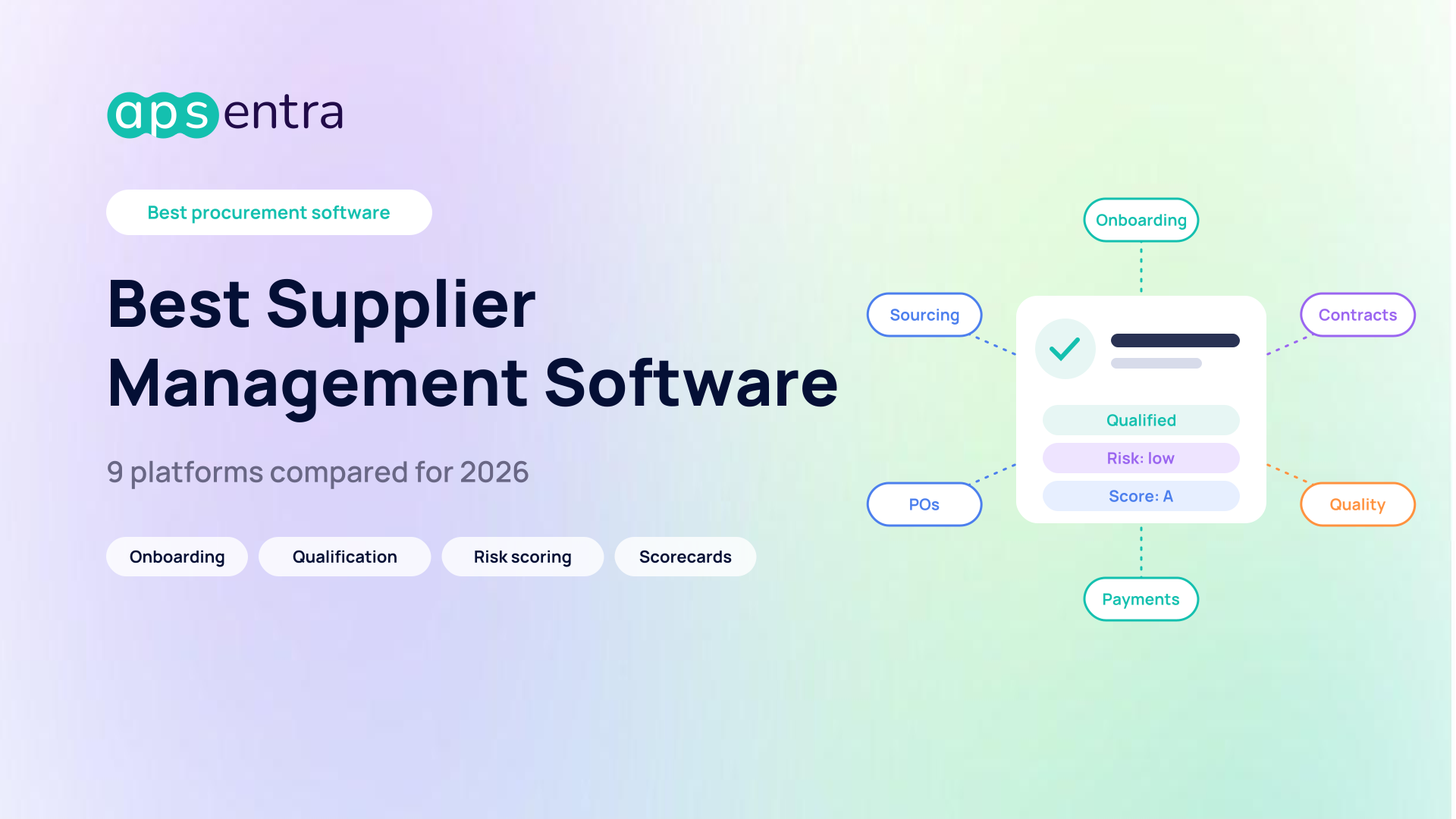
Best Supplier Management Software: 9 Platforms Compared
Quick answer:
The best supplier management software in 2026 keeps one trusted record per supplier and uses it at every decision point: who may be invited to a tender, who may receive a purchase order, and who gets paid. Most platforms can collect supplier data. Far fewer apply it automatically when money is about to be committed.
APSentra is our top pick for multi-entity organizations that want supplier qualification, performance, and risk tied directly to sourcing and purchasing in one source-to-pay system. SAP Ariba suits SAP-centric enterprises that rely on a large supplier network. Coupa and Ivalua fit buyers who want supplier management inside a broad suite. HICX is the specialist for supplier master data across many ERPs, Graphite Connect for fast, network-based onboarding, and Kodiak Hub for performance and sustainability programs.
What is supplier management software?
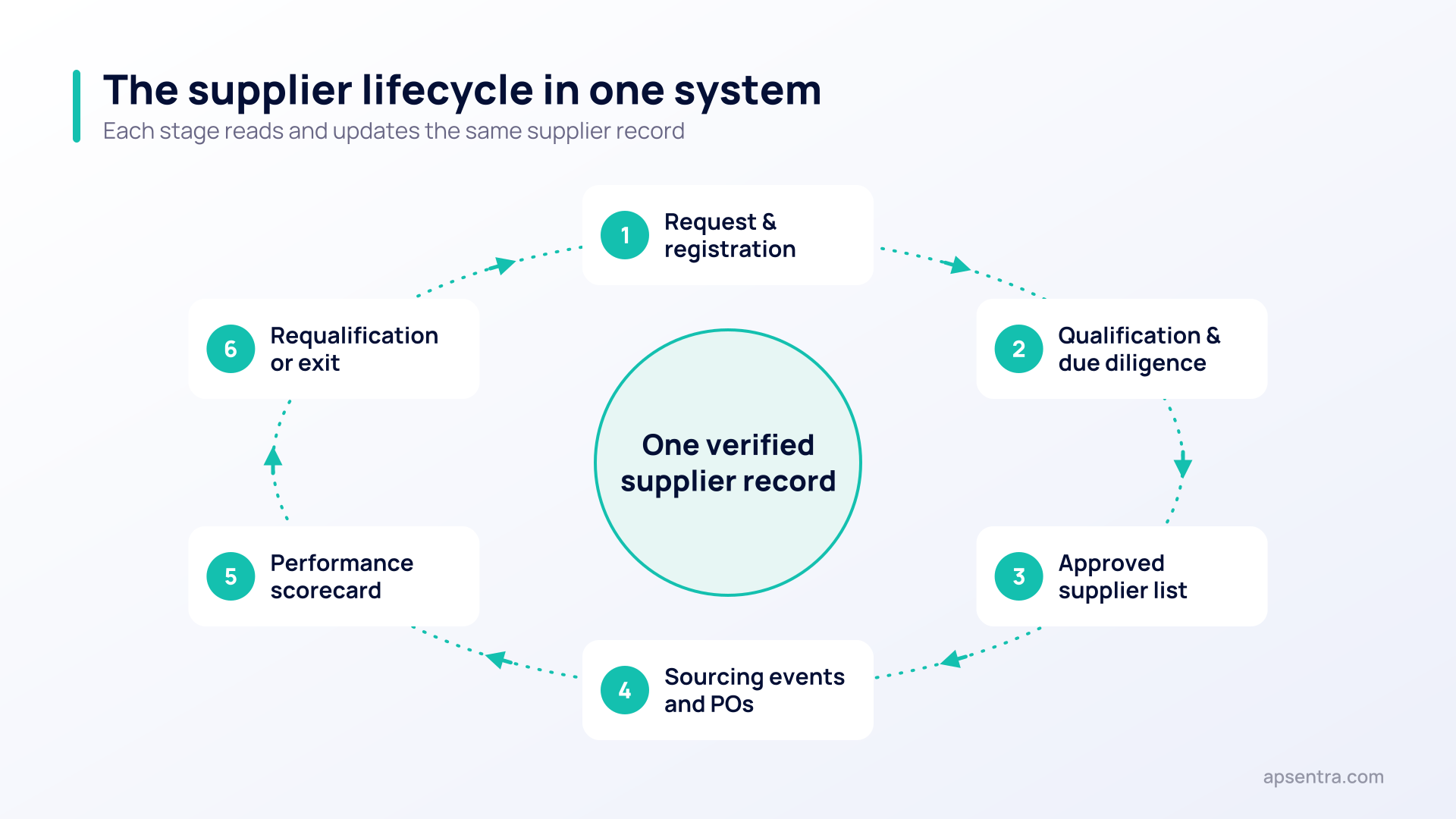
Supplier management software is a platform that governs the full supplier lifecycle in one system: registration, onboarding, qualification, performance scoring, risk monitoring, and offboarding. It maintains a single verified supplier record and feeds that record into sourcing, contracts, purchase orders, and payments, so only approved suppliers receive company spend.
Supplier management vs. vendor management vs. SRM
The labels overlap, and vendors use them loosely. The useful distinction is which part of the relationship the tool controls.
- Supplier information management (SIM) keeps supplier master data clean: legal entity, bank details, certificates, contacts, and ERP sync.
- Supplier lifecycle management (SLM) adds the workflow around that record: onboarding, qualification, renewal of documents, and offboarding.
- Supplier relationship management (SRM) covers the strategic layer: performance reviews, development plans, and joint improvement with key suppliers.
A complete supplier management platform covers all three and connects them to purchasing. For tools that focus on contracts and day-to-day vendor administration, see our guide to the best vendor management software.
Why supplier management moved up the agenda in 2026
Supplier decisions now carry finance and continuity risk, not only purchasing risk. In Deloitte’s 2025 Global Chief Procurement Officer Survey of more than 250 CPOs across 40 countries, 74% named securing alternative suppliers as a risk mitigation strategy and 64% said they were investing in supply chain visibility.
Both goals fail without reliable supplier data. An alternative supplier only helps if it is already qualified, onboarded, and visible to every entity that might need it. Visibility only helps if the supplier record behind each purchase is current.
Signs your supplier management has outgrown spreadsheets
- The same supplier exists three times in the ERP under slightly different names, so spend and performance never add up.
- Certificates expire unnoticed until an auditor or a customer asks for them.
- New suppliers get a purchase order before they are qualified, because onboarding takes weeks and the business cannot wait.
- Performance reviews happen once a year, from memory, rather than from delivery and quality data.
- Bank detail changes arrive by email, and nobody can show who verified them.
- Each entity keeps its own approved list, so a supplier rejected in one country gets an order in another.
How we evaluated supplier management software
| Criterion | What we checked | Why it matters |
|---|---|---|
| Lifecycle coverage | Registration, onboarding, qualification, performance, risk, and offboarding in one workflow | Gaps between steps are where unqualified suppliers slip through |
| Link to spend | Whether supplier status controls who can be invited to sourcing events and receive POs | A record that does not gate spend is only a directory |
| Supplier master data | Duplicate detection, bank detail validation, and sync with one or several ERPs | Finance trusts the platform only if the master data is clean |
| Performance management | Scorecards built from deliveries, quality, and invoices, not surveys alone | Scores based on transactions are harder to dispute |
| Risk signals | Financial, compliance, and delivery risk on the supplier record | Risk data in a separate tool rarely reaches the buyer in time |
| Multi-entity structure | Approved lists and qualification rules per entity, country, and category | Groups need shared suppliers with local rules |
| Supplier experience | Self-service portal, document upload, and onboarding effort | Suppliers who find onboarding slow quote less often |
| Time to value | Typical go-live and who configures changes afterward | Supplier rules change faster than integrator cycles |
Sources include vendor documentation, analyst and industry coverage from 2025 and 2026, and practitioner discussions. Product details were checked in November 2026. APSentra figures are vendor-reported.
The 9 best supplier management software platforms in 2026
1. APSentra: best for tying supplier status to sourcing and spend across entities
Best for: multi-entity groups and enterprises that want one supplier record governing tenders, purchase orders, and payments in every entity.
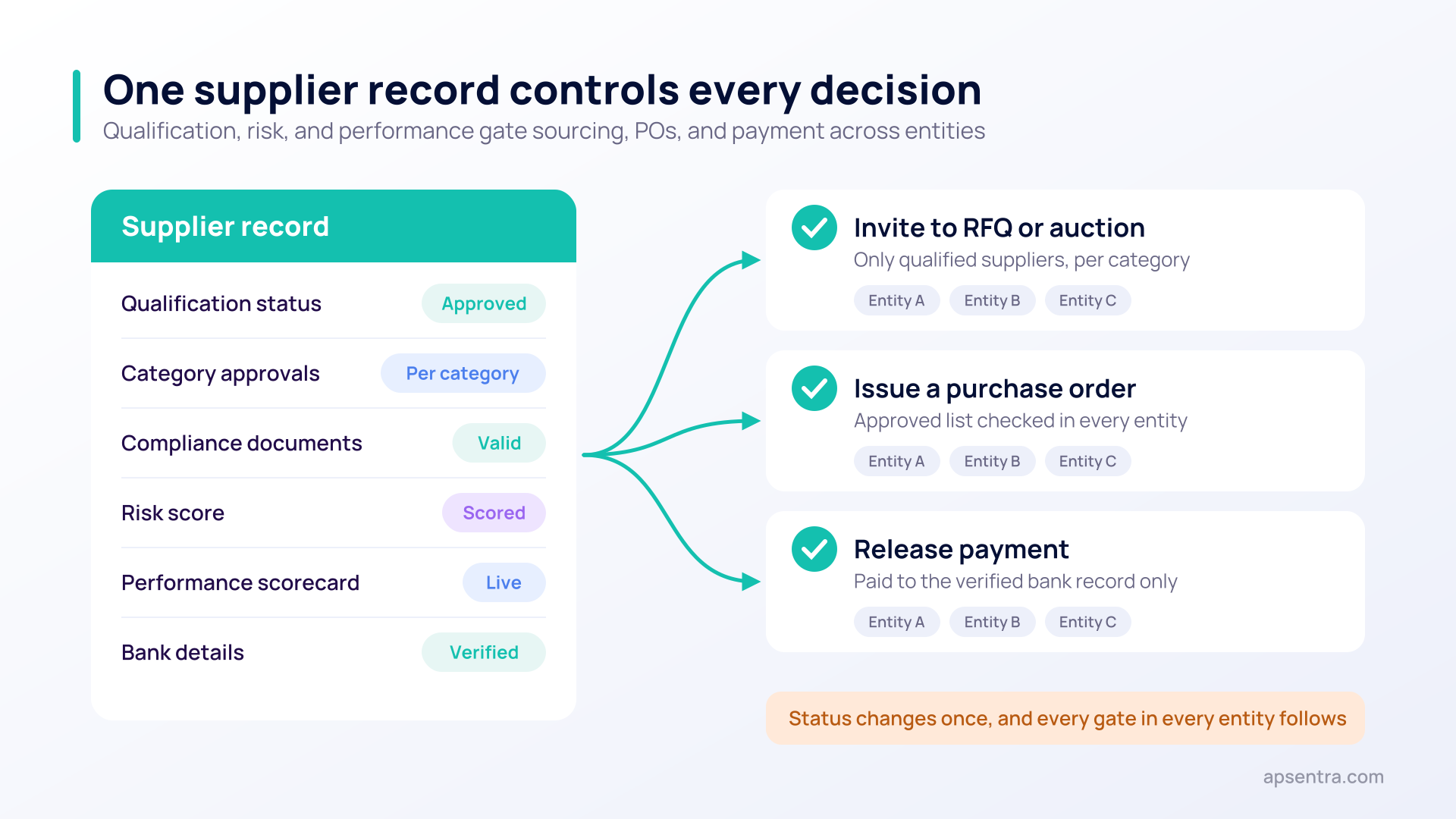
APSentra is a source-to-pay platform built on a digital twin of the organization: its entities, approval hierarchies, budgets, and roles. Supplier management sits inside that model rather than beside it, so a supplier’s qualification status, category approvals, and risk score decide who can be invited to an RFQ or auction and who can receive a purchase order in each entity.
Key capabilities:
- Structured supplier qualification: onboarding workflows, document collection, and approval routes configured per entity, country, and category.
- Pre-award compliance gating: suppliers that fail qualification or compliance checks cannot be awarded or receive POs.
- Supplier risk scoring: scores based on delivery, quality, and financial signals, visible to buyers at the moment of decision.
- Performance scorecards: updated from transactions, so reviews rest on delivery and quality data rather than recollection.
- Automated vendor risk questionnaires: due diligence collected and stored on the supplier record with a full audit trail.
- One supplier base for the group: shared suppliers with local qualification rules, synced to SAP, NetSuite, Dynamics 365, Odoo, and other ERPs, plus an open API.
Proof point (vendor-reported): APSentra reports more than 120,000 suppliers and counterparties connected, 386,000+ tenders, and 265,000+ auctions run on the platform across 130+ enterprise clients. Implementation takes up to eight weeks, and business admins change workflows after go-live without an integrator.
Limitations:
- Supplier management is part of the source-to-pay platform, not sold as a standalone supplier data tool.
- A smaller supplier network than SAP Ariba.
- Pricing is by custom quote.
Named leadership:
- Eugene Ponomarov, Co-Founder, Procurement Strategy & Enterprise Transformation: 15+ years and 100+ transformation initiatives redesigning procurement operating models, financial governance, and spend control.
- Natalie Eksi, CEO, Business Transformation & Executive Advisory: advises executive teams on turning procurement into a strategic function that connects finance, procurement, and operations.
- Mauricio Dezen, VP Professional Services & Customer Success: leads implementation, process optimization, change management, and adoption.
2. SAP Ariba Supplier Lifecycle and Performance: best for SAP-centric enterprises
Best for: companies running SAP S/4HANA that want supplier management inside the SAP procurement suite and its business network.
SAP’s supplier module covers registration, qualification, segmentation, and performance management, and connects to the SAP Business Network, where many large suppliers already hold profiles. SAP made next-generation Ariba generally available in March 2026 with Joule agents (ERP Today).
Limitations: implementations are heavy, practitioners rate the user experience poorly, and suppliers above network thresholds pay transaction fees.
3. Coupa Supplier Management: best inside a total spend management suite
Best for: enterprises already running Coupa for procurement and invoicing.
Coupa manages supplier onboarding, information, and risk within its spend management suite and draws on community data from more than $8 trillion of anonymized spend. It was named a Leader in the 2026 Gartner Magic Quadrant for Source-to-Pay Suites, according to Coupa’s announcement.
Limitations: value depends on running the wider suite, and pricing is not published.
4. Ivalua: best for complex qualification rules on one data model
Best for: enterprises with detailed, regulated qualification processes and strong internal IT.
Ivalua runs on a single codebase and one data model, so supplier records stay consistent as they move into contracts and performance scoring (Procurement Magazine).
Limitations: configuration depth depends on skilled administrators, and timelines grow with scope.
5. GEP SMART: best for supplier management alongside managed services
Best for: enterprises that want supplier management with sourcing depth and the option of outsourced procurement services.
GEP was among the vendors assessed in Ardent Partners’ 2025 Supplier Management Technology Advisor and is a Leader in the 2026 Gartner Magic Quadrant for Source-to-Pay Suites.
Limitations: review analyses rate ease of use below the market average, and pricing is not published.
6. Jaggaer: best for direct materials and supplier quality
Best for: manufacturers, higher education, and public-sector buyers.
Jaggaer is strong in sourcing, supplier risk, and audit trail, and was named a Leader in the IDC MarketScape for AI-enabled direct spend in 2026.
Limitations: buyers with mostly indirect spend tend to find it heavy.
7. HICX: best for supplier master data across many ERPs
Best for: large enterprises with tens of thousands of suppliers spread across several ERPs.
HICX is a pure-play platform built around supplier master data rather than retrofitted from a source-to-pay suite (Procurement Magazine). It typically sits alongside an existing procurement suite.
Limitations: it does not run sourcing or purchasing, so you budget for a second system.
8. Graphite Connect: best for fast, network-based onboarding
Best for: teams whose main pain is slow supplier registration and banking validation.
Graphite Connect lets suppliers keep one profile they share with multiple customers, which reduces duplicate data entry, according to the vendor.
Limitations: it focuses on onboarding and supplier data, so performance, sourcing, and purchasing run elsewhere.
9. Kodiak Hub: best for performance and sustainability programs
Best for: procurement teams that run structured supplier performance, quality, and sustainability reviews.
Kodiak Hub concentrates on supplier performance management, quality, and sustainability, and was assessed in Ardent Partners’ 2025 Supplier Management Technology Advisor.
Limitations: it is not a full procurement platform, so supplier status does not gate purchasing by itself.
Supplier management software comparison table
| Platform | Category | Supplier status gates POs and awards | Performance scorecards | Risk signals | Multi-ERP master data | Main concern |
|---|---|---|---|---|---|---|
| APSentra | Source-to-pay with built-in supplier management | Yes, per entity and category | From transactions | Delivery, quality, financial | Yes, any ERP plus open API | Smaller supplier network |
| SAP Ariba SLP | Source-to-pay suite module | Yes, within Ariba | Yes | Yes, plus partners | Strongest on SAP | User experience; supplier fees |
| Coupa | Spend management suite module | Yes, within Coupa | Yes | Yes | Yes | Value tied to the full suite |
| Ivalua | Source-to-pay suite | Yes | Yes | Yes | Yes | Configuration effort |
| GEP SMART | Source-to-pay suite | Yes | Yes | Yes | Yes | Ease of use |
| Jaggaer | Source-to-pay suite | Yes | Yes, quality focus | Yes | Yes | Heavy for indirect spend |
| HICX | Supplier data specialist | Through the connected suite | Yes | Yes | Core strength | A second system to run |
| Graphite Connect | Onboarding specialist | Through ERP or suite | Limited | Onboarding checks | Yes | Narrow scope |
| Kodiak Hub | Performance specialist | No | Core strength | Sustainability and quality | Partial | Not a procurement platform |
Capabilities reflect vendor documentation and public materials as of November 2026. Confirm specifics in a demo.
Supplier performance management: what good looks like
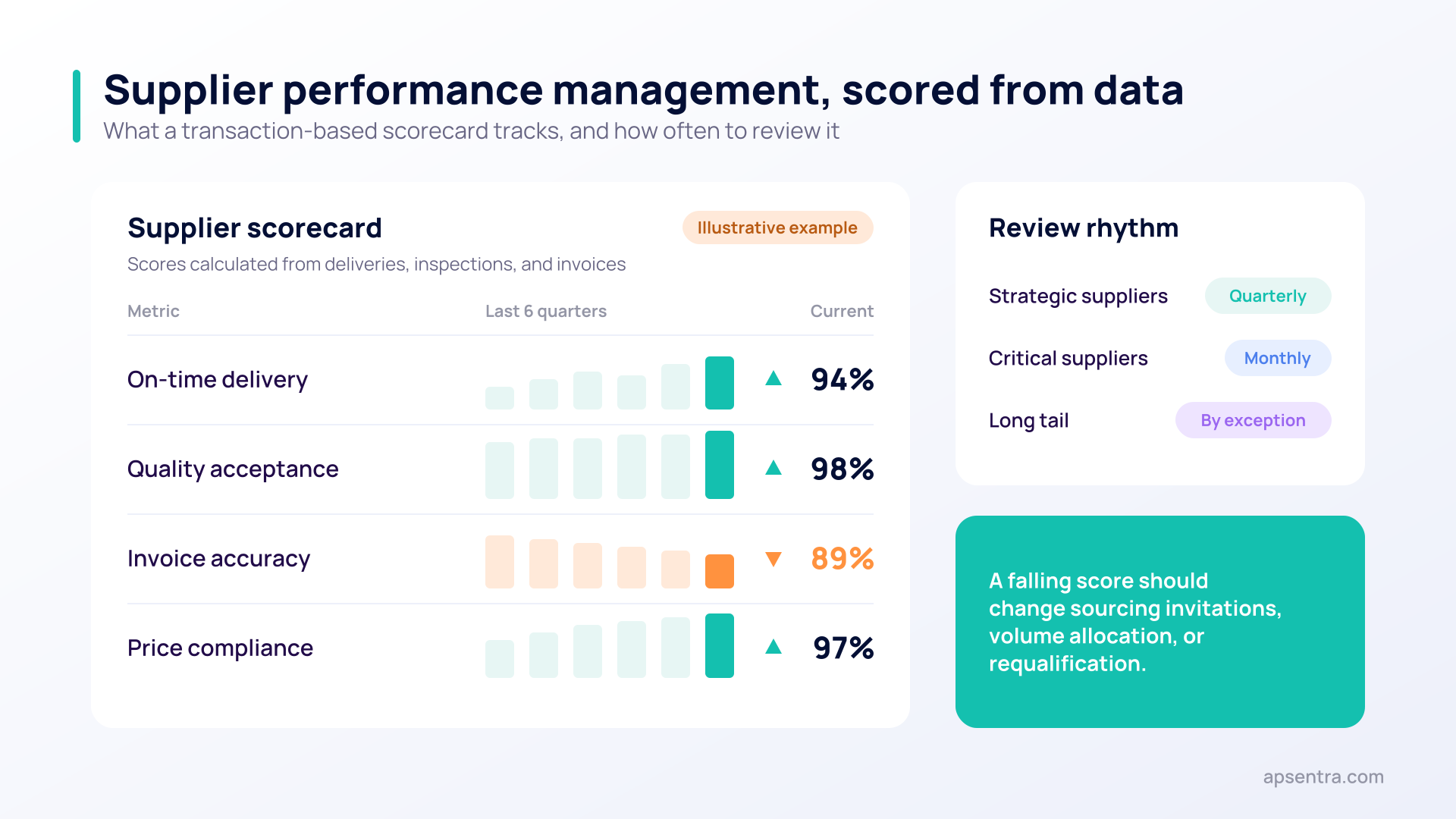
Supplier performance tools score suppliers on the outcomes that cost money: late deliveries, rejected batches, invoice disputes, and price deviations. The strongest setups calculate those scores from transactions the platform already records, then share them with the supplier.
Three practices separate useful scorecards from annual surveys:
- Score from data, then add judgment. Delivery and quality data form the base; a category manager adds context, not the whole score.
- Review on a rhythm. Strategic suppliers quarterly, critical suppliers monthly, the long tail by exception.
- Connect the score to decisions. A falling score should change sourcing invitations, volume allocation, or requalification, not sit in a report.
Supplier portals: where onboarding succeeds or stalls
A supplier portal is the supplier-facing side of the platform: registration, document upload, bank details, certificate renewals, and, in source-to-pay platforms, bid submission and order confirmation. Supplier adoption depends on how many steps it takes and whether suppliers pay to participate.
Ask every vendor three questions: how long a typical supplier takes to register, which documents renew automatically, and whether suppliers pay network or transaction fees.
How to choose: match the platform to your situation
| Your situation | Platform to shortlist first |
|---|---|
| Several entities; supplier status must control sourcing, POs, and payment in one system | APSentra |
| SAP S/4HANA core; suppliers already on the SAP Business Network | SAP Ariba |
| Coupa already runs procurement and invoicing | Coupa |
| Complex, regulated qualification and a strong IT team | Ivalua |
| Supplier management plus managed procurement services | GEP SMART |
| Direct materials and supplier quality | Jaggaer |
| Tens of thousands of suppliers across several ERPs; suite stays in place | HICX |
| Onboarding speed and bank detail validation are the main pain | Graphite Connect |
| Structured performance and sustainability reviews | Kodiak Hub |
For supplier selection and tendering, see our comparison of the best strategic sourcing software. For full-cycle platforms, see the best enterprise procurement software.
10 questions to ask in every supplier management demo
- Show a supplier that failed qualification. Can a buyer still send it an RFQ or a PO?
- How are duplicate suppliers detected across our ERPs, and who merges them?
- Who verifies a bank detail change, and where is that recorded?
- Can each entity keep its own approved list while sharing one supplier record?
- Which performance metrics come from transactions, and which from surveys?
- How do expiring certificates trigger action, and for whom?
- Where does a buyer see the supplier risk score when choosing a supplier?
- What does onboarding cost the supplier in time and fees?
- Can our admin change a qualification workflow without a change request?
- How long from contract to the first live entity?
Questions 1, 4, and 7 show whether supplier data controls spend or only describes it. Not sure where your team stands? The Procurement Maturity Assessment gives a scored read in five minutes.
Sources and methodology
Survey data comes from Deloitte’s 2025 Global Chief Procurement Officer Survey. Vendor coverage draws on Procurement Magazine, Ardent Partners’ 2025 Supplier Management Technology Advisor, ERP Today, and vendor announcements. APSentra figures are vendor-reported.
Editorial policy: vendors can’t pay for inclusion or ranking in this article.