Just-in-Time Procurement: How to Run Lean Without Running Blind
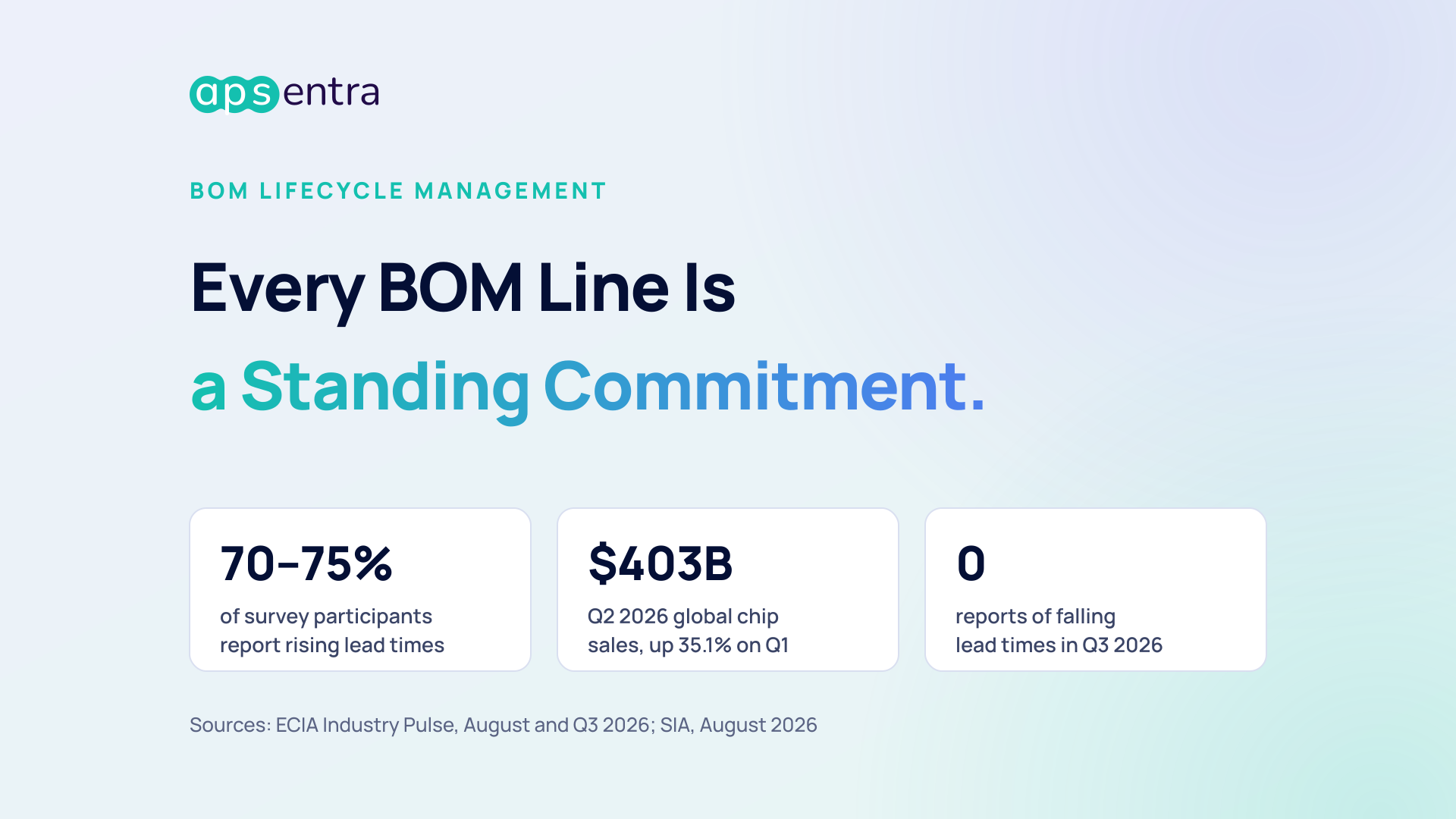
Just-in-time procurement has spent the last few years being argued about as a philosophy. Either you believe in lean and you carry almost nothing, or you have been burned and you carry everything. The data from 2026 says the argument was never the right one. Buyers are holding less inventory relative to sales than they did a year ago, and they are doing it while supply-chain pressure sits well above its long-run average. That is not a strategy. That is a squeeze.
This guide covers what just-in-time procurement actually asks of a buying organization, which parts belong on a pull signal and which do not, where the replenishment loop loses time before anyone notices, and how to size cover from your own lead-time history instead of a round number someone picked in a planning meeting.
What just-in-time procurement actually means
Just-in-time procurement is the practice of timing inbound supply to consumption rather than to a calendar or a batch size. Material arrives close to the moment it is used, replenishment is triggered by actual draw rather than by a forecast cycle, and the cost of holding stock is traded against the cost and probability of not having it.
It is worth separating this from just-in-time manufacturing. The manufacturing version is about flow inside the plant: small lots, short changeovers, no work-in-process piling up between stations. The procurement version is about the inbound edge of that system, and it is harder, because the variable that matters most sits outside the company. You control your order date. Your supplier controls the delivery date.
Three things just-in-time procurement is not:
- It is not zero inventory. It is the smallest buffer that still protects the line, calculated rather than assumed. Carrying nothing is not lean, it is unhedged.
- It is not fewer suppliers. Tight timing raises the cost of a single point of failure. Sole-sourcing a just-in-time part is the combination that fails worst.
- It is not lighter contracts. Running lean requires more contractual commitment from suppliers, not less: capacity reservations, lead-time guarantees, forecast obligations, and notice periods.
The 2026 picture: thinner buffers, higher pressure
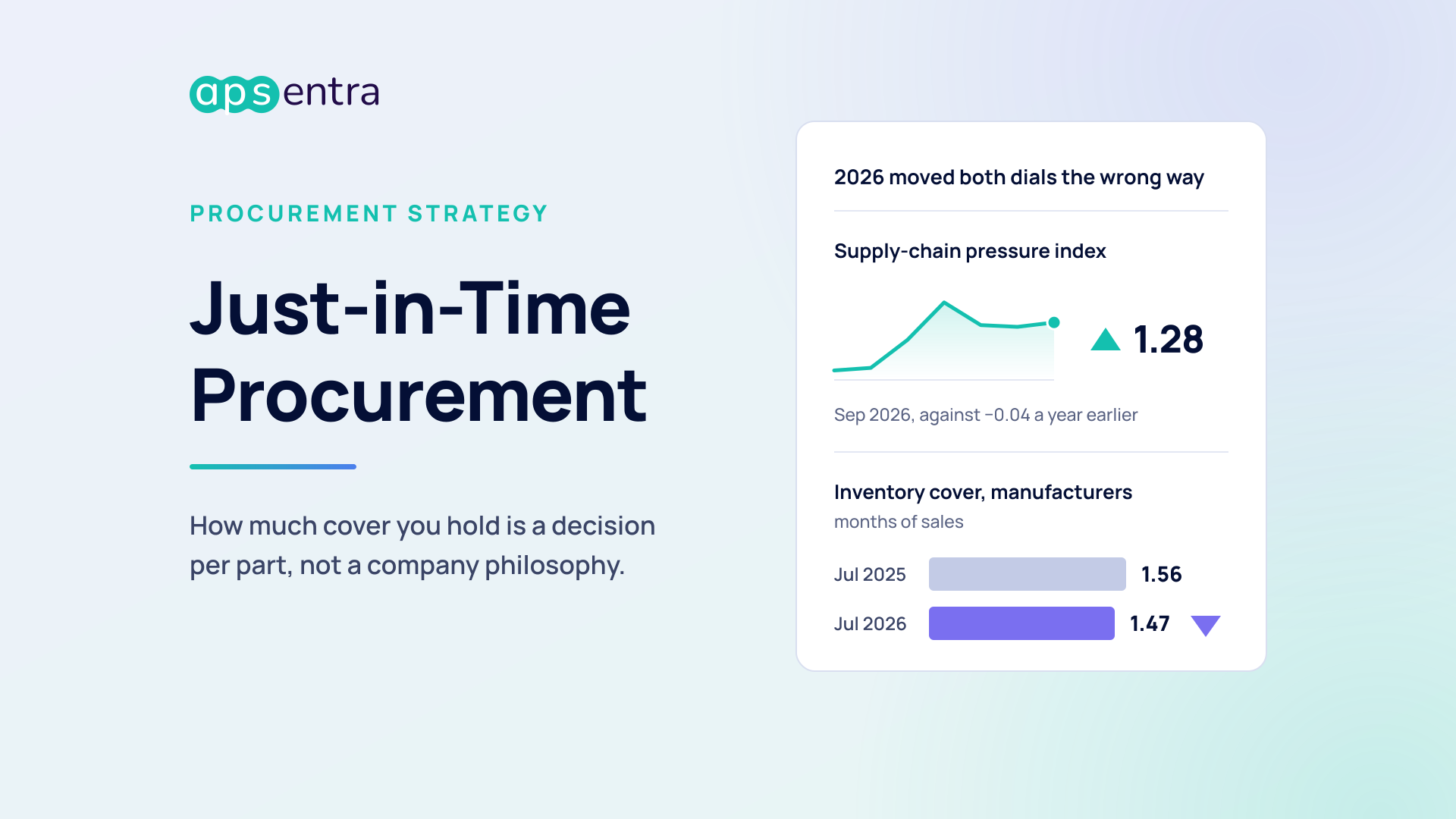
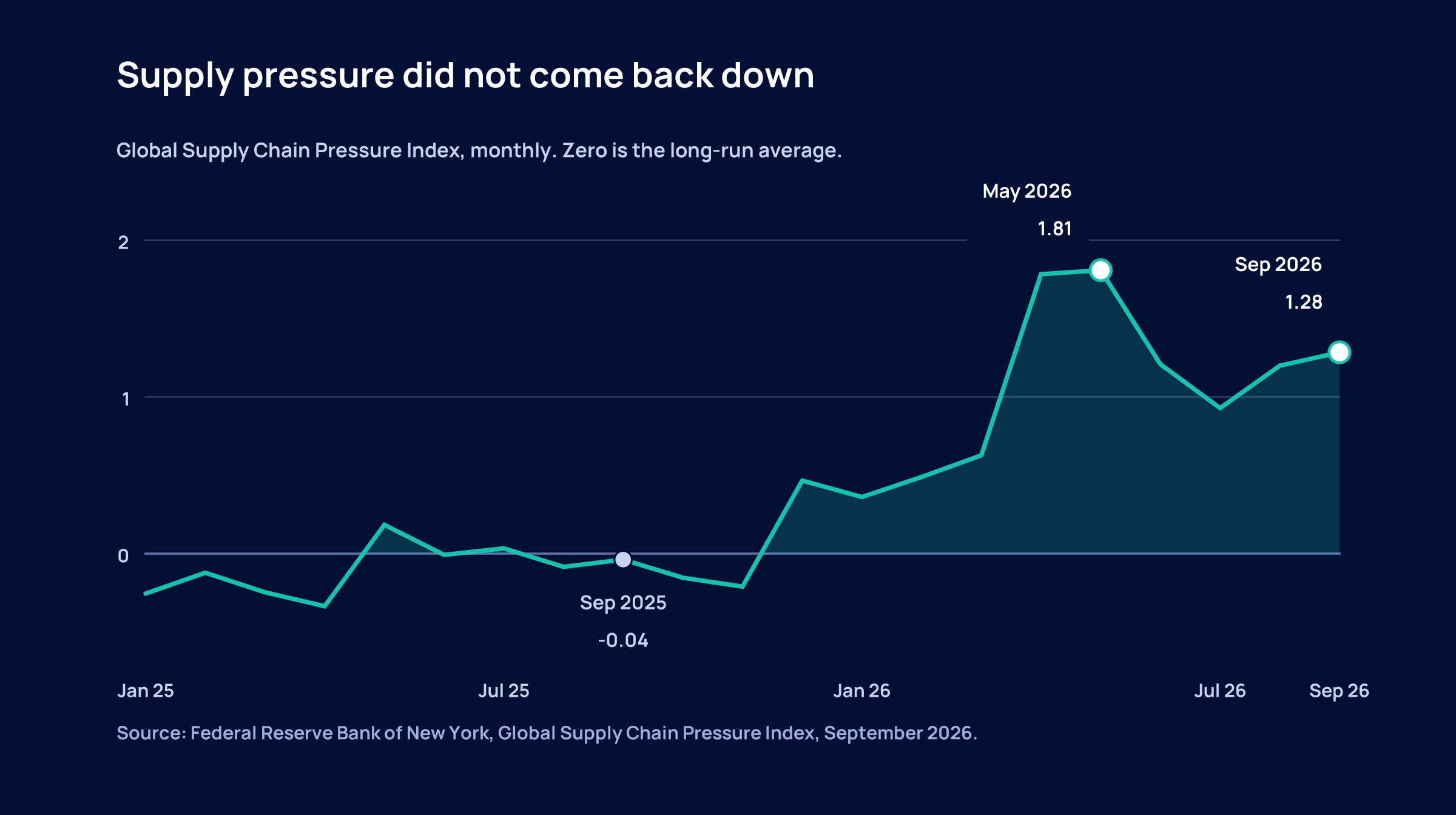
The Federal Reserve Bank of New York’s Global Supply Chain Pressure Index spent most of 2025 at or below its long-run average. In 2026 it moved decisively above it, peaking at 1.81 in May and still reading 1.28 in September 2026, against an upwardly revised 1.20 in August. That is far below the extremes of the pandemic years, but it is a different regime from 2025.
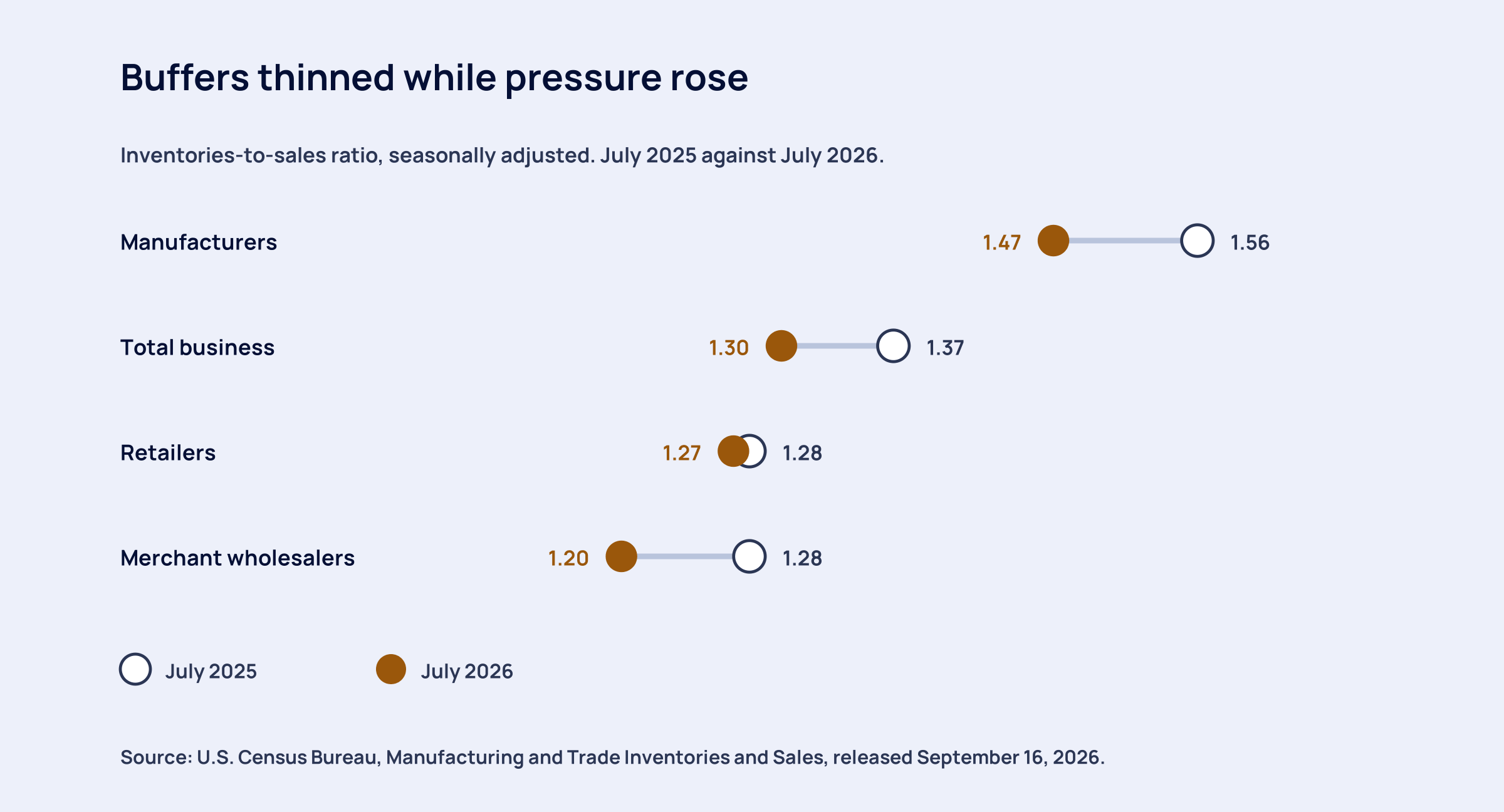
Meanwhile the amount of inventory held per dollar of sales went down. The Census Bureau’s Manufacturing and Trade Inventories and Sales report released on September 16, 2026 put the total business inventories-to-sales ratio at 1.30 for July 2026, against 1.37 a year earlier. Manufacturers came in at 1.47, down from 1.56. Merchant wholesalers fell from 1.28 to 1.20.
The two numbers belong together
A falling inventories-to-sales ratio is not automatically a lean win. It can mean sales grew faster than stock, or that stock was drawn down because money got expensive. The qualitative evidence from 2026 points at the second. The Federal Reserve’s Beige Book published on September 2, 2026 reported that in the Kansas City District, retailers and manufacturers drew down inventories amid elevated prices and uncertain demand, while input price pressures stayed elevated across manufacturing and construction, particularly for metals and petrochemicals.
The buying behavior underneath was not steady either. The GEP Global Supply Chain Volatility Index, produced by S&P Global and GEP from monthly purchasing-manager surveys, recorded reports of safety stockpiling at their highest level in three years by March 2026, and they kept climbing to a three-and-a-half-year peak in the second quarter. Then they turned: in July, stockpiling reports fell for the first time since January, with buyers running down the inventory they had built since the Middle East conflict began, even though reports of critical items in short supply had barely improved.
So the sequence for a lot of companies in 2026 was: build cover in a hurry when prices and risk spiked, then unwind it a quarter later when working capital got tight, while the underlying supply conditions had not actually normalized. That is the most expensive possible order of operations. It buys high and runs lean into a market that is still stretched.
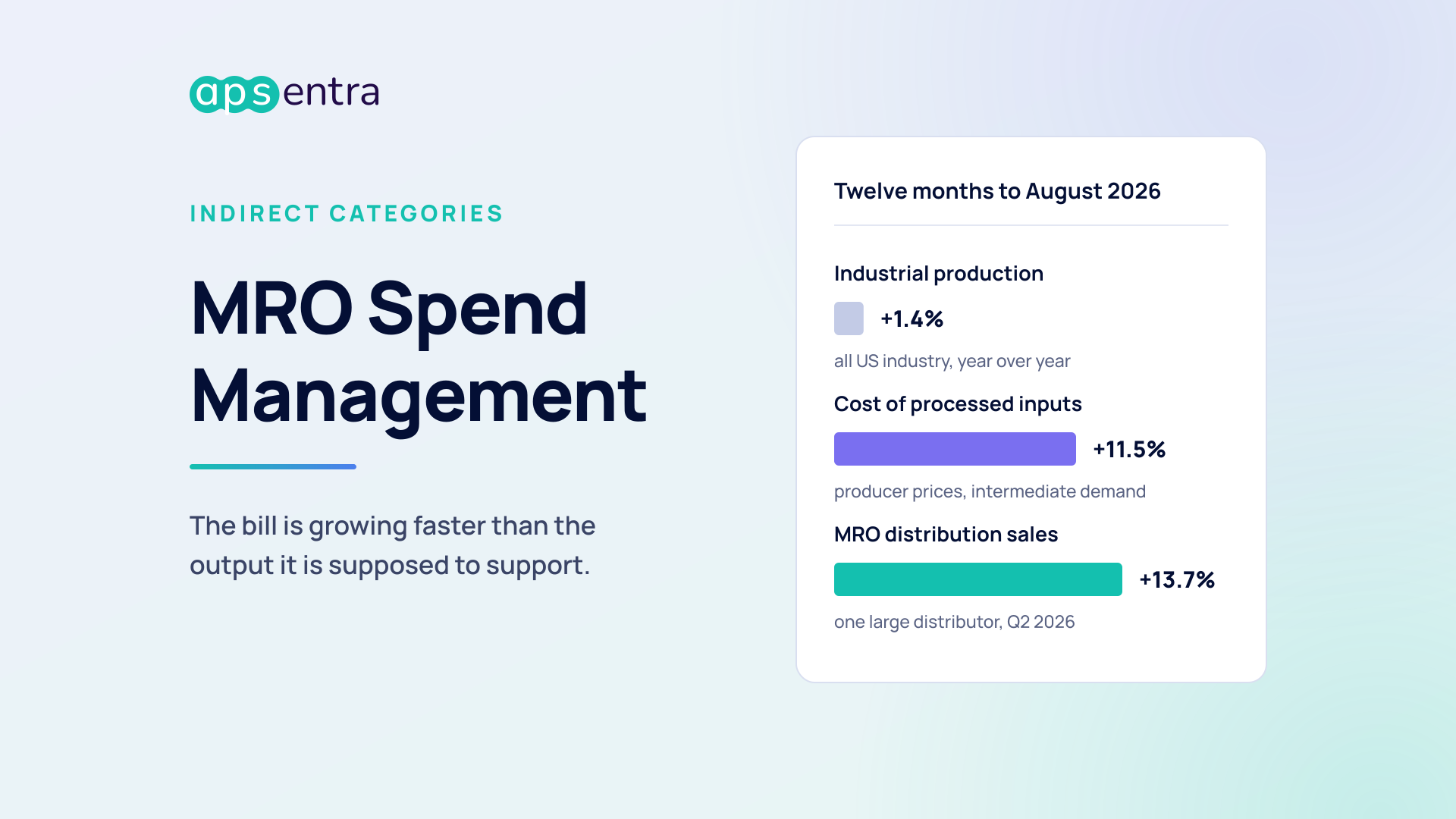
Input costs make the penalty worse. The Bureau of Labor Statistics reported on September 10, 2026 that processed goods for intermediate demand rose 1.8 percent in August alone and were up 11.5 percent over the previous twelve months. When input prices move that fast, the question of when you buy is no longer a logistics detail. It is a price decision.
The useful conclusion is not “hold more” or “hold less.” It is that the decision does not belong at the company level at all. Some parts should be on a pull signal with no safety stock. Some should never have been on one. Treating inventory policy as a single corporate posture is what produces the buy-high, run-lean sequence.
Where just-in-time fits, and where it quietly fails
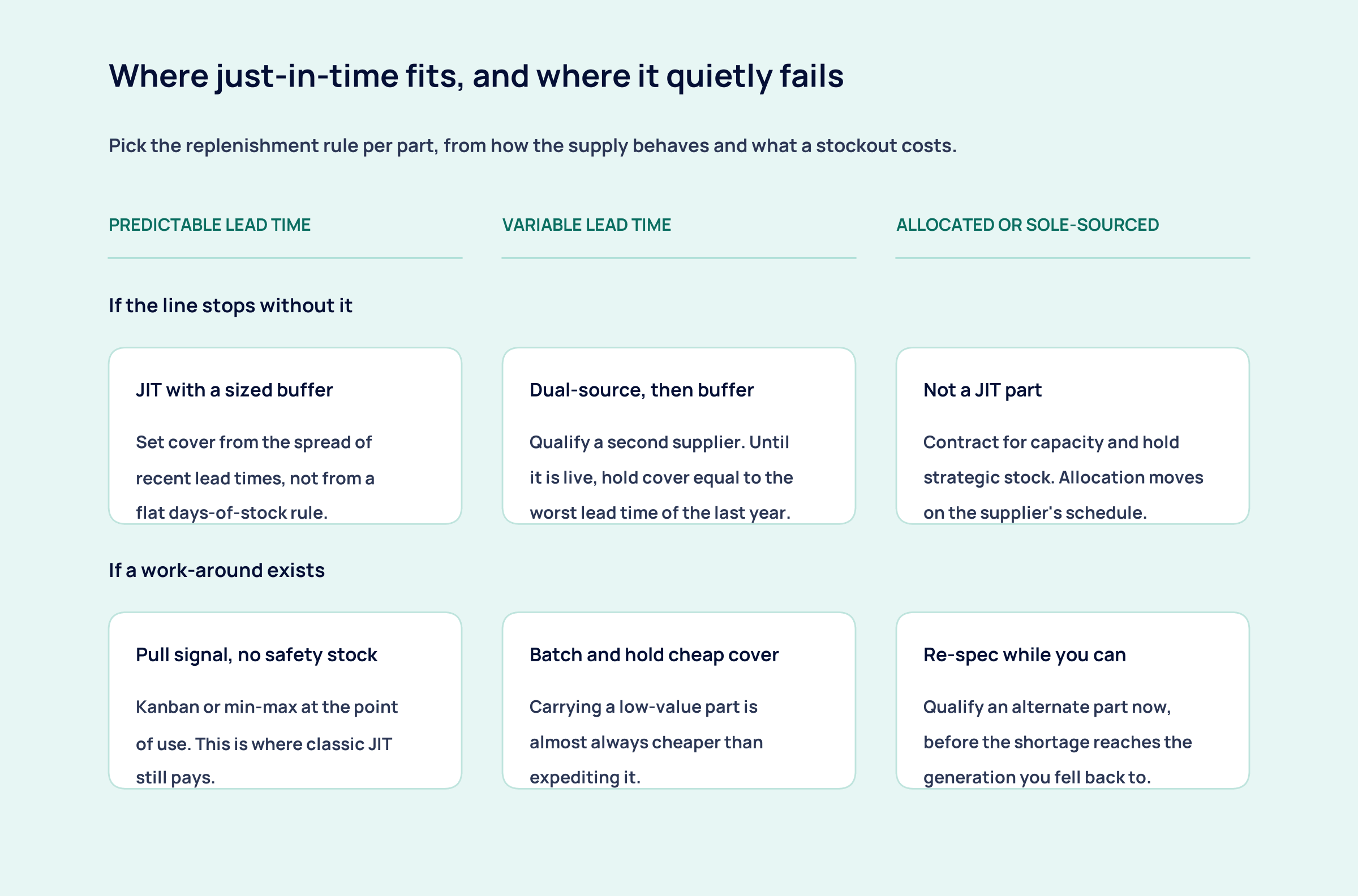
Two questions decide the replenishment rule for a part. How does the supply behave, and what does a stockout cost? Supply behavior is not one thing: a part can have a long but dependable lead time, a short but erratic one, or no usable lead time at all because the supplier is allocating. The cost of a stockout is similarly uneven. Some shortages stop a line. Some are absorbed by a substitution nobody outside the plant notices.
Predictable lead time
This is where just-in-time earns its reputation. If the last twelve months of receipts cluster tightly around a mean, the buffer only has to cover the spread, not the whole lead time. For low-consequence parts you can run a pull signal with no safety stock at all: kanban, min-max at the point of use, or a supplier-managed bin. For parts that stop the line, hold cover sized from the observed spread rather than a flat days-of-stock rule.
Variable lead time
Variability, not length, is what breaks just-in-time. A reliable sixty-day lead time is easy to plan around. A lead time that is usually twelve days and occasionally thirty-five is not. For cheap parts, batching and holding a little extra is almost always cheaper than the expedite freight and the planner hours you spend chasing them. For parts that stop the line, qualify a second source, and until that source is live, hold cover equal to the worst lead time you actually saw in the last year.
Allocated or sole-sourced
This is the case where just-in-time does not apply, and pretending otherwise is how companies get hurt. When a supplier is allocating, your order date stops setting the delivery date. The 2026 memory market is the clearest example: TrendForce reported in June 2026 that consumer DRAM contract prices for DDR2 rose roughly 55 to 60 percent in the second quarter with another 35 to 40 percent expected in the third, because the major suppliers shifted wafer capacity toward high-bandwidth and server memory. Buyers responded by downgrading specifications, replacing DDR4 designs with DDR3 and redesigning some DDR3 products around DDR2, which is how a shortage walks down through technology generations.
For parts in that state, the answer is contractual and technical rather than logistical: reserve capacity, hold strategic stock, and qualify an alternate part before the shortage reaches the generation you fell back to.
The loop just-in-time runs on
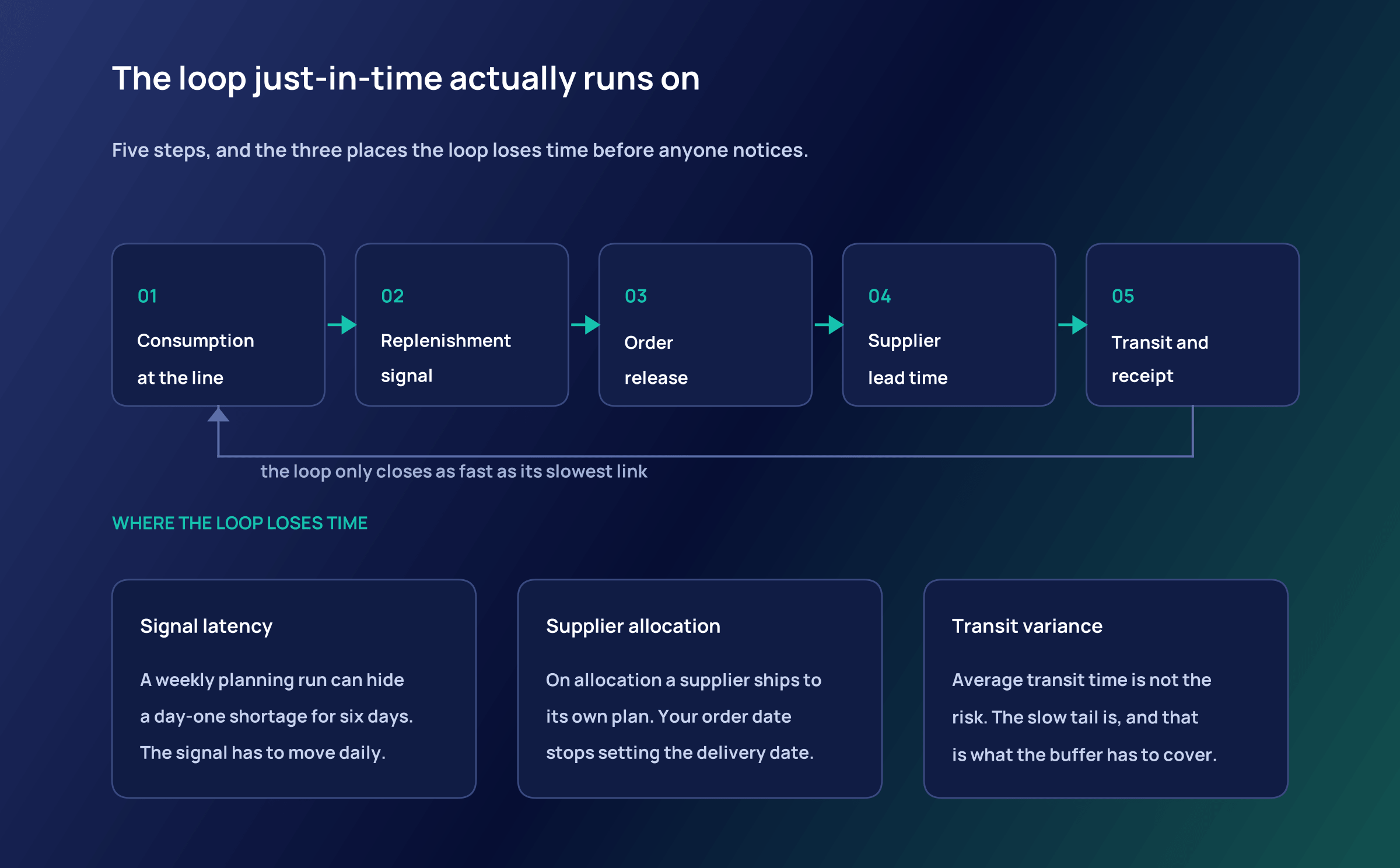
Just-in-time procurement is a control loop, and like any control loop it is only as fast as its slowest link. Most organizations that struggle with it have not got a supplier problem. They have a loop that leaks time in places nobody measures.
Signal latency
If consumption is reported by a weekly planning run, a shortage that becomes visible on the plant floor on Monday does not reach the buyer until the following Monday. Six days of the buffer are gone before anyone has done anything wrong. This is the cheapest of the three problems to fix and the most commonly ignored: the signal has to move at the speed of consumption, not the speed of the planning calendar.
Supplier allocation
A supplier on allocation ships against its own plan. Order dates, expedite requests, and escalation calls stop working, because the constraint is capacity, not attention. The signal to watch for is not a late delivery. It is a change in how a supplier answers: quoted lead times that stop being quoted, confirmations that arrive without dates, and partial shipments that were never discussed. By the time those show up in an on-time-delivery report, the decision window has closed.
Transit variance
Average transit time is the wrong number to plan against. The buffer exists to cover the slow tail, not the mean. A lane that runs eighteen days on average and twenty-nine days in its worst month needs eleven days of cover for that variance alone, before any supplier variability is counted. Planning against the average guarantees that roughly half of shipments arrive later than the plan assumed.
Sizing the buffer instead of guessing it
Most safety-stock settings in practice are round numbers: two weeks, thirty days, a month. They were set once, by someone who is no longer in the role, and they have never been tested against what the part actually did. A defensible buffer needs four inputs, all of which you already have.
| Input | Where it comes from | What it tells you |
|---|---|---|
| Demand over the lead time | Consumption history for the part, not the forecast | The baseline quantity the buffer has to carry you through |
| Lead-time spread | Promise date against actual receipt date, last twelve months | How much of the variation is the supplier and how much is transit |
| Worst observed lead time | The single slowest receipt in the last twelve months | A sanity check: if your cover is below this, you are exposed to a repeat |
| Cost of a stockout | Line rate, changeover cost, or the cost of the workaround | How much protection is worth buying, and where to stop |
Two practical rules make this usable. First, size cover from the spread, not the average. If receipts arrive anywhere between twelve and thirty-five days, the planning number is not the average of those. It is twelve days, plus up to twenty-three days of exposure. Second, check every buffer against the worst receipt you actually saw. If a part has twelve days of cover and its slowest delivery in the last year took thirty-one, the buffer is decorative.
Review the settings on a schedule. Lead-time behavior in 2026 is not what it was in 2025, and a buffer calculated eighteen months ago is carrying assumptions that have already expired. Quarterly is enough for most categories. For anything on allocation, monthly.
The contract terms that make lean possible
Running tight timing on a handshake transfers all the risk to you. The terms below are what shift some of it back, and they are the difference between just-in-time procurement and simply ordering late.
| Term | What it does | When to insist on it |
|---|---|---|
| Blanket order with scheduled releases | Fixes price and total volume, lets you call off quantities against actual consumption | Any repeat-buy part with steady annual volume |
| Capacity reservation | The supplier holds production capacity for you whether or not you call it | Parts where the supplier serves a market that can outbid you |
| Lead-time commitment with a remedy | Converts a quoted lead time into an obligation with a consequence attached | Anything that stops the line |
| Consignment or vendor-managed inventory | Stock sits at your site but is owned by the supplier until drawn | High-value parts with steady draw and a cooperative supplier |
| Forecast-sharing obligation, both ways | You commit to a rolling forecast, the supplier commits to flag capacity constraints against it | Any part on a pull signal |
| End-of-life and last-time-buy notice | A fixed notice period before a part is discontinued or re-specified | Electronics, and anything with a component roadmap you do not control |
These are negotiated in the same conversation as price, not after it. A lead-time commitment extracted a year into a relationship costs considerably more than one written into the award.
What to instrument
Just-in-time procurement fails quietly. By the time a shortage reaches a production schedule, the decision that caused it is weeks old. These are the measures that give you warning rather than history:
- Lead-time spread per part, not per supplier. A supplier with good average performance can still have one erratic part, and the average hides it.
- Promise date against actual receipt. Measured on the date the supplier committed to, not the date you requested. These are different numbers and only one of them is the supplier’s performance.
- Signal latency. The elapsed time between consumption at the point of use and a buyer seeing the replenishment need. If nobody has measured it, it is longer than anyone thinks.
- Expedite spend by part. Premium freight and rush fees are the price of a buffer that was set too low. Compared against carrying cost, the comparison usually settles the argument.
- Cover against target, flagged daily. Not a monthly inventory report. A daily flag on parts that have dropped below their calculated cover.
- Allocation signals. Quotes without dates, confirmations without quantities, and unrequested partial shipments. These precede a formal allocation notice by weeks.
Most of this data already exists across the purchasing, receiving, and planning systems. The work is usually joining it rather than collecting it, which is also why it tends not to get done. It is worth reading this alongside how the wider function is organized in manufacturing procurement and the step sequence described in the manufacturing procurement process.
A ninety-day sequence
If you are moving toward just-in-time procurement from a blanket inventory policy, the order of work matters. Segment before you cut.
- Weeks 1 to 3. Pull twelve months of receipts with promise dates. Calculate the spread and the worst observed lead time for every part above a volume threshold. Resist the urge to act on it yet.
- Weeks 4 to 6. Place each part on the grid: predictable, variable, or allocated, against whether a stockout stops the line. Flag every part that is both sole-sourced and line-stopping. That list is the risk register.
- Weeks 7 to 9. Recalculate cover for the line-stopping parts first. Expect some buffers to go up. A credible program that raises cover on twenty parts and removes it from four hundred is a better outcome than one that cuts everything.
- Weeks 10 to 12. Fix signal latency on the parts you have just put on a pull signal. Then negotiate lead-time commitments and capacity reservations into the next contract cycle for the risk register.
What this sequence avoids is the common failure mode: cutting inventory across the board, discovering the exposure through a line stoppage, and over-correcting back to blanket cover. The approach to supplier risk in the manufacturing supply chain covers the resilience side of the same decision.
Five mistakes that keep showing up
- Setting inventory policy at the company level. A single posture guarantees that some parts are over-covered and the ones that matter are not.
- Planning against the average lead time. Half of all receipts arrive later than the average. The buffer exists for those.
- Running just-in-time on a sole-sourced part. Tight timing and a single point of failure is the combination with the worst outcomes.
- Measuring on-time delivery against the requested date. It measures your optimism, not the supplier’s reliability. Measure against the committed date.
- Treating stockpiling as the opposite of lean. Buying ahead on a price signal and running lean on a working-capital signal are both reactive. The decision should come from the part, not the quarter.
What this comes down to
Just-in-time procurement works, on a specific set of parts, under specific conditions, with specific contract terms behind it. It is not a posture a company adopts, and 2026 has been an expensive lesson in what happens when it is treated as one. Buffers thinned across every sector the Census tracks while supply-chain pressure stayed above its long-run average all year. The companies that came through that well were not the ones holding the most or the least. They were the ones that knew, part by part, which was which.
A practical starting point: pull the last twelve months of promise dates against actual receipts, find the ten parts with the widest spread that would stop a line, and check what cover they are carrying today. That single query usually reframes the whole discussion.