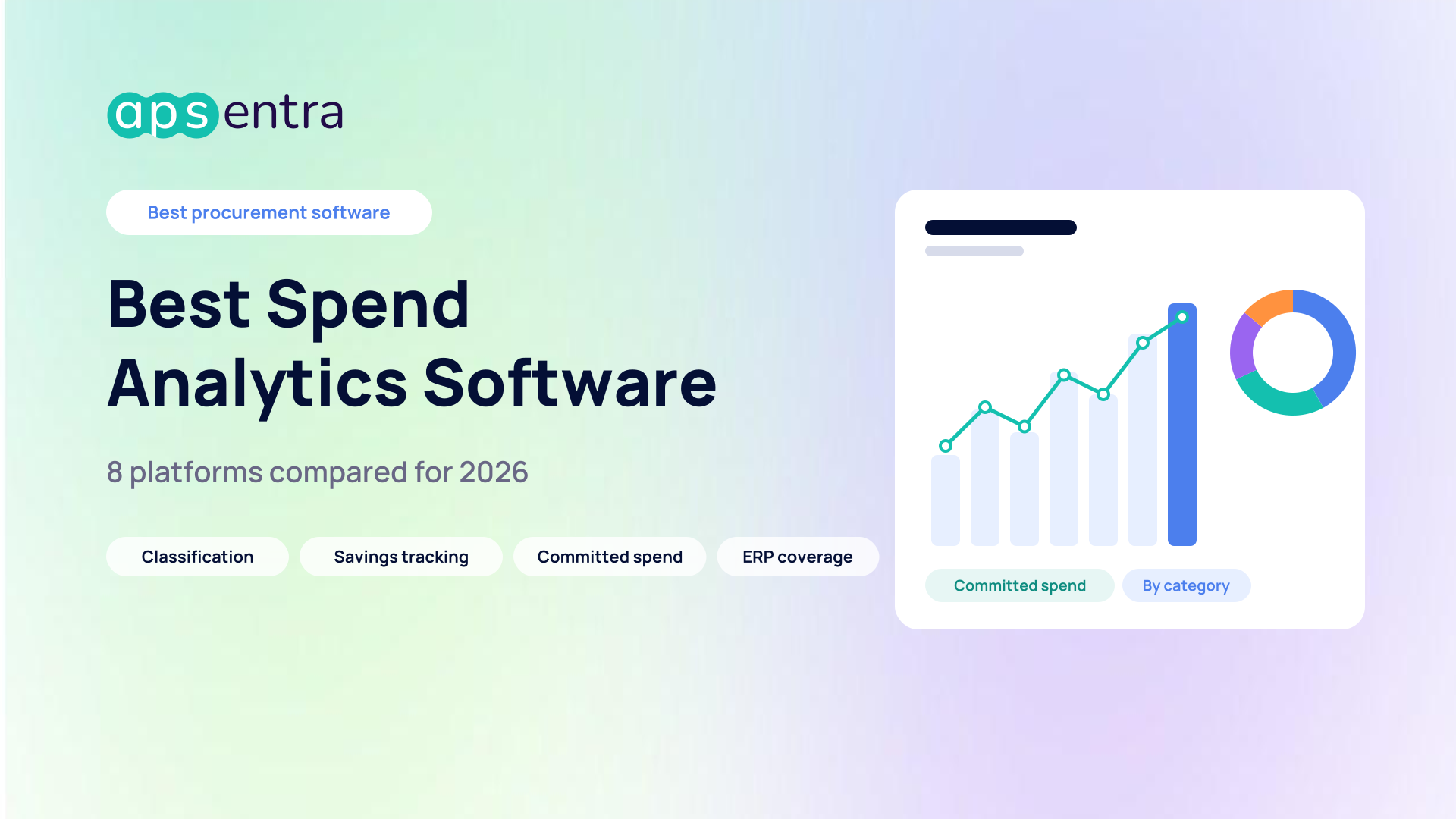
Best Spend Analytics Software: 8 Platforms Compared
Quick answer:
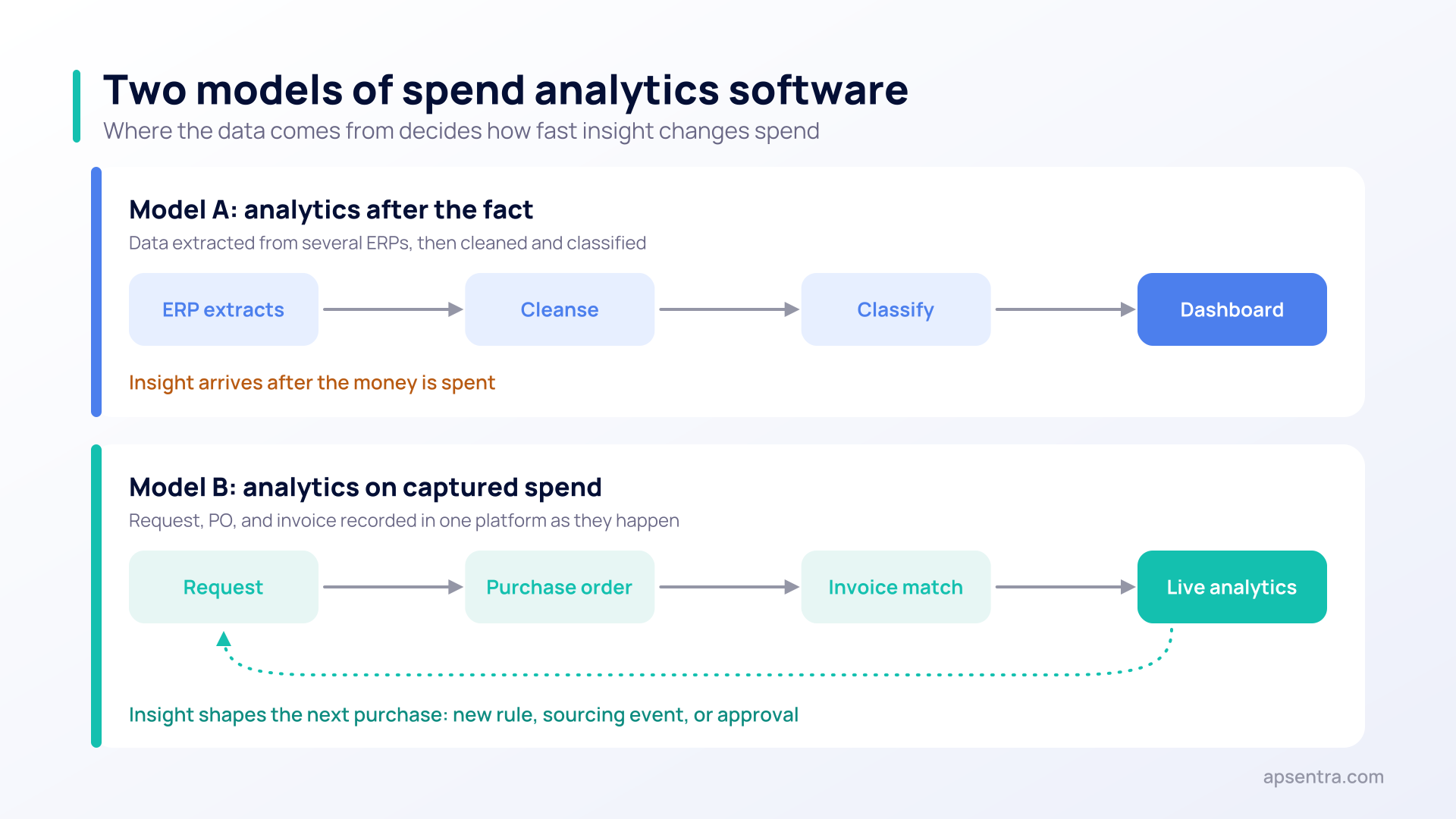
Spend analytics software comes in two models. Analytics layers such as Sievo, SpendHQ, and Suplari pull data from many ERPs after the fact, then clean and classify it. Transactional platforms capture spend at the request and PO stage, so the data is structured before it is analyzed and the insight can change the next purchase.
APSentra is our top pick for organizations that want spend analytics built on data captured in the workflow, with committed spend visible before invoices arrive. Sievo is the strongest choice for complex multi-ERP data with analyst services. SpendHQ and Suplari suit teams that want a faster, product-led analytics layer. Coupa fits companies already on its suite.
What is spend analytics software?
Spend analytics software is a platform that collects procurement and accounts payable data from ERPs and other systems, cleans and classifies it by supplier and category, and turns it into views of who spends what, with whom, and at what price. Teams use it to find savings, track compliance, and set sourcing priorities.
Spend analytics vs. spend management
Spend management software controls spend as it happens: requests, approvals, budgets, and purchase orders. Spend analytics explains spend: where it went, whether it followed contracts, and where the next savings are. The two work best when they share one data model, so a finding becomes a rule. For control-side tools, see our guide to the best spend management software.
Why spend analytics is a finance priority in 2026
In Deloitte’s 2025 Global CPO Survey of 265 CPOs in 40 countries, margin improvement through cost reduction (72%), operational efficiency (68%), and digital transformation with GenAI (67%) were the top priorities. All three depend on a single, trusted view of spend.
The common obstacle is not the dashboard. It is data: duplicate suppliers, free-text line items, missing categories, and invoices that never had a PO. Every platform below solves that problem differently.
Signs you need spend analytics software
- Category spend reports take a week and still need manual corrections.
- The same supplier appears under several names across ERPs and entities.
- Savings claimed in sourcing never show up in the P&L.
- Finance learns about spend at the invoice, not at the commitment.
- Tail spend is invisible, so nobody knows how many suppliers receive under a few thousand a year.
- Leadership asks for supplier concentration or price trends and the answer takes days.
How we evaluated spend analytics software
| Criterion | What we checked | Why it matters |
|---|---|---|
| Data coverage | Number and type of ERPs, AP, P-card, and contract sources supported | Analytics is only as complete as its inputs |
| Classification quality | Automated and AI-assisted categorization, supplier normalization, and correction workflow | Misclassified spend leads to wrong sourcing priorities |
| Timeliness | Committed vs. invoiced spend; refresh frequency | Last quarter’s data cannot change this quarter’s buying |
| Savings tracking | Whether negotiated savings are tracked to realized spend | Finance credits only savings it can see in the numbers |
| Path to action | Whether an insight can trigger a sourcing event, a rule, or a supplier review | Insight without action is reporting |
| Self-service | How easily category managers and finance build their own views | Analyst bottlenecks slow decisions |
| BI integration | Export to Power BI and other tools | Finance often consolidates in its own BI |
| Operating model | Software only, or software plus analyst services | Determines internal effort and cost |
Sources include vendor documentation, Gartner Peer Insights listings, industry coverage from 2025 and 2026, and practitioner discussions. Product details were checked in November 2026. APSentra figures are vendor-reported.
The 8 best spend analytics software platforms in 2026
1. APSentra: best for analytics on spend captured at the point of commitment
Best for: multi-entity organizations that want group-level spend visibility from structured data, with findings turned into sourcing and approval rules in the same system.
APSentra is a source-to-pay platform built on a digital twin of the organization. Because requests, tenders, contracts, POs, and invoices run through one data model, spend arrives already linked to an entity, budget, category, supplier, and contract. Analytics shows committed spend before invoices arrive, not only what was paid last quarter.
Key capabilities:
- Committed and actual spend across entities and currencies: finance sees one picture without a monthly consolidation exercise.
- Category and supplier analytics: price variance, supplier concentration, contract compliance, and maverick spend by entity.
- Savings traced from tender to invoice: prices won in a sourcing event govern the PO and are checked at the invoice.
- AI-assisted analysis: invoice capture, PO matching, and spend analysis, with a person approving consequential decisions.
- Power BI integration and an open API for finance’s own reporting.
Proof point (vendor-reported): 2,050,000+ procurement requests and 443,000+ purchase orders processed, with $129B+ in total procurement volume managed across 130+ enterprise clients.
Limitations:
- Deepest analytics cover spend that runs through the platform; historical or out-of-scope ERP data needs integration.
- Not an outsourced analyst service.
- Pricing is by custom quote.
Named leadership:
- Eugene Ponomarov, Co-Founder, Procurement Strategy & Enterprise Transformation: 15+ years and 100+ transformation initiatives redesigning procurement operating models, financial governance, and spend control.
- Natalie Eksi, CEO, Business Transformation & Executive Advisory: advises executive teams on turning procurement into a strategic function that connects finance, procurement, and operations.
- Mauricio Dezen, VP Professional Services & Customer Success: leads implementation, process optimization, change management, and adoption.
2. Sievo: best for complex multi-ERP data with analyst support
Best for: multinationals with fragmented ERP landscapes that want software plus a managed data service.
Sievo’s modules include Spend Analysis, Savings Lifecycle, Contract Analytics, Materials Forecasting, and CO2 Analytics (Gartner Peer Insights). A meaningful part of the offer is its analyst team, which helps classify and interpret data on an ongoing basis.
Limitations: the services-led model adds cost and implementation time, and insights still need another system to act on them.
3. SpendHQ: best for product-led procurement performance tracking
Best for: procurement teams that want spend intelligence and performance tracking without buying a full suite.
SpendHQ aggregates, analyzes, and visualizes procurement data to support sourcing decisions (Gartner Peer Insights).
Limitations: an analytics layer only; purchasing controls run elsewhere.
4. Suplari: best for an AI-native intelligence layer on existing systems
Best for: teams that want fast, SaaS-priced spend intelligence over their current ERP and P2P tools.
Suplari supports procurement, finance, and operations teams with spend intelligence and supplier management, according to its Gartner Peer Insights listing.
Limitations: it depends on the quality of data in the systems it reads.
5. Simfoni: best for analytics combined with tail spend and eSourcing
Best for: organizations that want spend analytics linked to tail spend management and eSourcing.
Simfoni’s platform includes spend analytics, eSourcing, and tail spend management, using machine learning to automate parts of the process (Gartner Peer Insights). For more on the tail, see the best tail spend management software.
Limitations: less suited to companies that want analytics and full source-to-pay in one data model.
6. Rosslyn: best for data-led analytics teams
Best for: procurement analytics teams that want a dedicated data platform for classification and reporting.
Rosslyn is a point solution for procurement analytics, separate from source-to-pay suites (Art of Procurement).
Limitations: acting on insight requires a separate sourcing or purchasing system.
7. Spendscape by McKinsey: best for consulting-led diagnostic programs
Best for: companies running a cost transformation with McKinsey or similar advisers.
Spendscape is McKinsey’s procurement analytics point solution (Art of Procurement).
Limitations: typically tied to a consulting engagement rather than everyday buying.
8. Coupa Spend Analytics: best inside the Coupa suite
Best for: enterprises that already run Coupa for procurement and AP.
Coupa’s analytics draw on community data from more than $8 trillion of anonymized spend for benchmarks, and Coupa was a Leader in the 2026 Gartner Magic Quadrant for Source-to-Pay Suites (Coupa).
Limitations: best value inside the wider suite, and pricing is not published.
Spend analytics software comparison table
| Platform | Model | Data source | Committed spend before invoice | Savings tracked to invoice | Path to action | Main concern |
|---|---|---|---|---|---|---|
| APSentra | Analytics inside source-to-pay | Captured in the platform, plus ERP integration | Yes | Yes | Same system: sourcing, rules, approvals | Historical data needs integration |
| Sievo | Analytics layer plus services | Many ERPs and AP systems | Limited | Yes | Separate system | Services cost and timeline |
| SpendHQ | Analytics layer | ERP and AP extracts | Limited | Yes | Separate system | No purchasing control |
| Suplari | AI-native analytics layer | Existing ERP and P2P | Limited | Yes | Separate system | Depends on source data |
| Simfoni | Analytics plus tail spend and eSourcing | ERP and AP extracts | Limited | Yes | eSourcing and tail spend | Not full source-to-pay |
| Rosslyn | Analytics platform | Many sources | Limited | Partial | Separate system | Needs an analytics team |
| Spendscape | Consulting-linked analytics | Client data | No | Program-based | Consulting program | Tied to an engagement |
| Coupa | Analytics inside suite | Coupa transactions | Yes, inside Coupa | Yes | Inside Coupa | Value tied to the suite |
Capabilities reflect vendor documentation and public materials as of November 2026. Confirm specifics in a demo.
From descriptive to prescriptive: what to expect from AI
Most spend analytics today is descriptive: it shows where money went. Classification models now do much of the cleanup that analysts once did by hand, and AI features increasingly suggest where to act: consolidating suppliers, re-tendering a category, or flagging price drift against a contract.
Treat AI claims as you would any other: ask which tasks run in production, how accuracy is measured, and where a person approves the change. A suggested action is only valuable if the platform, or the one next to it, can execute it.
How to choose: match the platform to your situation
| Your situation | Platform to shortlist first |
|---|---|
| Multi-entity group; wants committed spend visibility and insights that become rules in one system | APSentra |
| Fragmented multi-ERP landscape; wants a managed analytics partner | Sievo |
| Wants a product-led analytics layer over existing systems | SpendHQ, Suplari |
| Large tail spend alongside analytics | Simfoni |
| In-house analytics team building its own models | Rosslyn |
| Running a consulting-led cost program | Spendscape |
| Already on Coupa | Coupa Spend Analytics |
For purchase-to-pay controls, see the best procure-to-pay software. For full-cycle platforms, see the best enterprise procurement software.
“We’re in the AI era. Why do you need the report in the first place?”
— Mauricio Dezen, VP Professional Services & Customer Success, APSentra
His point applies directly to spend analytics: if a platform can model the data and surface the decision, many recurring reports stop being necessary. Automating a report nobody acts on is faster busywork, not transformation.
10 questions to ask in every spend analytics demo
- Load a sample of our real data. How much is classified automatically, and how accurately?
- How do you merge duplicate suppliers across ERPs, and who approves the merge?
- Can we see committed spend before invoices arrive?
- How are negotiated savings tracked into actual invoice prices?
- How often does the data refresh?
- Can a category manager build a view without an analyst?
- What happens after an insight: can it trigger a sourcing event, a rule, or an approval change?
- Which AI features run in production today, and how is accuracy measured?
- Does it export cleanly to Power BI or our own BI?
- Is pricing software only, or software plus services?
Questions 3, 4, and 7 show whether analytics will change spend or only describe it. Not sure where your team stands? Take the Procurement Maturity Assessment.
Sources and methodology
Survey data comes from Deloitte’s 2025 Global CPO Survey. Vendor descriptions draw on Gartner Peer Insights, Art of Procurement, and Coupa. APSentra figures are vendor-reported.
Editorial policy: vendors can’t pay for inclusion or ranking in this article.