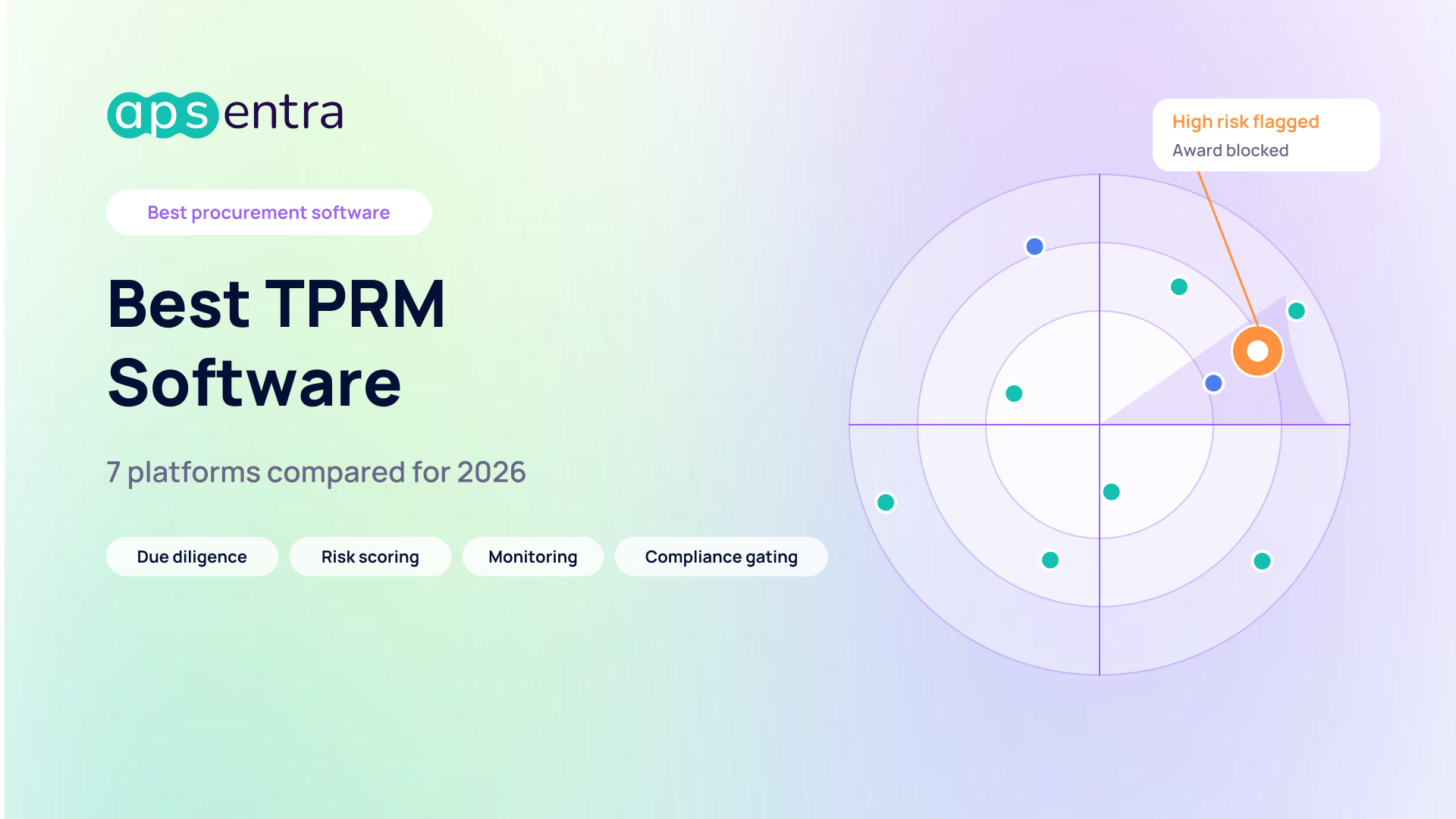
Best TPRM Software in 2026: 7 Platforms Compared
Quick answer:
The best TPRM software depends on which risk you need to control and who owns it. Risk and compliance teams that assess hundreds of vendors for cybersecurity and regulatory exposure need a dedicated TPRM platform. Procurement teams that need supplier risk to stop a bad award or a bad payment need risk checks inside the buying workflow.
In the Forrester Wave for TPRM Platforms, Q1 2026, Archer, LogicGate, and ProcessUnity were the three Leaders. Exiger leads Gartner’s 2026 Magic Quadrant for Supplier Risk Management. APSentra is our pick for procurement-led risk control: due diligence, risk scoring, and compliance gating built into sourcing, purchase orders, and payments across entities.
What is TPRM software?
Third-party risk management (TPRM) software is a platform that identifies, assesses, monitors, and mitigates risks from vendors, suppliers, and partners across the relationship lifecycle. It runs due diligence questionnaires, tracks risk scores and remediation, monitors external signals, and keeps an audit trail that regulators and auditors can inspect.
TPRM vs. supplier risk management: who owns the risk?
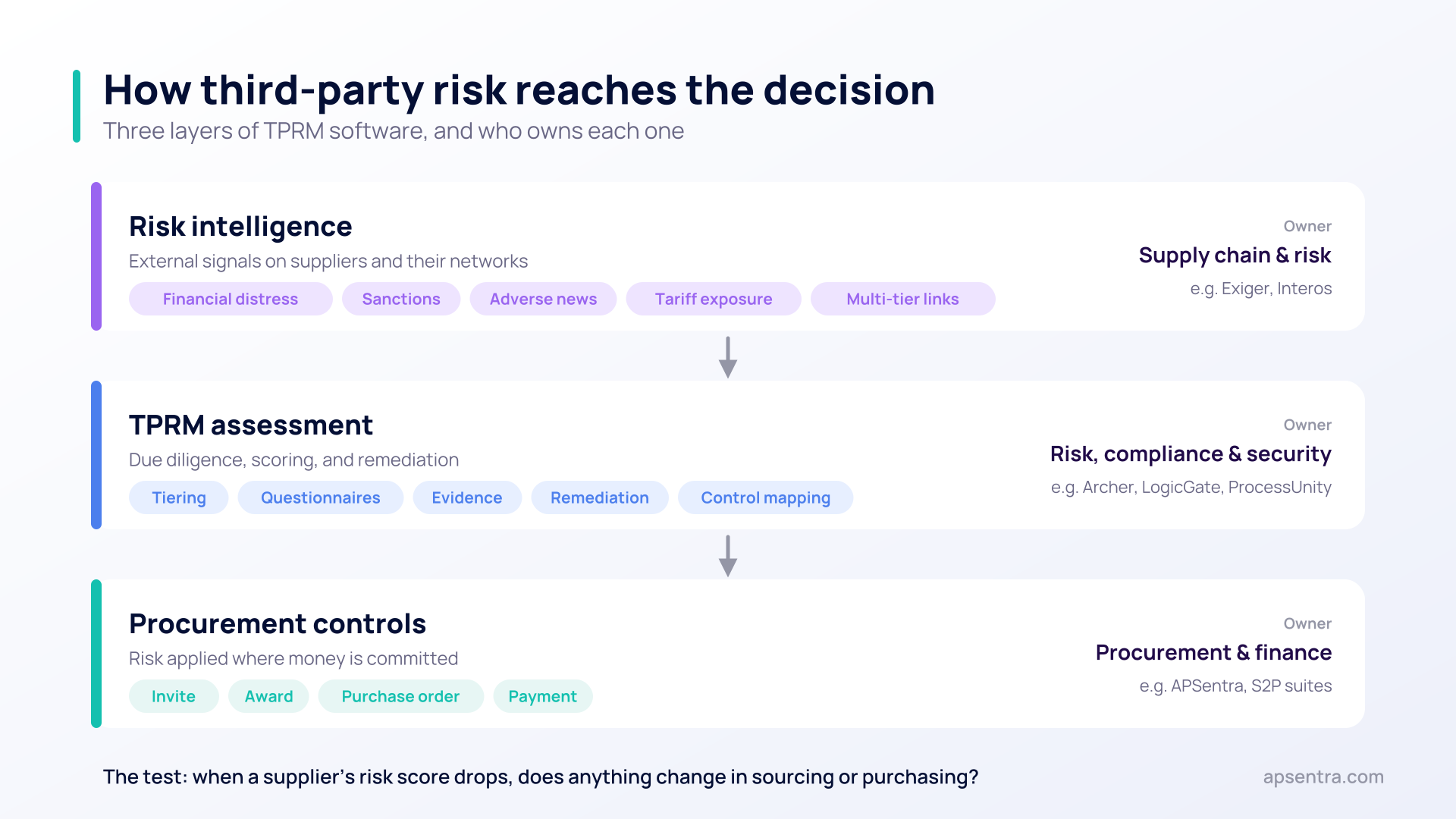
The market splits into three groups that buyers often compare by mistake.
- GRC-led TPRM platforms (Archer, LogicGate, ProcessUnity, Mitratech Prevalent) serve risk, compliance, and security teams. Their strength is assessment workflows, control mapping, and regulatory reporting.
- Supplier risk intelligence platforms (Exiger, Interos) map supply networks and monitor external data for financial, geopolitical, sanctions, and continuity risk.
- Procurement-native risk controls (APSentra and the source-to-pay suites) apply risk to decisions: who may be invited, awarded, ordered from, and paid.
Most large organizations need risk data from the first two groups to reach the decisions in the third. The practical test: when a supplier’s risk score drops, does anything change in sourcing or purchasing without a manual email?
What changed in third-party risk management in 2026
1. Continuous monitoring replaced the annual questionnaire. Forrester’s 2026 evaluation describes the shift from periodic vendor assessments to lifecycle management of third-party risk, and it scored 12 providers on 27 criteria (ProcessUnity via Business Wire).
2. Supplier risk became its own analyst category. Gartner published its second Magic Quadrant for Supplier Risk Management Solutions on 4 May 2026, with Exiger named a Leader for the second year (PR Newswire).
3. Tariffs and reputation entered the risk model. Interos launched its iQ platform in May 2026 with tools for reputational risk, tariff exposure, and multi-tier tracing (CFOtech).
Procurement leaders are acting on the same pressure. In Deloitte’s 2025 Global CPO Survey, 74% of CPOs named securing alternative suppliers as a mitigation strategy.
How we evaluated TPRM software
| Criterion | What we checked | Why it matters |
|---|---|---|
| Risk domains | Cyber, financial, compliance, sanctions, ESG, operational, and geopolitical coverage | Most incidents start in a domain nobody assessed |
| Assessment workflow | Tiering, questionnaires, evidence collection, and remediation tracking | Assessment volume grows faster than risk teams |
| Continuous monitoring | External data feeds and alerts after onboarding | Most supplier problems surface after the first review |
| Link to procurement | Whether risk status blocks awards, POs, or payments | Risk that never reaches the buyer changes nothing |
| Multi-tier visibility | Sub-supplier mapping where it matters | Direct suppliers rarely fail alone |
| Audit trail | Who assessed, approved, and accepted each risk | Regulators ask for evidence, not intent |
| Configuration | Who changes tiers, scoring, and workflows after go-live | Risk frameworks change with regulation |
| Analyst recognition | 2026 Forrester and Gartner positions | Independent signal on vision and execution |
Analyst positions are cited from vendor announcements; we did not have access to the full reports. Product details were checked in November 2026. APSentra figures are vendor-reported.
The 7 best TPRM software platforms in 2026
1. APSentra: best for procurement-led supplier risk control across entities
Best for: procurement and finance leaders who need supplier risk to block an unsafe award, purchase order, or payment in every entity, without waiting for a separate risk team.
APSentra is a source-to-pay platform built on a digital twin of the organization. It is not a cyber-assessment tool for every vendor in the enterprise. Its role in third-party risk is narrower and closer to the money: due diligence, risk scoring, and compliance checks sit on the supplier record that sourcing, contracts, and purchasing already use.
Key capabilities:
- Automated vendor risk questionnaires: due diligence collected through configurable workflows and stored on the supplier record.
- Pre-award compliance gating: suppliers that fail screening or qualification cannot be awarded or receive POs.
- Supplier risk scoring: based on delivery, quality, and financial signals, shown to buyers at the point of decision.
- Structured qualification per entity and category: stricter rules for critical categories, lighter ones for low-risk spend.
- Audit-ready trail: every assessment, approval, exception, and award rationale is logged automatically.
- Connects to your risk stack: open API for scores from a dedicated TPRM or risk intelligence platform.
Proof point (vendor-reported): more than 120,000 suppliers and counterparties connected across 130+ enterprise clients, with implementation of up to eight weeks.
Limitations:
- Not a replacement for a GRC-led TPRM program covering cybersecurity, data privacy, and regulatory control mapping.
- No proprietary external risk data network yet. Integrations with external risk data sources are planned; today, outside risk scores connect through the open API.
- Pricing is by custom quote.
Named leadership:
- Eugene Ponomarov, Co-Founder, Procurement Strategy & Enterprise Transformation: 15+ years and 100+ transformation initiatives redesigning procurement operating models, financial governance, and spend control.
- Natalie Eksi, CEO, Business Transformation & Executive Advisory: advises executive teams on turning procurement into a strategic function that connects finance, procurement, and operations.
- Mauricio Dezen, VP Professional Services & Customer Success: leads implementation, process optimization, change management, and adoption.
2. Archer: best for enterprise GRC programs with mature risk teams
Best for: large, regulated organizations that run third-party risk inside a wider governance, risk, and compliance program.
Archer was named a Leader in the Forrester Wave for TPRM Platforms, Q1 2026, which evaluated 12 vendors (Business Wire). It has more than 20 years in the GRC market.
Limitations: it is built for risk teams, so procurement decisions only change if the integration is designed for it.
3. LogicGate: best for configurable, AI-assisted GRC workflows
Best for: risk and compliance teams that want to design their own TPRM workflows without heavy development.
LogicGate was named one of three Leaders in the Forrester Wave for TPRM Platforms, Q1 2026 (LogicGate).
Limitations: its strength is the GRC workflow layer; supplier sourcing and purchasing run in other systems.
4. ProcessUnity: best for high-volume assessment programs
Best for: organizations assessing large vendor populations for cybersecurity and operational risk.
ProcessUnity was named a Leader in the same Forrester Wave and received the highest possible scores in 13 of 27 criteria, according to its announcement.
Limitations: focused on risk and security teams rather than procurement execution.
5. Mitratech Prevalent: best unified TPRM platform for mid-size risk teams
Best for: risk teams that want assessment, monitoring, and remediation in one TPRM product.
Prevalent, now part of Mitratech, automates vendor risk assessment, monitoring, and remediation across the third-party lifecycle (Expert Insights).
Limitations: procurement controls depend on integration with your purchasing system.
6. Exiger: best for multi-tier supplier risk intelligence
Best for: manufacturers, defense, and regulated enterprises that need visibility below tier one.
Exiger was named a Leader in the 2026 Gartner Magic Quadrant for Supplier Risk Management, placed highest in execution and furthest in vision. In May 2026, Vodafone Telenor Procurement Company selected it for supplier risk intelligence (Exiger).
Limitations: it is an intelligence layer; acting on its signals in sourcing and purchasing needs a procurement platform.
7. Interos: best for continuous external risk monitoring
Best for: supply chain and risk teams that monitor large supplier networks for disruption and reputational risk.
Interos launched iQ in May 2026, combining its supplier data with Dataminr’s real-time news and social monitoring to detect corruption, financial distress, and regulatory breaches (IT Brief).
Limitations: monitoring alone does not run assessments or block transactions.
TPRM software comparison table
| Platform | Type | Primary owner | 2026 analyst recognition | Blocks awards, POs, or payments | Main concern |
|---|---|---|---|---|---|
| APSentra | Procurement-native risk controls | Procurement and finance | Not yet in analyst reports | Yes, natively | Not a full GRC or cyber TPRM program |
| Archer | GRC-led TPRM | Risk and compliance | Forrester Wave Leader | Via integration | Built for risk teams |
| LogicGate | GRC-led TPRM | Risk and compliance | Forrester Wave Leader | Via integration | Procurement runs elsewhere |
| ProcessUnity | TPRM specialist | Risk and security | Forrester Wave Leader | Via integration | Procurement runs elsewhere |
| Mitratech Prevalent | TPRM specialist | Risk and compliance | Not cited here | Via integration | Depends on purchasing integration |
| Exiger | Supplier risk intelligence | Supply chain and risk | Gartner MQ Leader (Supplier Risk Management) | Via integration | Intelligence layer only |
| Interos | Supplier risk monitoring | Supply chain and risk | Not cited here | No | Monitoring without workflow control |
Positions reflect vendor announcements as of November 2026. Confirm specifics in a demo.
How to build a TPRM stack that procurement actually uses
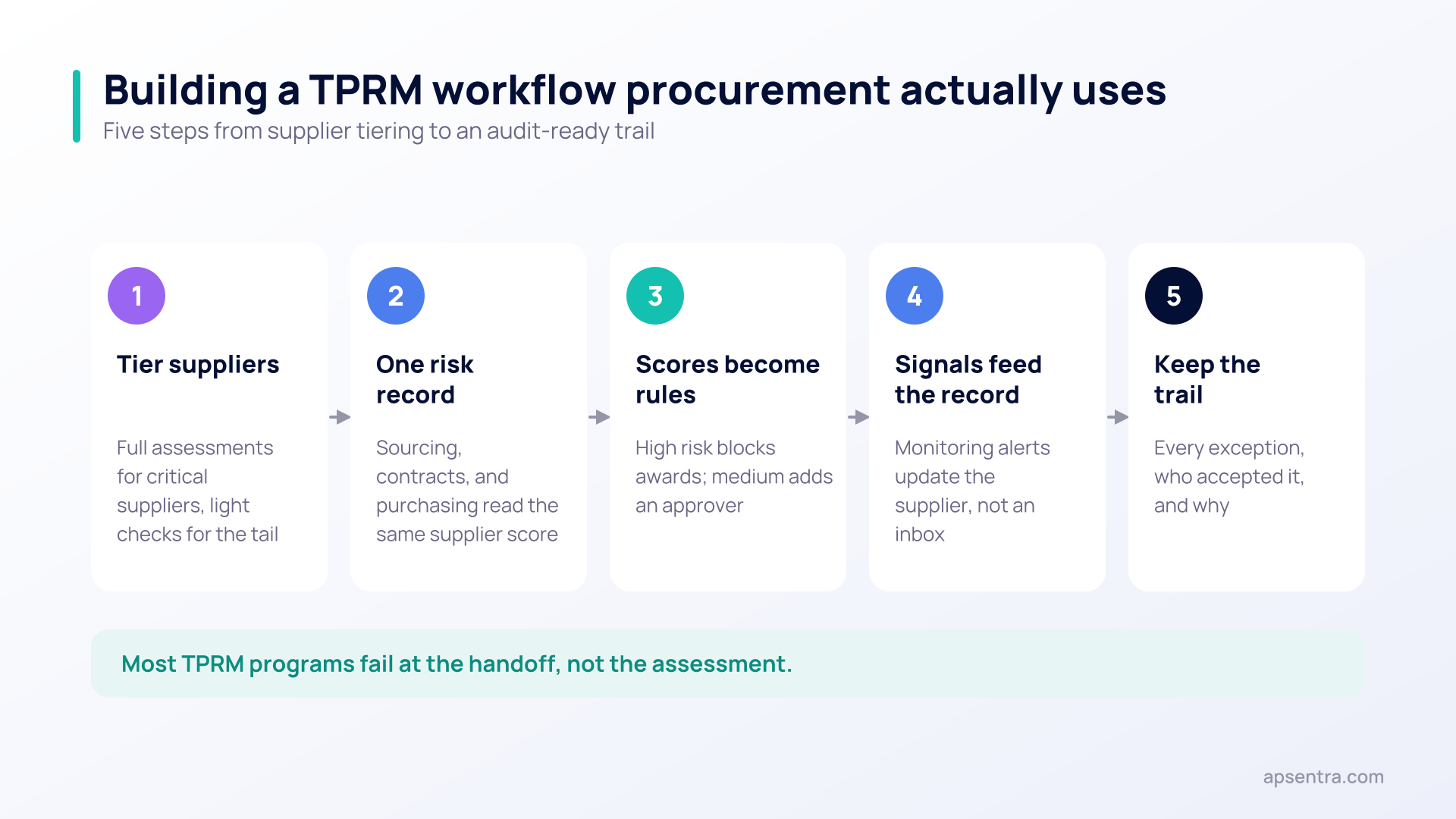
Most TPRM programs fail at the handoff, not the assessment. The risk team rates a supplier as high-risk, and a buyer in another entity issues a purchase order the same week because nothing in the purchasing system changed.
- Tier suppliers by spend and criticality first. Full assessments for critical suppliers, light checks for the long tail.
- Decide where the risk score lives. One supplier record, read by sourcing, contracts, and purchasing.
- Turn scores into rules. High risk blocks new awards; medium risk requires an extra approver; expired documents pause POs.
- Feed external signals in, not around. Monitoring alerts should update the supplier record, not an inbox.
- Keep the trail. Record every exception, who accepted it, and why.
How to choose: match the platform to your situation
| Your situation | Platform to shortlist first |
|---|---|
| Procurement owns supplier risk; risk must block awards, POs, and payments across entities | APSentra |
| Mature GRC program; third-party risk sits with risk and compliance | Archer, LogicGate |
| Large vendor population assessed for cybersecurity | ProcessUnity, Mitratech Prevalent |
| Multi-tier supply chain, sanctions, or forced-labor exposure | Exiger |
| Continuous external monitoring of disruption and reputation | Interos |
Many enterprises combine a risk platform with a procurement platform. For the supplier lifecycle itself, see the best supplier management software. For contracts and day-to-day vendor administration, see the best vendor management software.
“Procurement is not a support function during a recession. It is the financial architecture that determines whether a business protects its margins or loses them to decisions made without visibility.”
— Natalie Eksi, CEO, APSentra
10 questions to ask in every TPRM demo
- Which risk domains do you assess natively, and which come from partners?
- How do you tier suppliers, and can we change the tiers ourselves?
- Show a supplier rated high-risk. What happens when a buyer tries to award or order from it?
- How often is external data refreshed after onboarding?
- Can you show sub-supplier exposure for one of our critical categories?
- How are exceptions approved, and where is that recorded?
- Which systems receive the risk score, and how fast?
- How do suppliers complete questionnaires, and how long does it take them?
- Which regulations do your reports map to?
- What is the full three-year cost, including data feeds?
Questions 3, 6, and 7 show whether risk reaches the decision. Not sure where your team stands? Take the Procurement Maturity Assessment.
Sources and methodology
Analyst positions are cited from vendor announcements: Archer, LogicGate, ProcessUnity, and Exiger. Product updates come from IT Brief, CFOtech, and Expert Insights. Survey data comes from Deloitte’s 2025 Global CPO Survey. APSentra figures are vendor-reported.
Editorial policy: vendors can’t pay for inclusion or ranking in this article.