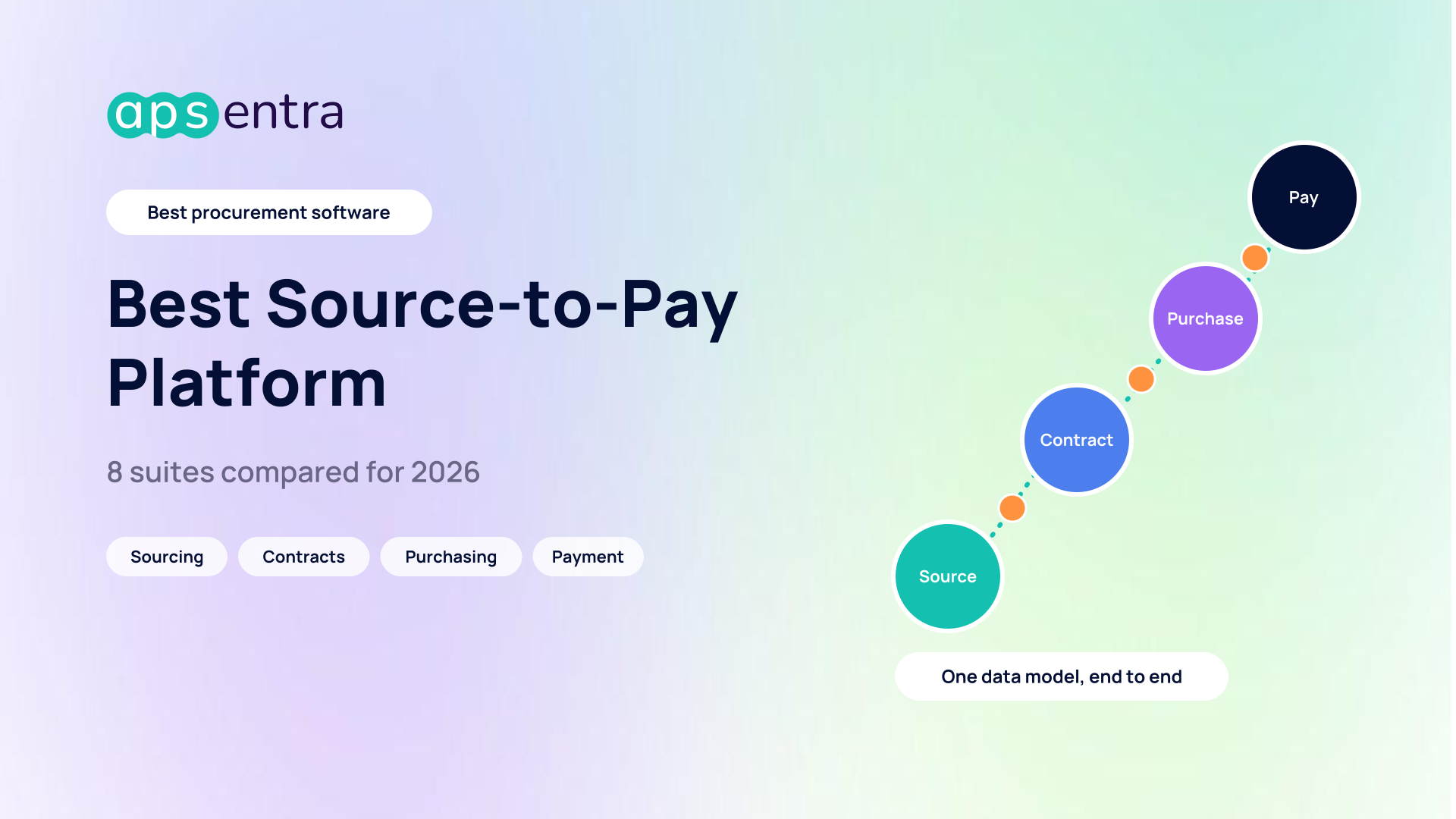
Best Source-to-Pay Platform in 2026: 8 Suites Compared
Quick answer:
Every source-to-pay platform lists the same modules. The difference is what happens between them: whether the price won in a tender automatically governs the contract, the purchase order, and the invoice match, in every entity, without re-keying.
APSentra is our top pick for organizations that want one data model across the full cycle, configured around their own structure and live in up to eight weeks. Coupa is the broadest suite for total spend management, SAP Ariba suits SAP-centric companies, and GEP SMART, Ivalua, Oracle, Zycus, and Jaggaer each win in specific situations.
What is a source-to-pay platform?
A source-to-pay (S2P) platform is software that runs the full procurement cycle in one system: spend analysis, sourcing, supplier management, contracts, requisitions, purchase orders, invoice matching, and payment. Its value comes from shared data, so terms agreed in sourcing carry through to what is ordered and paid.
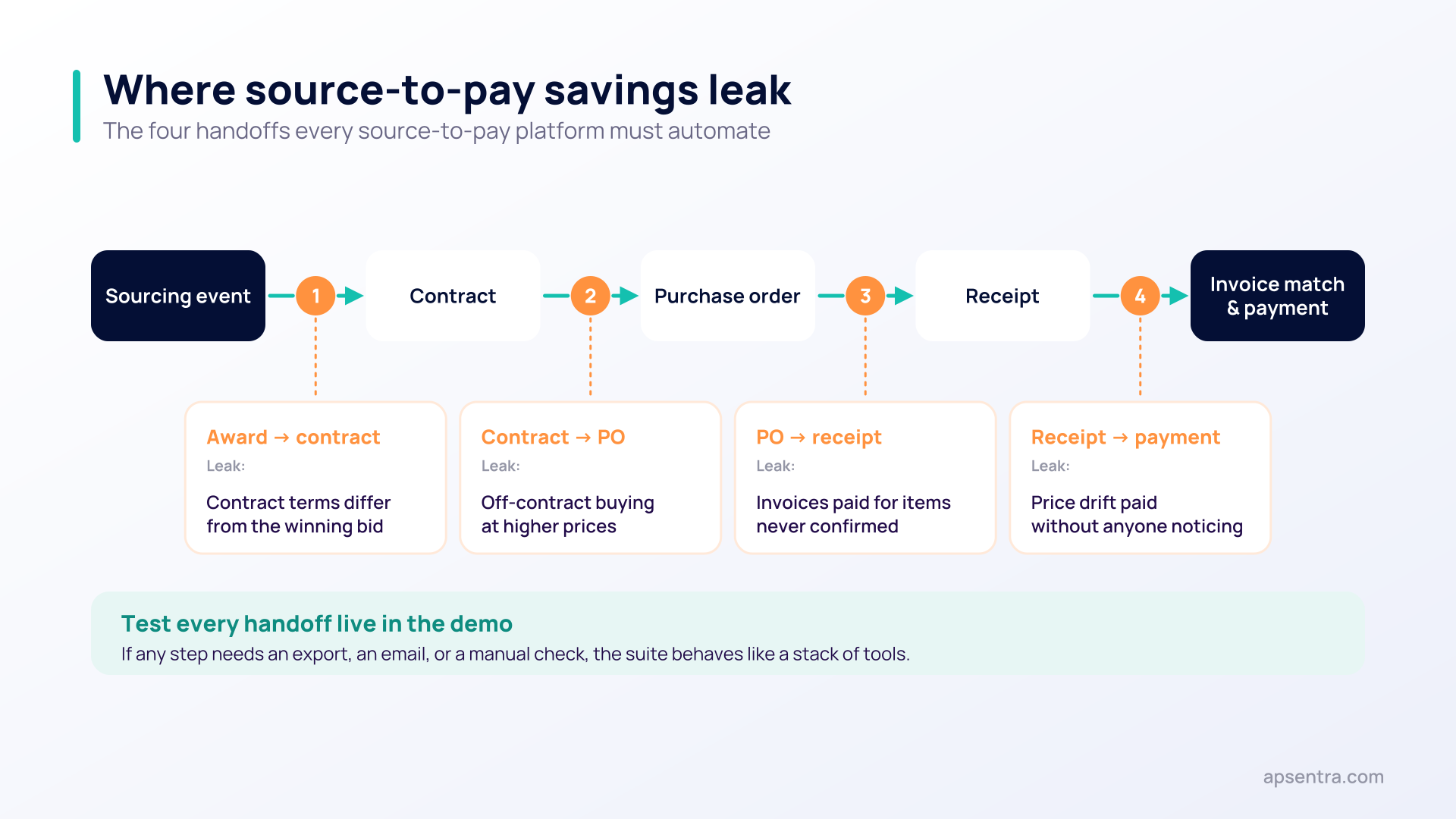
The handoff test: where source-to-pay savings leak
Savings rarely disappear inside a module. They disappear at the handoffs between modules, especially when those modules were built separately or acquired. Test each one in the demo.
| Handoff | What should happen | What leakage looks like |
|---|---|---|
| Award → contract | The awarded supplier, price, and terms become the contract without re-keying | Contract terms differ from the winning bid |
| Contract → PO | Every entity can only order at contracted prices from contracted suppliers | Off-contract buying at higher prices |
| PO → receipt | Goods and services received are recorded against the PO | Invoices paid for items never confirmed |
| Receipt → invoice → payment | Price and quantity are matched to the contract before payment | Price drift paid without anyone noticing |
If any handoff needs an export, an email, or a manual check, the platform behaves like a stack of tools, whatever its brochure says.
Suite or stack: when each makes sense
A single source-to-pay platform fits when one team must govern spend across many entities, ERPs, and categories, and savings tracking matters to finance. A stack of best-of-breed tools, such as a sourcing specialist plus an intake layer plus ERP purchasing, fits when one step is the clear bottleneck and the rest already works.
The cost of a stack is integration and ownership: each tool has its own data model, contract, and admin. The cost of a suite is fit: rigid suites force the business to adapt to the template. The best source-to-pay platform reduces both.
How we evaluated source-to-pay platforms
| Criterion | What we checked | Why it matters |
|---|---|---|
| One data model | Whether sourcing, contracts, P2P, and analytics share records | Separate models recreate the handoff problem |
| Handoff automation | The four handoffs above, shown live | Savings leak at handoffs |
| Organizational fit | Entities, approval matrices, budgets, and roles modeled as they are | Workarounds start where the model does not fit |
| Configuration ownership | Business admins change workflows without integrators | Change requests drive long-term cost |
| ERP landscape | Several ERPs side by side, including local systems | Most groups run more than one ERP |
| AI in production | Agents running today, with a person approving key decisions | Roadmap AI adds risk, not value |
| Time to value | Weeks or months to the first live entity | Return starts at go-live |
| Analyst recognition | 2026 Gartner Magic Quadrant for Source-to-Pay Suites | Independent signal on vision and execution |
According to vendor announcements, Gartner evaluated 13 providers in its 2026 Magic Quadrant for Source-to-Pay Suites and named Coupa, SAP, Oracle, Ivalua, GEP, and Zycus Leaders. We did not have access to the full report. Product details were checked in November 2026. APSentra figures are vendor-reported.
The 8 best source-to-pay platforms in 2026
1. APSentra: best for one data model configured around your organization
Best for: multi-entity groups, holdings, and enterprises that want the full source-to-pay cycle in one system, shaped to their own structure and live in weeks.
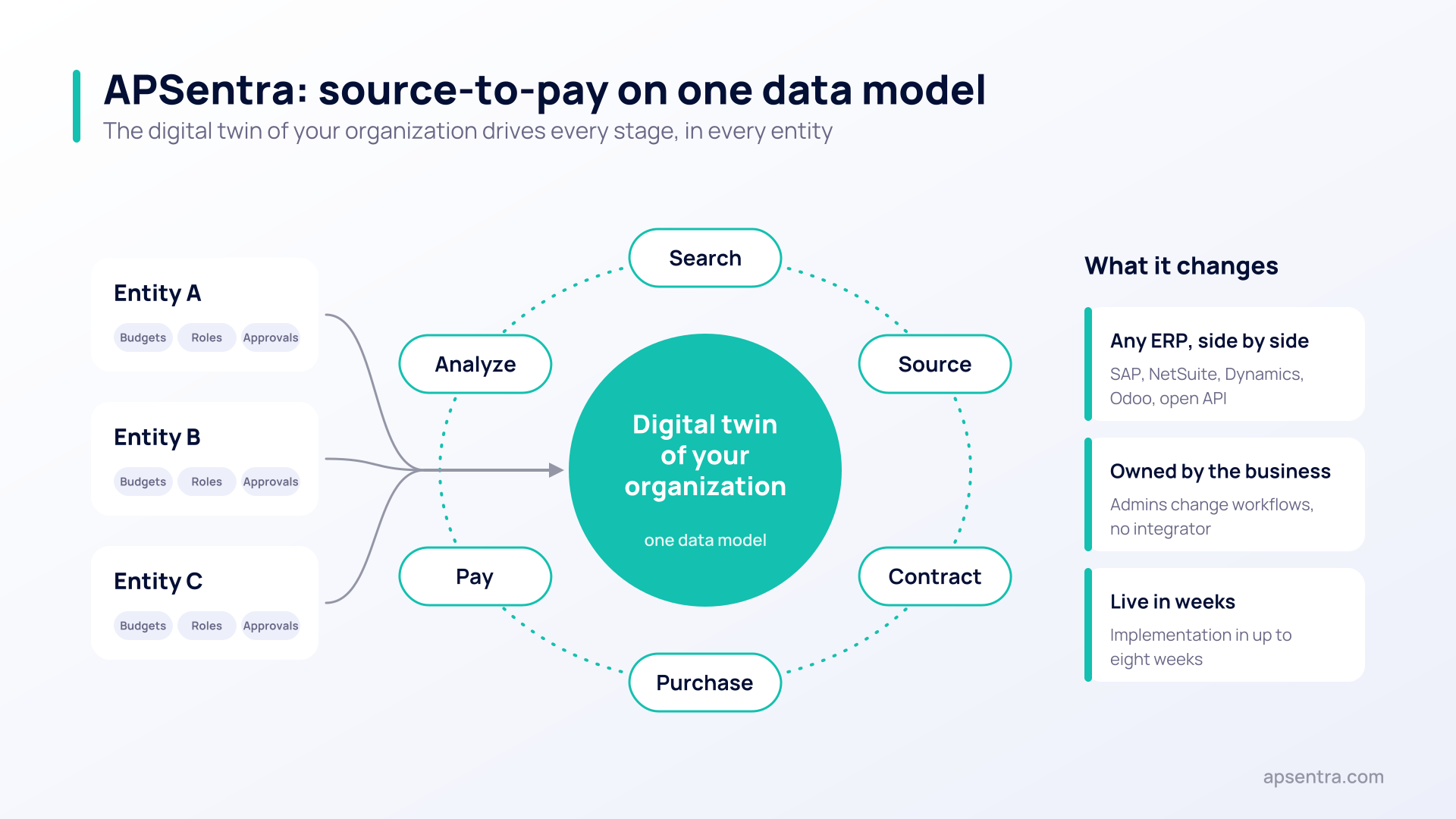
APSentra is a source-to-pay platform built on a digital twin of the organization: a live model of its entities, approval hierarchies, budgets, and roles. Search, sourcing, contracts, purchasing, payment, and analytics share one data model, so the four handoffs run inside the platform rather than between tools.
Key capabilities:
- Full cycle in one system: intake, RFQs, RFPs, and reverse auctions, contract management, POs, receipt, invoice matching, payment control, and spend analytics.
- Configuration owned by the business: procurement admins change workflows, thresholds, and approval routes without integrator change requests.
- Any ERP, side by side: SAP, SAP Business One, NetSuite, Dynamics 365 Business Central, Odoo, and others, plus an open API.
- Group-level visibility: committed and actual spend across entities and currencies.
- Audit-ready governance: every request, approval, award rationale, and price change logged.
- Flexible hosting: APSentra’s cloud or the client’s own environment.
Proof point (vendor-reported): 386,000+ tenders, 265,000+ auctions, 443,000+ purchase orders, and 126,000+ active contracts managed across 130+ enterprise clients. At Bunge, more than 200 users run strategic sourcing on the platform. Implementation takes up to eight weeks.
Limitations:
- Not yet assessed in the major analyst reports.
- A smaller supplier network and partner ecosystem than SAP or Coupa.
- Pricing is by custom quote.
Named leadership:
- Eugene Ponomarov, Co-Founder, Procurement Strategy & Enterprise Transformation: 15+ years and 100+ transformation initiatives redesigning procurement operating models, financial governance, and spend control.
- Natalie Eksi, CEO, Business Transformation & Executive Advisory: advises executive teams on turning procurement into a strategic function that connects finance, procurement, and operations.
- Mauricio Dezen, VP Professional Services & Customer Success: leads implementation, process optimization, change management, and adoption.
2. Coupa: best suite for total spend management
Best for: enterprises that want procurement, invoicing, expenses, and payments in one suite.
Coupa was named a Leader in the 2026 Gartner Magic Quadrant for Source-to-Pay Suites for the third consecutive year and launched Coupa Compose and Navi Agent Studio at Inspire 2026 (Supply Chain Digital).
Limitations: practitioners describe heavy implementations, and pricing is not published. See how APSentra compares.
3. SAP Ariba: best for SAP-centric enterprises
Best for: companies running SAP S/4HANA that value the SAP Business Network.
Next-generation Ariba has been generally available since March 2026, with Joule agents for intake and contracts (ERP Today).
Limitations: user experience, supplier network fees, and long multi-year contracts.
4. GEP SMART: best for sourcing depth plus managed services
Best for: enterprises that want strong sourcing and contracts, optionally with outsourced procurement.
GEP was placed in the Leaders quadrant of the 2026 Gartner Magic Quadrant for the second consecutive year (GEP).
Limitations: ease of use rated below average in review analyses.
5. Ivalua: best for non-standard processes on one codebase
Best for: enterprises with complex processes and strong internal IT.
Ivalua is a 2026 Gartner Magic Quadrant Leader built on a single codebase and data model, with no-code and low-code configuration.
Limitations: configurability depends on skilled administrators or integrators.
6. Oracle Fusion Cloud Procurement: best for Oracle ERP customers
Best for: enterprises running Oracle Fusion Cloud ERP.
Oracle is a 2026 Gartner Magic Quadrant Leader with embedded AI agents for recommendations, requisitions, approvals, and exceptions.
Limitations: most of its advantage depends on running Oracle Fusion as the ERP.
7. Zycus: best for AI-driven tail spend and negotiation
Best for: enterprises prioritizing autonomous negotiation and tail spend automation.
Zycus is a 2026 Gartner Magic Quadrant Leader, with Merlin agentic AI and Merlin Intake at the core of its suite (Zycus).
Limitations: practitioner views on implementation are mixed.
8. Jaggaer: best for direct materials and the public sector
Best for: manufacturers, higher education, and public-sector organizations.
Jaggaer was named a Leader in the IDC MarketScape for AI-enabled direct spend in 2026 (Jaggaer).
Limitations: buyers with mostly indirect spend tend to find it heavy.
For longer profiles, pricing, and contract terms of these suites, see our comparison of the best enterprise procurement software.
Source-to-pay platform comparison table
| Platform | 2026 analyst recognition | Handoffs inside one data model | Configured by business admins | ERP stance | Typical rollout | Main concern |
|---|---|---|---|---|---|---|
| APSentra | Not yet in Gartner MQ | Yes | Yes | Any ERP, side by side | Up to 8 weeks (vendor-reported) | Smaller ecosystem |
| Coupa | Gartner MQ Leader (3rd year) | Yes, within the suite | Partial | ERP-independent | Several months to 1+ year | Heavy rollouts |
| SAP Ariba | Gartner MQ Leader | Yes, within SAP | Partner-led | SAP-first | 6–18 months | User experience; supplier fees |
| GEP SMART | Gartner MQ Leader (2nd year) | Yes | Partial | ERP-independent | Months | Ease of use |
| Ivalua | Gartner MQ Leader | Yes, single codebase | Yes, with skilled admins | ERP-independent | Months | Configuration effort |
| Oracle | Gartner MQ Leader | Yes, within Fusion | Partner-led | Oracle Fusion | Tied to ERP program | Value inside Oracle only |
| Zycus | Gartner MQ Leader | Yes | Partial | ERP-independent | Months | Mixed implementation reports |
| Jaggaer | IDC MarketScape Leader (direct spend) | Yes | Partial | ERP-independent | Months | Heavy for indirect spend |
Positions reflect vendor announcements and public materials as of November 2026. Confirm specifics in a demo.
How to choose: match the platform to your situation
| Your situation | Platform to shortlist first |
|---|---|
| Several entities and ERPs; full cycle in one data model, configured to your structure, live in weeks | APSentra |
| One suite for procurement, AP, expenses, and payments | Coupa |
| SAP S/4HANA core; global supplier network | SAP Ariba |
| Sourcing and contract depth plus managed services | GEP SMART |
| Non-standard processes and a strong IT team | Ivalua |
| Oracle Fusion ERP in place | Oracle |
| Tail spend and autonomous negotiation | Zycus |
| Direct materials or public sector | Jaggaer |
If you are smaller or simpler, see the best procurement software for mid-market companies. If only purchasing needs fixing, see the best procure-to-pay software. All head-to-head pages are on our comparisons hub.
“By connecting our entire process from request to contract, we’ve created a reliable environment where 250+ users can operate with full transparency and budget alignment.”
— Business Unit Director, Intesa Sanpaolo
10 questions to ask in every source-to-pay demo
- Run one award through to payment live. Where did anyone re-key data?
- After the award, can any entity order the same item at a different price?
- Configure one of our entities and its approval matrix. How long did it take, and who did it?
- Can our admin change a workflow after go-live without a change request?
- How does the platform work with two or more ERPs, including local ones?
- Which modules were built in-house and which were acquired? Do they share one data model?
- Which AI agents run in production today, and where does a person approve?
- What do suppliers pay to participate?
- What is the fixed-scope plan to get the first entity live, and in how many weeks?
- What is the full three-year cost, and how do we export our data at exit?
Questions 1, 2, and 6 tell you whether you are buying one platform or several tools under one brand. Not sure where your team stands? The Procurement Maturity Assessment gives a scored read in five minutes.
Sources and methodology
Analyst positions are cited from vendor announcements: Coupa, GEP, Zycus, and Jaggaer. Product updates come from ERP Today and Supply Chain Digital. APSentra figures are vendor-reported.
Editorial policy: vendors can’t pay for inclusion or ranking in this article.