Manufacturing Procurement in 2026: Direct Materials, Rising Prices, and Where Money Leaks
This guide covers what manufacturing procurement includes, what the current buying environment looks like, how to negotiate direct materials from cost rather than from the supplier’s quote, and where spend quietly escapes control.
What Manufacturing Procurement Covers
Manufacturing procurement is the sourcing, negotiation, and purchasing of everything a manufacturer needs to make its products and run its plants. It splits into direct procurement, meaning raw materials, components, and contract manufacturing that go into the product, and indirect procurement, meaning MRO supplies, equipment, energy, logistics, and services.
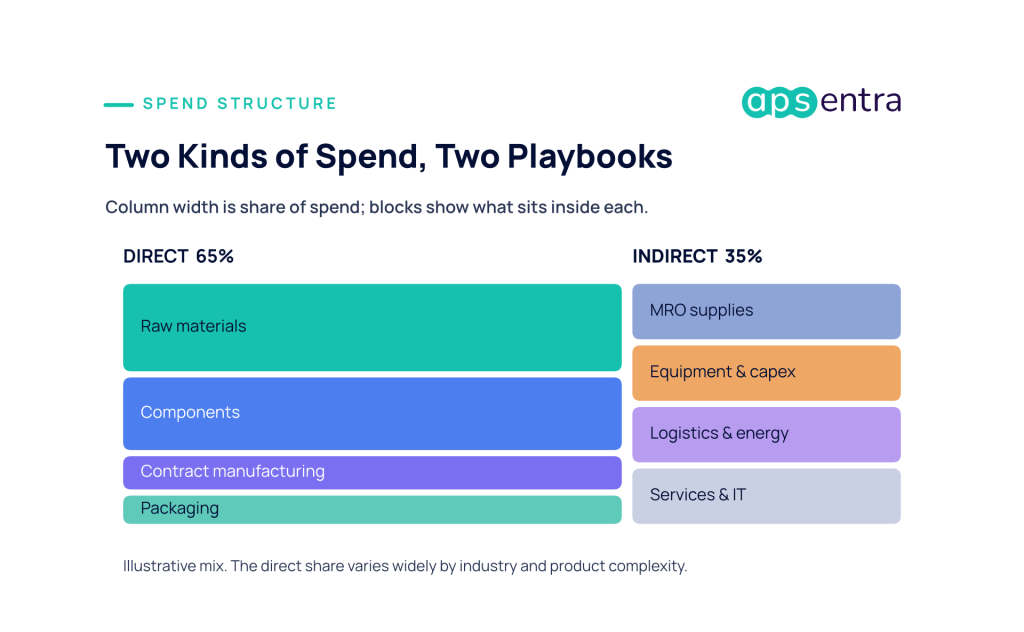
The two halves need different playbooks. Direct spend is concentrated, engineering-driven, and tied to the bill of materials, so the work is cost modeling, supplier development, and long-term agreements. Indirect spend is fragmented across thousands of small orders, so the work is standardization, catalogs, and making the compliant choice the easy one.
Many manufacturers run both halves with the same process, and that is where problems start. Applying tender-heavy sourcing to MRO wastes effort on low-value items, while treating direct materials like catalog buying leaves the largest cost lever untouched.
For discrete manufacturers where direct materials dominate, the engineering side of this work is covered in depth in OEM procurement consulting.
The 2026 Buying Environment
In 2026, manufacturing buyers face two pressures at once: raw material prices have risen every month for nearly two years, and supplier deliveries keep slowing. That combination rewards buying earlier and negotiating from cost, and it penalizes reactive, order-by-order purchasing.
The ISM Manufacturing PMI Report for August 2026, compiled from purchasing and supply executives, put the Prices Index at 71.1 percent, which ISM reports as raw materials prices increasing for the 23rd consecutive month. ISM attributed the pressure to steel and aluminum prices, tariffs on imported goods, and higher petroleum-based product costs linked to the Middle East conflict.
Deliveries are slowing at the same time. ISM’s Supplier Deliveries Index showed slower delivery performance for a ninth straight month in August. Among respondents’ negative comments that month, 57 percent mentioned pricing volatility and 46 percent mentioned increasing lead times.
The same report shows how far ahead manufacturers are committing. ISM’s buying-policy data put the average commitment lead time at 171 days for capital expenditures, 84 days for production materials, and 48 days for MRO supplies. Those three horizons are, in practice, three different procurement jobs running on three different clocks.
Two practical consequences follow for procurement teams.

Plan further out on constrained items

Decide which prices should float
What Manufacturers Say Is Most Critical to Buy
Asked what matters most to their operations over the next year, manufacturers point to categories that are expensive, slow to replace, or both.
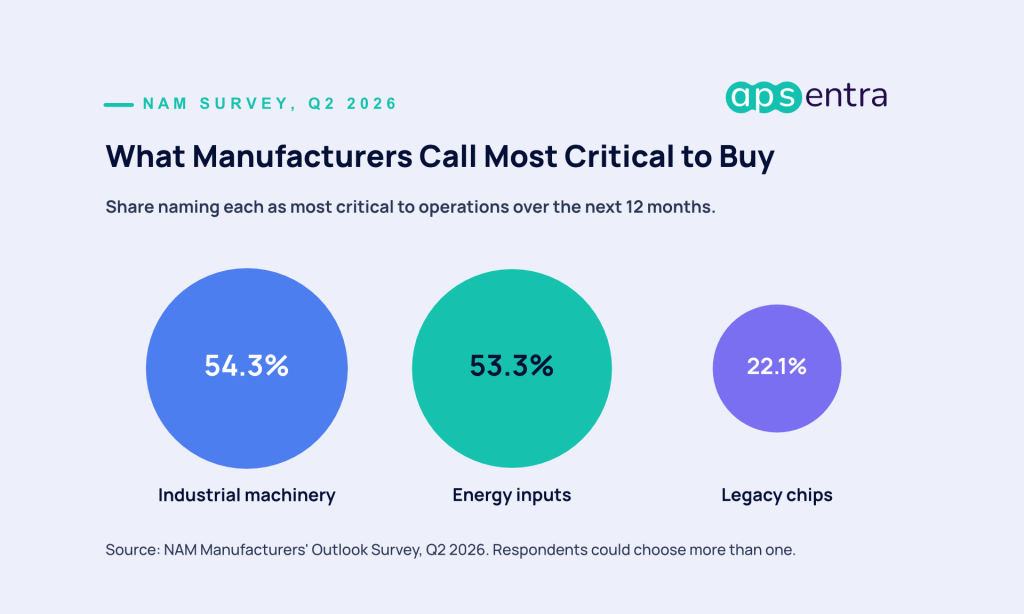
In NAM’s Q2 2026 Manufacturers’ Outlook Survey, 54.3 percent of respondents named industrial machinery, including electrical power distribution equipment, as most critical to their operations over the next twelve months. Energy inputs followed at 53.3 percent, and 22.1 percent named legacy chips. Trade uncertainty was the second most cited business challenge at 71.8 percent, and the top challenge for companies with more than 500 employees.
Capital equipment buying is set to rise as well. In NAM’s Q3 2026 survey, 63.0 percent of manufacturers said they plan to import industrial machinery in the next year. Of those, 69.2 percent plan to upgrade or replace existing machinery and 63.6 percent plan to use it for new or expanded operations. For procurement, that means more high-value, long-lead equipment decisions, where total cost of ownership matters far more than the purchase price.
Direct Materials: Negotiate From the Cost, Not the Quote
The strongest position in a direct-materials negotiation is knowing what the part should cost before the supplier tells you what it does cost.
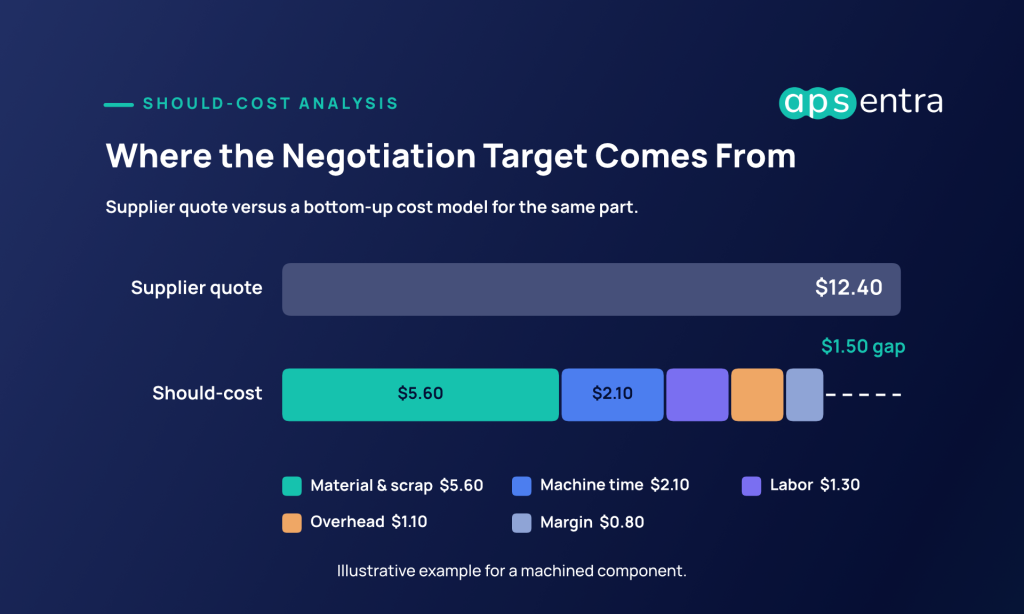
A should-cost model rebuilds a part’s price from its inputs: material and scrap, machine time, labor, overhead, and a reasonable margin. The gap between that figure and the supplier’s quote becomes the negotiation target, and it turns the conversation from haggling into a line-by-line review of assumptions.
Three habits make should-cost work in practice.
- Model the parts that matter. Build full models for the highest-spend and most price-sensitive components. For the rest, track price per unit of material weight against the commodity index.
- Update inputs monthly in a rising market. A model built on last quarter’s steel price will understate cost and weaken your credibility with the supplier.
- Separate commodity movement from conversion cost. Accept justified material increases through an index. Challenge increases in machine time, labor, and overhead, which the supplier controls.
Should-cost is one input to a competitive sourcing event, not a substitute for one. How that process runs, and what outside help costs, is covered in strategic sourcing consulting. For a worked example in food manufacturing, see how a multi-site food manufacturer saved $6.5 million in marketing spend through structured sourcing.
Indirect Spend and MRO: Where Control Slips
Indirect spend is where manufacturing procurement usually loses discipline, because no single purchase is large enough to attract attention.
MRO is the clearest example. Bearings, seals, filters, and tooling are bought in small quantities, often by maintenance staff under time pressure, from whichever supplier can deliver fastest. Over a year, that pattern produces duplicate part numbers across plants, prices far above any agreement, and spend that nobody can see in one place.
The fix is structural rather than heroic: a shared item master across sites, catalogs for repeat items, standing agreements with a small number of distributors, and approval thresholds that let routine orders flow while flagging exceptions. None of that requires tendering every order.
Where analytics helps first in this category is covered in AI in MRO procurement. Many plants still run this spend on email and spreadsheets, and the trade-offs of moving off them are set out in procurement software vs. Excel.
Where Money Leaves the Procure-to-Pay Cycle
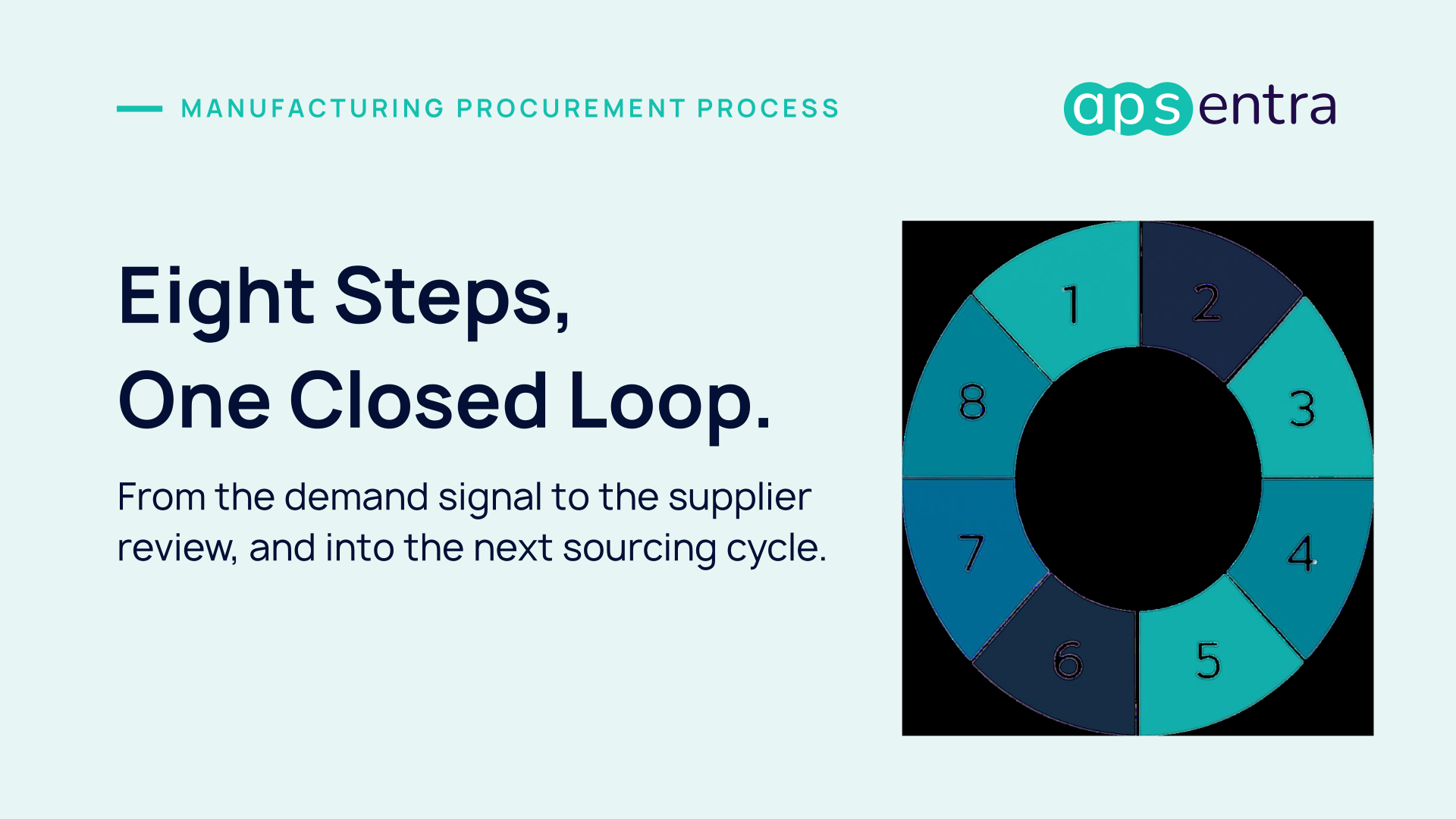
Most savings are lost after the negotiation, not during it. The procure-to-pay cycle has four points where manufacturing spend most often leaks.
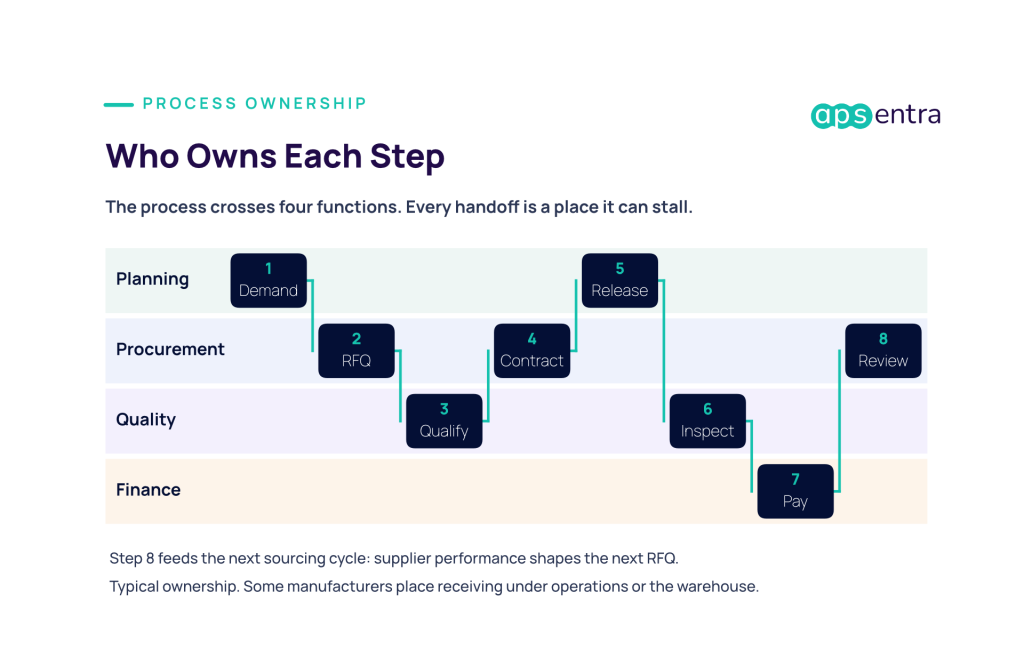
- Spec creep. A requirement grows from what the line needs to what an engineer prefers, and the premium is locked in before procurement sees it.
- Maverick buying. An order bypasses the agreed supplier because the buyer did not know the agreement existed or found it slower to use.
- Off-contract price. The right supplier is used, but the purchase order carries a price that does not match the contract, often an old list price.
- Price or quantity mismatch. The invoice does not match the order or the goods received, and the difference is paid because nobody checks line by line.
Each of these is a control problem, not a negotiation problem. The broader case for measuring realized rather than negotiated savings is made in procurement cost reduction strategies.
Building a Procurement Function That Holds Up
In a rising market, the gains from good sourcing disappear quickly if the rules are not applied on every order. Four foundations make them stick.
- One view of spend across plants. Classified, deduplicated spend data is what shows which suppliers, categories, and sites deserve attention first.
- Contracts connected to purchasing. Agreed prices, index clauses, and volume tiers should apply automatically to the orders that follow, not live in a file.
- Approvals matched to risk. Routine MRO orders should move quickly; capital equipment and single-source direct materials should get deeper review.
- Three-way matching by default. Order, receipt, and invoice should reconcile automatically, with only exceptions reaching a person.
Building the spend view is covered in spend analytics consulting. For sector-specific examples, see auto procurement consulting for automotive, and the state-owned aerospace company case study for structured procurement in a complex manufacturing environment.