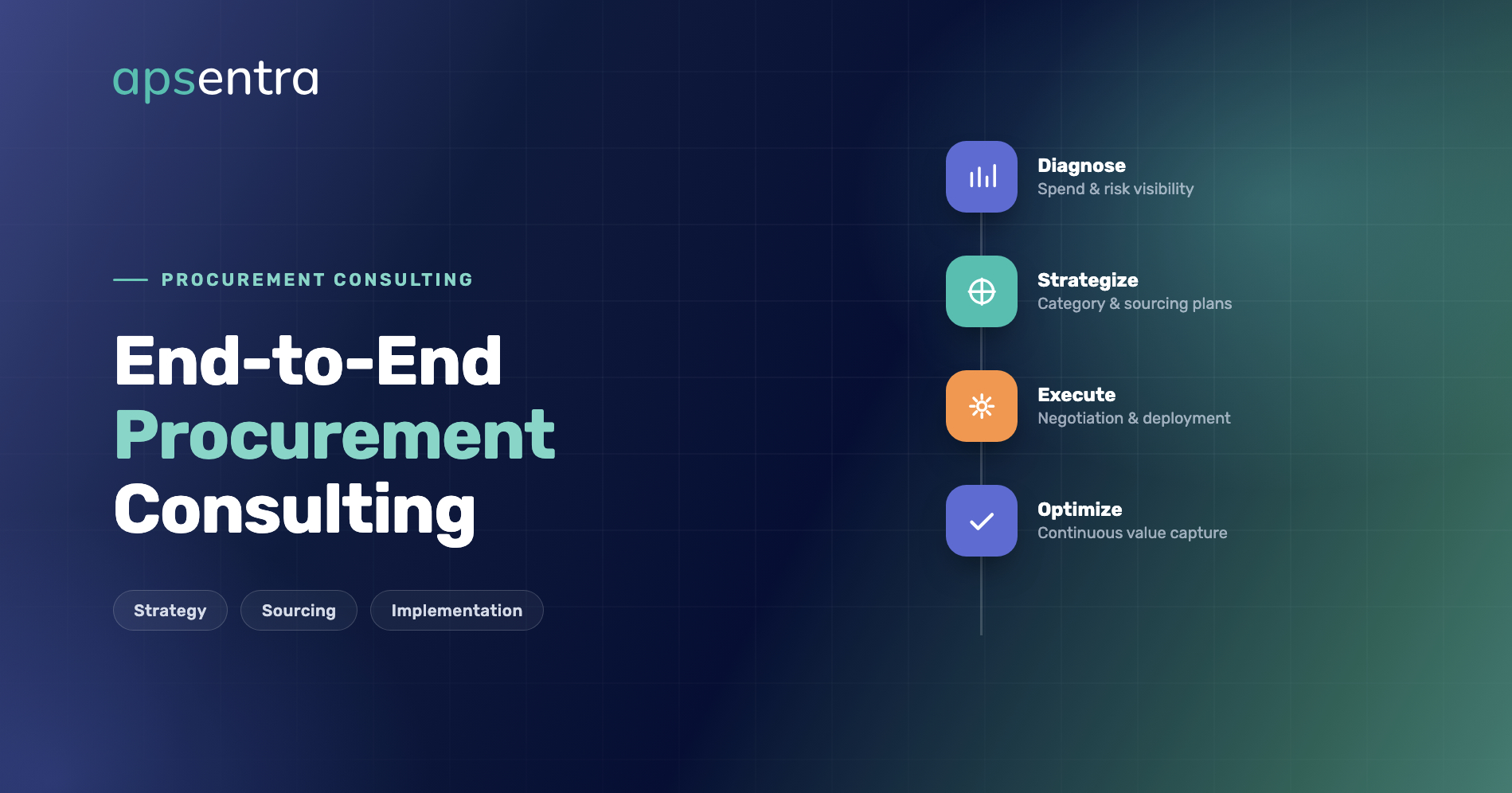
End-to-End Procurement Consulting: What It Actually Means, and Why the Full Chain Matters
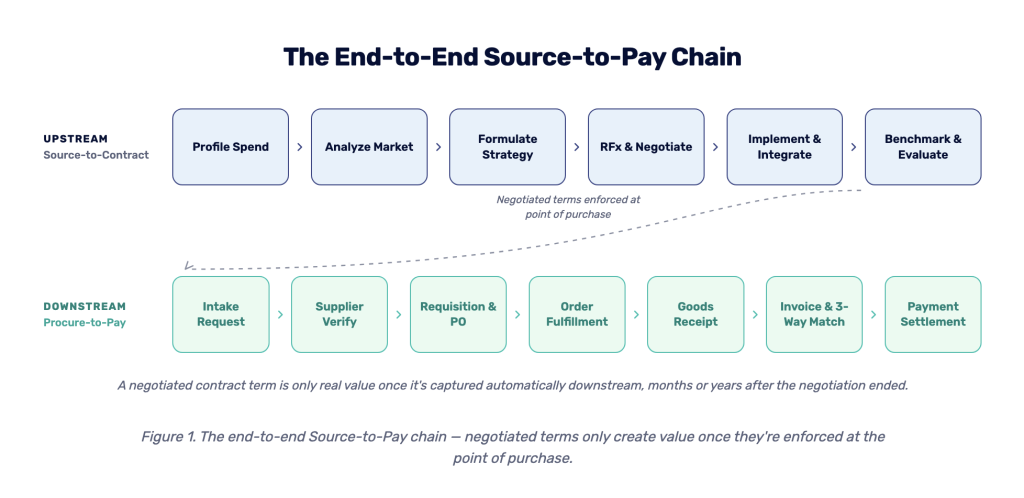
End-to-end procurement consulting exists to close that gap. Rather than treating sourcing, contracting, intake, and payment as separate problems to be solved by separate initiatives, it treats the entire Source-to-Pay (S2P) chain as one continuous system — because that’s what it actually is. A negotiated contract term is only real value if it’s captured automatically at the point of purchase, months or years after the negotiation ended. This article walks through what “end-to-end” actually covers, the frameworks that hold it together, common ways transformations fail, and how a full transformation typically gets delivered in practice.
The Two Halves of the Chain
End-to-end procurement splits into two interdependent domains, and a transformation that only touches one of them is, by definition, not end-to-end.
- Upstream — Source-to-Contract (S2C): spend data cleansing, category strategy, supply market benchmarking, strategic sourcing events, and contract negotiation. This is where value gets identified and negotiated.
- Downstream — Procure-to-Pay (P2P): intake orchestration, purchase order generation, goods receipt, e-invoicing, and payment settlement. This is where that negotiated value either gets captured in daily operations, or quietly leaks away.
The reason this split matters isn’t academic. A sourcing team can negotiate an excellent volume discount, but if the downstream P2P system doesn’t enforce buying through the approved catalog and supplier, employees will keep ordering off-contract out of habit or convenience — and the negotiated rate never gets applied.
Conversely, automating a purchase-order workflow without first fixing upstream category strategy just means bad purchasing decisions get executed faster and with less friction. End-to-end consulting exists specifically to prevent both failure modes by designing the two halves together.
KEY TAKEAWAYS
End-to-end procurement means designing Source-to-Contract (S2C) and Procure-to-Pay (P2P) together, not as separate projects.Negotiated savings are only real once they’re enforced automatically at the point of purchase.Fixing only one half of the chain reliably produces one of two failure modes: savings that decay, or automation that just executes bad decisions faster.
Upstream: The Kearney 7-Step Strategic Sourcing Process
The most widely used framework for the upstream half is Kearney’s seven-step strategic sourcing process, which turns sourcing from a one-off negotiation into a disciplined, repeatable methodology:
- Profile the spend category — aggregate purchase history across ERPs, POs, card transactions, and ledgers to build real demand transparency. This step alone routinely surfaces specification divergence and duplicate vendor relationships that nobody realized existed.
- Conduct supply market analysis — study supplier economics, cost drivers, and market structure, often using should-cost modeling to build a realistic, defensible negotiation baseline.
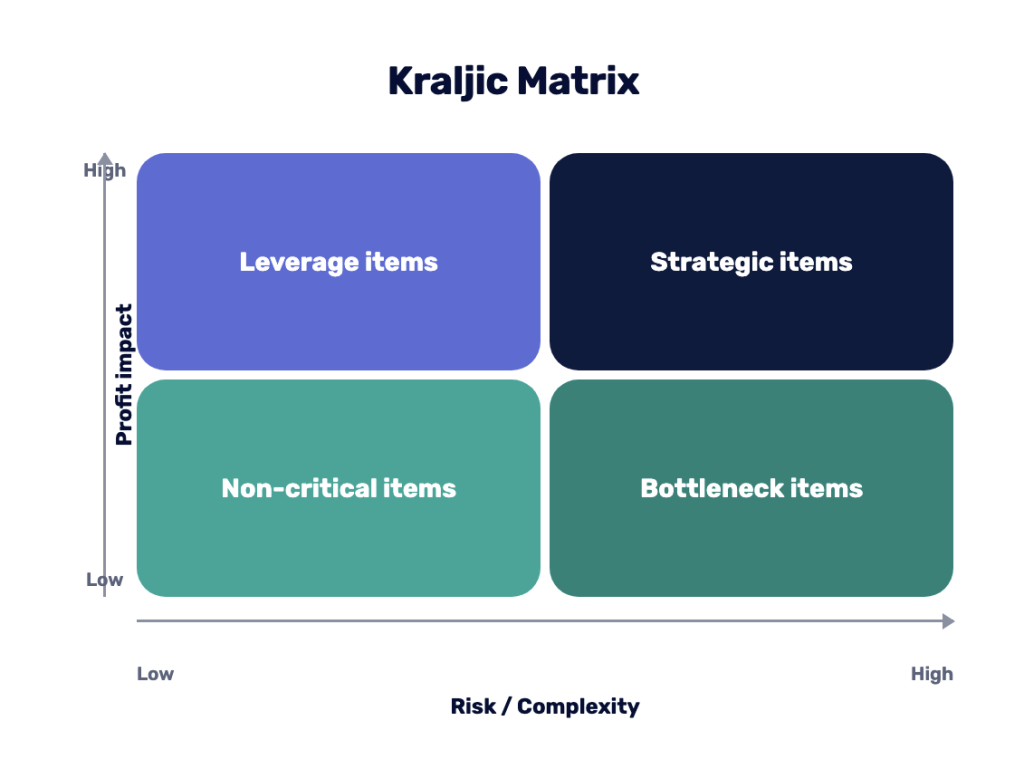
- Formulate sourcing strategy — decide the commercial approach based on category type. This is typically where the Kraljic Matrix comes in, segmenting spend by financial impact and supply risk into four categories: leverage items (high impact, low risk — compete aggressively), strategic items (high impact, high risk — build long-term partnerships), bottleneck items (low impact, high risk — secure supply continuity), and non-critical items (low impact, low risk — automate and simplify).
- Select sourcing process and issue RFx — run the appropriate RFI/RFP/RFQ event with clear baseline specifications, SLAs, and ESG requirements built in.
- Negotiate and select suppliers — evaluate proposals on total value, not just unit price: payment terms, volume rebates, inventory guarantees, and liability terms all matter as much as the headline number.
- Implement and integrate — this is the step most sourcing-only projects skip, and it’s exactly where value leaks. It means migrating master data, building product catalogs, connecting systems via EDI/API, and training internal stakeholders on the new mandatory purchasing channel.
- Continuously benchmark and evaluate — sourcing isn’t a one-time event. Ongoing supplier performance tracking against contractual KPIs feeds back into step one when market conditions shift or a supplier underperforms.
Step six is the hinge on which “end-to-end” actually turns. Skip it, and steps one through five produce a great strategy document that never becomes real savings.
KEY TAKEAWAYS
Kearney’s 7-step process turns sourcing into a repeatable methodology, not a one-off negotiation.The Kraljic Matrix (Kraljic, 1983, Harvard Business Review) is the standard tool for segmenting spend by impact and supply risk.”Implement and Integrate” (step 6) is the most-skipped step — and the one most responsible for negotiated savings never showing up in actuals.
Downstream: Procure-to-Pay in Practice
Once contracts are live, the P2P side governs everyday transactional buying through seven operational steps: intake request, supplier verification against pre-negotiated contracts, requisition approval and PO generation, order fulfillment, goods receipt or service attestation, invoice ingestion with three-way matching, and payment settlement.
The operative word throughout is automatic. Modern P2P execution is designed so that the commercial terms negotiated upstream — the approved supplier, the negotiated price, the agreed payment window are enforced by the system itself, rather than depending on an employee remembering which vendor they’re supposed to use.
KEY TAKEAWAYS
P2P has seven operational steps, from intake request through payment settlement.The goal is enforcement by design: the system applies negotiated terms automatically, rather than relying on employee memory or discipline.
Common Pitfalls in End-to-End Transformations
Most of the value lost in a procurement transformation isn’t lost to bad strategy — it’s lost to predictable execution failures. The most common ones:
- Change management as an afterthought. New systems get rolled out without a communication plan, training, or a clear mandate — so adoption stalls and employees quietly keep buying the old way.
- Sourcing and P2P run as separate workstreams. Without one accountable owner for value capture across the full chain, upstream and downstream teams optimize locally instead of for the whole system.
- Rushing or skipping “Implement and Integrate.” Contracts get signed but never loaded into catalogs or connected via EDI/API, so the negotiated price never reaches the point of purchase.
- Underinvesting in data cleanup. Vendor normalization and categorization get skipped to save time, so every downstream automation and report inherits the same bad data.
- No feedback loop from P2P back to sourcing. Maverick spend and supplier performance data never make it back to category managers, so sourcing strategy goes stale between events.
- Treating technology as the whole fix. A new S2P platform is assumed to change behavior on its own, without the operating model, governance, and incentive changes needed to make the new way the easy way.
KEY TAKEAWAYS
Most transformation value is lost to execution gaps, not strategy gaps.Change management, data quality, and a single accountable owner matter as much as the sourcing or technology decisions themselves.
Getting the Structure Right: Target Operating Models
Even a well-designed sourcing-to-payment process needs the right organizational structure around it. Three models dominate:
For most multi-national or multi-business organizations, the hybrid hub-and-spoke model has become the default answer. The central hub retains authority over high-impact categories, the analytics platform, procurement policy, and complex negotiations.
Spokes sit inside individual business units or regions, acting as trusted local advisors who translate central strategy into on-the-ground execution — while a shared-services layer handles high-volume, low-complexity transaction processing like requisition approvals and AP support. This structure is specifically designed to prevent the two most common organizational failure modes: business units bypassing procurement entirely, and a central team designing policy that has no connection to how the business actually operates day to day.
KEY TAKEAWAYS
The hybrid hub-and-spoke model is the default TOM for multi-national or multi-business organizations.It’s designed to prevent two failure modes at once: business units bypassing procurement, and central policy disconnected from ground-level reality.
The Data Foundation: Spend Analytics and Taxonomy
None of the above works without clean data, and raw ERP exports are rarely clean. Spend analytics consulting exists to turn fragmented, misclassified transaction data into something a sourcing team can actually act on, typically through three stages:
Aggregation and ETL
Vendor normalization
Categorization
This groundwork feeds the KPIs that consultants and CPOs actually track: Spend Under Management (SUM) — the share of total spend actively overseen by procurement rather than bought informally — and cost per purchase order, where manual, paper-heavy workflows run dramatically more expensive per transaction than touchless, automated ones.
Expanding SUM is consistently one of the highest-return activities in a procurement transformation, precisely because indirect spend — the operating expenses, software, travel, and professional services that support the business rather than go into the product — tends to be the most fragmented and least visible category in most organizations, and therefore the one with the most low-hanging savings still on the table.
KEY TAKEAWAYS
Clean data is a prerequisite, not a nice-to-have — aggregation, vendor normalization, and categorization (e.g., UNSPSC) come before any strategy work.Spend Under Management (SUM) and cost per PO are the two KPIs that best indicate whether the data foundation is actually paying off.Indirect spend is usually the most fragmented category — and the one with the most savings still on the table.
Where Technology and Consulting Intersect
Modern procurement technology sits in layers, and understanding them helps clarify what a consulting engagement actually needs to configure rather than build from scratch:
- Intake orchestration at the top — the guided-buying interface employees actually interact with.
- Unified Source-to-Pay suites underneath, governing sourcing, contracting, purchasing, and accounts payable as one connected system.
- Specialized point solutions layered on for spend analytics, third-party risk mapping, and ESG scoring.
- Core ERP platforms at the foundation, holding the financial ledgers and master data everything else depends on.
Despite how much technology is available off the shelf, a genuinely integrated, validated digital procurement strategy is still the exception rather than the rule at most organizations — which is exactly the gap end-to-end consulting is built to close: not by inventing new technology, but by architecting how existing platforms connect to each other and to the operating model around them.
Generative and agentic AI are now a meaningful part of that architecture rather than a future promise. In practice this shows up as AI systems drafting RFx documents and negotiation playbooks from historical demand data, contract-review tools flagging non-standard clauses and missed discount terms buried in supplier agreements, and OCR-driven invoice matching resolving exceptions automatically instead of routing every mismatch to a human. None of this replaces the upstream category strategy or the operating model design — it simply compresses how fast a well-designed process runs.
KEY TAKEAWAYS
Procurement technology is layered: intake, S2P suite, point solutions, and ERP — consulting is mostly about architecting the connections, not building new tech.AI is already embedded in RFx drafting, contract review, and invoice matching — it accelerates a sound process, it doesn’t replace the strategy behind it.
Governance, Risk, and ESG as Core Scope — Not an Add-On
A genuinely end-to-end engagement doesn’t stop at cost and cycle time. Third-party risk management now routinely extends beyond first-tier suppliers into the deeper, less visible tiers of the supply chain, where disruption — a raw-material supplier’s financial trouble, a regional regulatory shift, a climate event — is increasingly likely to originate. Modern risk platforms pull continuous signals on supplier financial health, geopolitical developments, and regulatory watchlists specifically to catch these risks before they cascade into a production stoppage.
ESG has moved from a reporting afterthought into core sourcing criteria for the same structural reason: for most companies, the large majority of their environmental footprint sits in their supply chain (Scope 3) rather than in their own direct operations (Scopes 1 and 2), which means procurement decisions are where real decarbonization progress actually gets made.
Regulation has caught up with this reality — Germany’s Supply Chain Due Diligence Act (LkSG), in force since January 2023, and the EU’s Corporate Sustainability Due Diligence Directive (CSDDD) both require large enterprises to run human-rights and environmental risk assessments across multi-tier supply chains, not just their direct suppliers.
Following the 2026 “Omnibus I” simplification amendments, EU member states now have until July 2028 to transpose the CSDDD into national law, with obligations phasing in for the largest companies from mid-2029 — so the compliance clock is real, even though the timeline has moved. A modern sourcing scorecard increasingly weighs commercial price, service quality, and validated ESG performance together, rather than treating sustainability as a separate checkbox exercise after the commercial decision is already made.
KEY TAKEAWAYS
Third-party risk monitoring now extends past tier-1 suppliers into deeper, less visible supply chain tiers.Most companies’ environmental footprint sits in Scope 3 (supply chain), which is why ESG belongs in sourcing decisions, not just sustainability reporting.Germany’s LkSG is already in force; the EU’s CSDDD (as amended by Omnibus I in 2026) phases in for national transposition by 2028 and obligations from 2029 — plan sourcing scorecards accordingly.
Commercial Models for End-to-End Engagements
The full range of pricing models — time & materials, fixed-fee/milestone, retainer, and gainshare — applies to end-to-end engagements the same way it does to narrower ones, though scope tends to shift the mix: TOM design and platform deployment are usually priced on a fixed/milestone basis, while wave-based sourcing execution within the same program is often gainshare, tied to verified, audited savings against an agreed baseline. For a detailed breakdown of how each pricing model works and how gainshare mechanics are actually calculated, see our companion article, What Is Procurement Consulting, and Do You Need It?
KEY TAKEAWAYS
TOM design and platform deployment are usually fixed/milestone; wave-based sourcing execution is often gainshare against an audited baseline.
APSentra’s End-to-End Readiness Framework
Because so much transformation value is lost in the gap between strategy and execution, it’s worth assessing readiness across four lenses before committing to a full program:

People
Process

Technology
Data
Organizations that are weak on two or more of these lenses tend to see sourcing savings decay fastest — which is exactly what the self-assessment below is designed to surface.
KEY TAKEAWAYS
Readiness for an end-to-end transformation can be assessed across four lenses: People, Process, Technology, and Data.Weakness in two or more lenses is the strongest predictor of savings decay after a sourcing event.
Procurement Maturity Self-Assessment
Score each statement 1 (not true at all) to 5 (completely true) for your organization:
- We have a single, aggregated view of spend across all ERPs, cards, and ledgers.
- Spend is categorized against a standard taxonomy (e.g., UNSPSC) or a well-maintained custom structure.
- Sourcing strategy is segmented using a framework like the Kraljic Matrix, not applied uniformly across all categories.
- Negotiated contracts are consistently loaded into catalogs/systems within weeks of signature, not months.
- Employees are guided (or required) to buy through approved channels, and off-contract buying is visible and tracked.
- Purchase orders, goods receipt, and invoices are matched automatically for the large majority of transactions.
- Supplier performance data flows back to category managers on a regular cadence.
- One person or team is accountable for savings realization across sourcing and P2P together.
- Third-party risk monitoring extends beyond tier-1 suppliers.
- ESG performance is scored alongside price and quality in supplier selection, not evaluated separately.
Scoring guide: Average score below 3 suggests a fragmented chain with significant value leakage; 3–4 suggests a solid foundation with specific gaps worth targeting; above 4 suggests a mature, well-integrated operation ready for AI-driven optimization (see Phase 4 below).
A Phased Roadmap: How End-to-End Transformations Actually Get Delivered
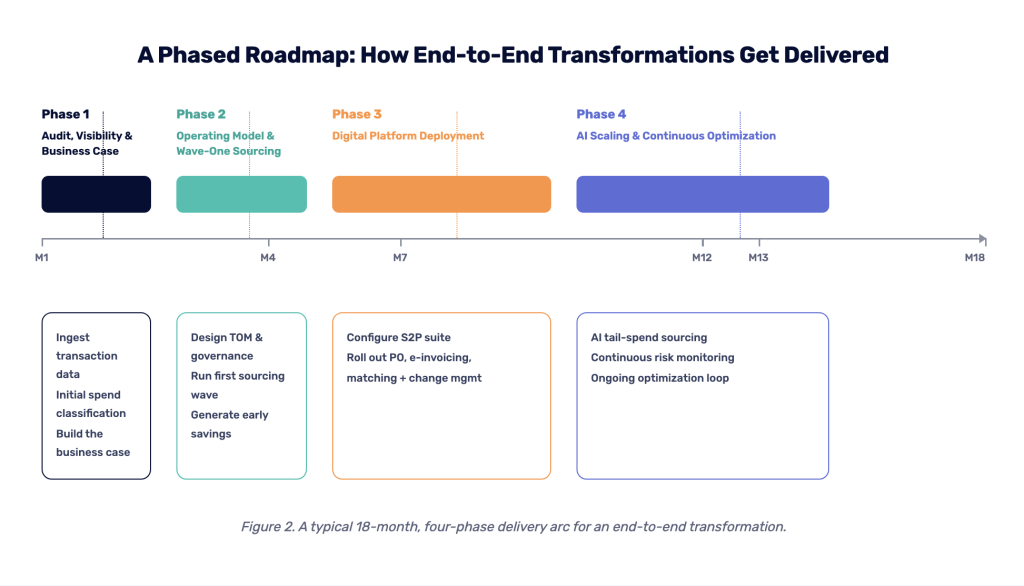
In practice, most well-run end-to-end engagements follow a similar four-phase arc:

Phase 1 — Audit, visibility, and business case (roughly months 1–3)
Phase 2 — Operating model design and wave-one sourcing (months 4–6)

Phase 3 — Digital platform deployment (months 7–12)

Phase 4 — AI scaling and continuous optimization (month 13 onward)
KEY TAKEAWAYS
Most programs run 12–18 months across four phases: audit, operating model + wave-one sourcing, platform deployment, and ongoing AI-driven optimization.Wave-one sourcing is deliberately chosen for early, visible savings to build momentum before the harder platform and change-management work.
Why “End-to-End” Is the Point, Not a Buzzword
It’s tempting to treat “end-to-end” as marketing language layered onto an otherwise ordinary sourcing engagement. It isn’t. The entire argument for end-to-end procurement consulting is structural: value identified upstream is only value realized if it’s enforced downstream, and downstream automation is only worth deploying once upstream strategy is actually sound.
Treat the two as separate projects, and you get exactly the failure pattern most procurement transformations fall into — a great sourcing outcome that decays within a year, or a fast, efficient system faithfully executing the wrong process. Treat them as one connected system, designed and governed together, and the savings compound instead of leaking away.
If you’re scoping a transformation and want to see how platform and partner roles divide across a program like this, our earlier piece on APSentra’s platform-plus-partner model covers that split in detail, and the APSentra Partner Network lists certified partners with end-to-end transformation experience by industry.
KEY TAKEAWAYS
“End-to-end” is a structural argument, not marketing language: upstream value only survives if downstream systems enforce it.Designed and governed as one system, savings compound; designed as separate projects, they decay.
Methodology and Transparency
The frameworks referenced in this article — Kearney’s 7-step sourcing process, the Kraljic Matrix, and the UNSPSC taxonomy — are established, publicly documented industry standards; direct citations and links are provided throughout and summarized in Sources below.
Regulatory references (LkSG, CSDDD) reflect their status as of this article’s last review date and are linked to their official or primary sources.
APSentra operates a platform-plus-partner model: APSentra’s own technology and advisory services are complemented by a network of certified delivery partners, referenced above.
Sources and Further Reading
- Kearney — Strategic Sourcing
- Kraljic, P. (1983). “Purchasing Must Become Supply Management.” Harvard Business Review.
- UNSPSC — United Nations Standard Products and Services Code
- Germany — Act on Corporate Due Diligence Obligations in Supply Chains (LkSG)
- European Commission — Corporate Sustainability Due Diligence Directive (CSDDD)