Agriculture Supply Chain Visibility: Lessons From the GCC
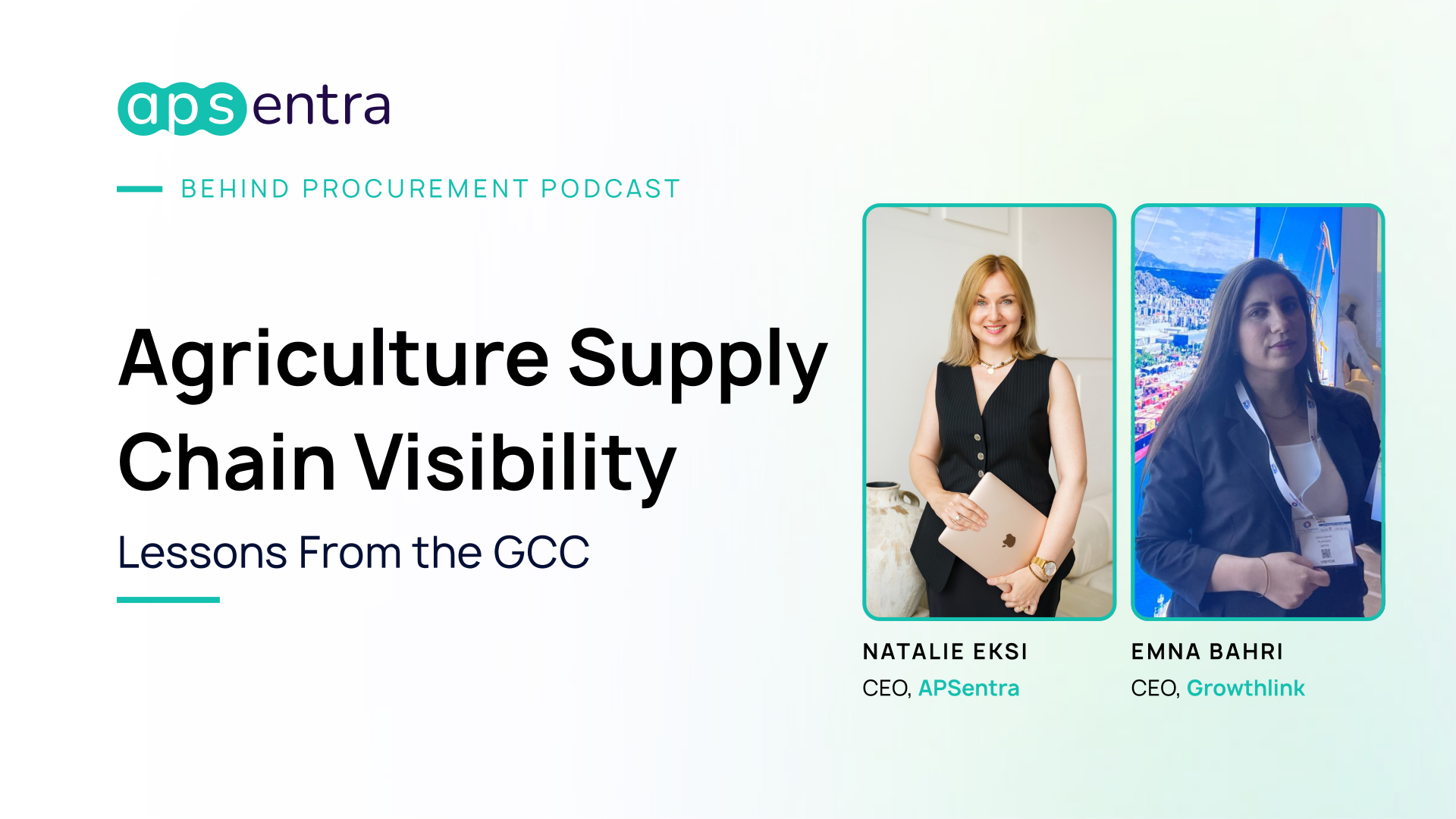
Procurement in agriculture is still widely read as a back-office buying function. The latest episode of the Behind Procurement Podcast, powered by APSentra, set out to test that reading against practice. Natalie Eksi, CEO at APSentra, was joined by Emna Bahri, CEO at GROWTHLINK LLC, a Qatar-based consultancy working across end-to-end supply chain, procurement, logistics and digital transformation, with more than ten years in automotive manufacturing, international logistics, e-commerce and consulting.
What Did the Audience Say Slows Procurement Most?
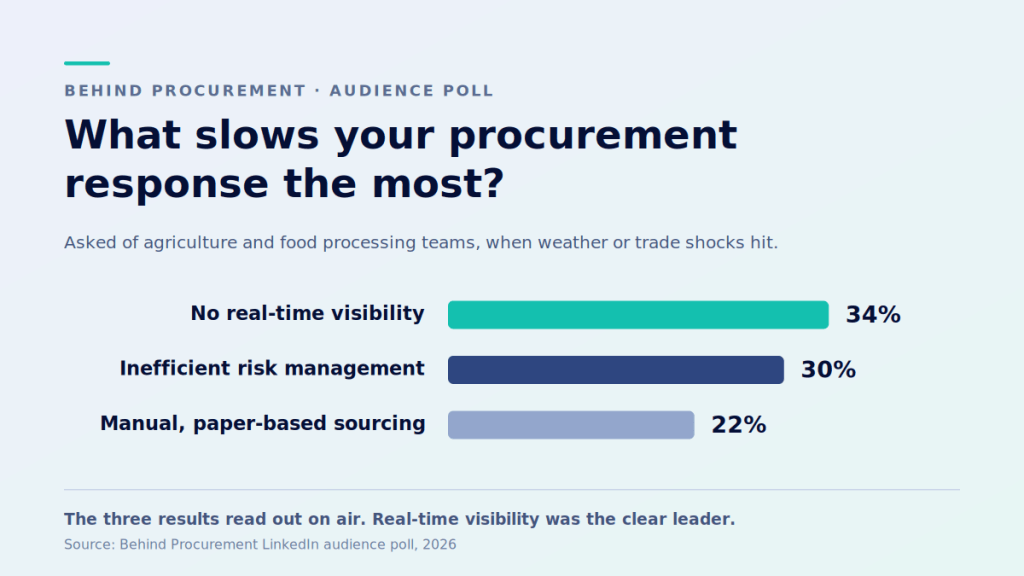
Asked what slows their procurement response when weather or trade shocks hit, agriculture and food processing teams named the absence of real-time visibility first. The three results read out on air: no real-time visibility 34 percent, inefficient risk management 30 percent, manual and paper-based sourcing 22 percent.
Natalie Eksi: I do not understand how you build an efficient process if you cannot see what is actually happening in real time. You cannot take a science-based decision, and you cannot work with risk.
Natalie: You are helping companies across the GCC build efficiency through digitalization. Does that match what you see in your region?
Emna Bahri: It matches exactly. All four pressures are real, and we have to face all of them. But in agriculture, the absence of real-time visibility is the critical one, because everything in agriculture depends on time.
Why Is Timing Different in Agricultural Procurement?
Because the production window does not wait, and the damage is not recoverable. A delayed component in manufacturing postpones an order. A delayed input in agriculture can remove a season.
“If one shipment is delayed, fertilizer, pesticides, peat moss potting soil, and it is late by a week, it can damage the whole production line. Agriculture is not a product you fix later or finish next month. If it is damaged, it is lost.”
— Emna Bahri, CEO at GROWTHLINK LLC
Emna Bahri: You need the visibility before, three months ahead, sometimes six. Here in the Middle East we outsource a great deal, so we work with many international suppliers and anything can happen in transport. If you receive the information and you can no longer do anything with it, it is already late.
That reframes what visibility is for. Visibility that arrives at month-end is a record. Visibility that arrives while a decision is still open is a control. The gap between those two is where a season is protected or lost.
The same logic applies to how procurement is positioned internally. It is the argument we set out in procurement as a strategic finance function: the function that holds commitment data first should be feeding financial decisions, not reporting to them.
What Do the 2026 Numbers Say About the Input Side?
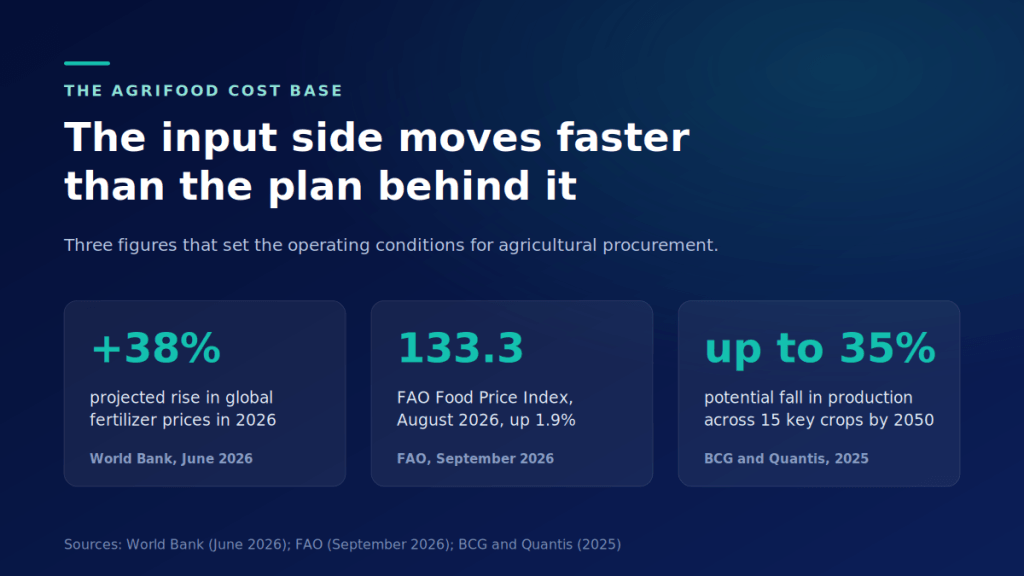
Input costs are rising faster than the budgets built around them. Three current figures set the operating conditions for any agricultural procurement team.
The FAO Food Price Index averaged 133.3 points in August 2026, up 1.9 percent in a month, with every commodity group higher than in July. The cereal index reached its highest level since May 2024, supported by weather concerns in key producing regions and continued uncertainty around Black Sea export flows.
The input side moved harder. The World Bank Food and Nutrition Security Update of June 2026 reports fertilizer prices up 35 percent across the first five months of the year against the same period in 2025, with the June Global Economic Prospects projecting a 38 percent rise across 2026. For a function that buys fertilizer, pesticides and animal feed on a seasonal calendar, that is a planning problem before it is a price problem.
The longer horizon was the subject of the article reviewed during the session: Building Resilience in Agrifood Supply Chains, published by BCG with Quantis. Their modelling covers fifteen major crops representing 65 percent of global crop production and 70 percent of global caloric intake, and finds production across them could fall by up to 35 percent by 2050. The same analysis notes that days of moderate or high price volatility for rice and wheat doubled or tripled between 2020 and 2024.
Natalie Eksi: The BCG and Quantis team also note that one third of all food produced globally is lost or wasted, while the World Health Organization estimates one person in eleven faces food insecurity. If a third is wasted, that is an efficiency problem before it is anything else, and it is not one humanity can afford.
What Does Procurement Efficiency Mean in Agriculture?
Natalie: When you talk about procurement efficiency in agriculture specifically, what does it mean?
Emna Bahri: It starts with collecting every kind of data related to the operation, in time. It is not simply consulting suppliers and checking where the goods are. People assume agriculture means food and production. In the Middle East it is wider than that. We work with greenhouses, water filtration, critical pesticides and a great deal of spare parts. I would say half of a buyer’s work here is finding the right supplier for a greenhouse component or a part for an agricultural machine, not for a general category.
Emna Bahri: Then it is classification. Which suppliers, from which region, on what terms, and how each one responds to us. We also carry a national vision: supporting local suppliers in a small market so they find their place here and across the GCC. Procurement sits between production, sales and the technical department. It has to know the ABC of production and the relative importance of every product, and hold both a short-term and a long-term view at once.
That description maps closely onto what agricultural procurement software has to handle in practice: seasonal windows, dispersed rural suppliers, shelf-life and storage constraints, and purchasing tied to real crop and livestock cycles rather than a generic approval flow. We cover that scope in detail on the agriculture and agri-processing procurement page.
Where Does Efficiency Break Down First?
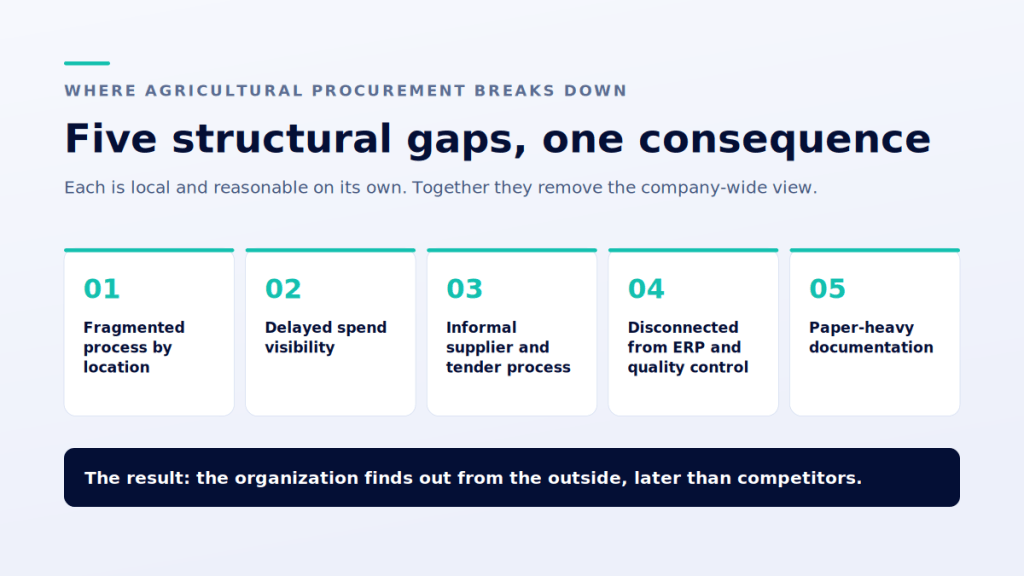
Five structural gaps recur across multi-location agribusinesses regardless of geography or crop. Each is local and reasonable on its own. Together they remove the company-wide view.
Natalie: If you had to fix those five, where would you start?
Emna Bahri: It is hard to pick one, but I would start with paper-heavy documentation, because it affects all the others. Without the exact documentation we lose the supplier. And documentation is tied directly to the quality control system, which here comes from the government. If the authorities find something they are not satisfied with in a product, they can change what they require. You have to know what will be controlled, and have the documentation ready before the goods arrive.
Emna Bahri: Then fragmented process, and specifically fragmentation by location. A company based in Qatar may invest in Algeria or elsewhere in North Africa. So multi-location is not several sites in one country. It can be multi-location worldwide, and the fragmentation travels with it.
That is the point at which a local workaround becomes a structural exposure. A single site can run a disciplined process on paper. A group cannot see fifteen disciplined local processes as one picture, which is what it needs when a sourcing region comes under pressure.
Which Pillar Moves the Financials Most?
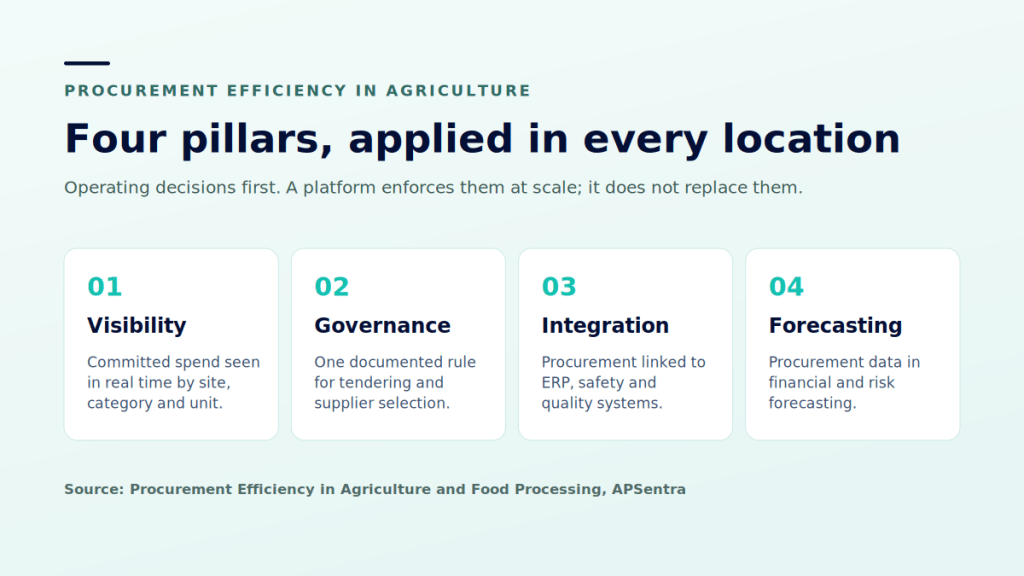
Four pillars carry procurement efficiency across an agribusiness: company-wide spend and commitment visibility, standardized supplier and tender governance, integration with ERP, safety and quality control systems, and procurement data feeding financial and risk forecasting.
Natalie: Which of the four influences the financials the most?
Emna Bahri: Forecasting. We saw it with a client who did not forecast properly. As we say in supply chain, failing to plan is planning to fail. Seeds are expensive. Add one zero to a quantity and you are not facing a small error, you are facing dead stock, an inventory you cannot manage, a finance team in trouble, and capital that could have been used somewhere else entirely.
Forecasting is also the pillar that depends on the other three. A forecast is only as good as the commitment data feeding it, which requires visibility, consistent supplier records and a connection to the systems that track what was actually received.
“None of the four is a software feature. They are operating decisions that a platform can enforce at scale but cannot substitute for.”
— Natalie Eksi, CEO at APSentra
How Does Qatar Turn Food Security Into an Operating Model?
Qatar’s National Food Security Strategy 2030 rests on three pillars: expanding local production and local markets, building strategic reserves and early-warning systems for storable commodities such as wheat, sugar and rice, and diversifying supply through international trade and investment partnerships.
Emna Bahri: The country faced real shortages during the 2017 blockade, and the response was to turn that problem into a strategy rather than a reaction. There is a major port project for stocking critical products. Farmers are encouraged to invest in local production, with training programmes and support on the price of fertilizer, pesticides and animal feed. The population is around three million, but consumption is high, so local capacity matters.
Emna Bahri: You cannot build a food security strategy without an efficient supply chain behind it, so they are also working on the operational layer. Even the rainy season is treated as an input: there is a process to collect and use what falls, small as the quantity is next to North Africa or Europe. Smart agriculture is growing quickly here too, with government-backed investment in AI for soil testing and for reducing fertilizer use. Qatar is becoming a reference for how to turn a problem into an opportunity.
Each of the three national pillars depends on the same operational capability. Local production targets mean little without spend and supplier data connecting sourcing decisions to output on the ground. Strategic reserves and early-warning systems work only if procurement can flag supplier or category concentration before a shortfall becomes a shortage. Diversified international sourcing is only as resilient as the tendering and supplier governance behind it.
A national strategy sets direction. Procurement efficiency, applied consistently across every farm, plant and trading relationship, is what converts direction into measurable progress. For agribusinesses operating in or sourcing from the GCC, that is a governance mandate at national scale rather than policy background.
What Does a Decade of Continuous Visibility Look Like?
Natalie Eksi: What I like most about this case is the first word in its title: long-term. This client has been with us for more than ten years, and the best compliment a customer can pay a vendor is simply to stay.
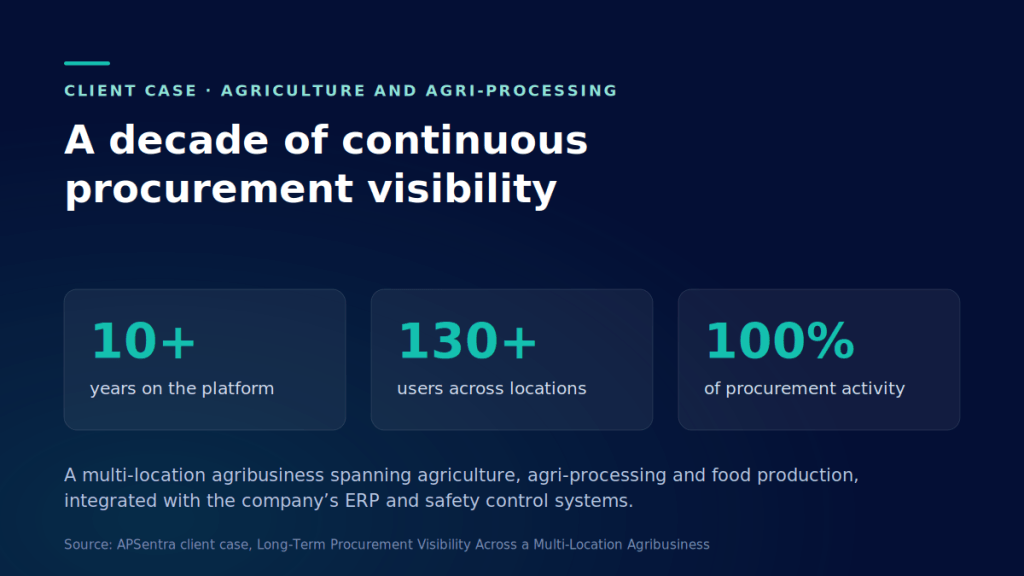
Agriculture & Agri-Processing | Food Processing & Production | 130+ Users | Multiple Locations
Challenge: Procurement activity was distributed across multiple locations and operational areas, with no consistent, centralized way for management to see purchasing activity, account for it, or connect it to the company’s existing ERP and safety control systems.
APSentra Solution: The company brought every core procurement activity into a single environment connected directly to its ERP, using the Tender & Surplus Disposition and Supplier Excellence modules to standardize tendering and supplier management across locations, and extended the platform to manage the sale of surplus goods and materials.
Outcome: More than a decade later, 100 percent of the company’s procurement activity runs through APSentra. Leadership has one source of truth for purchasing across every location, and the platform has scaled alongside a business that also carries a strategic investor from Saudi Arabia, where transparency and accountability are a standing requirement rather than an occasional audit item.
“The real value of a long-term implementation is that the system becomes part of the business itself. With all procurement managed through APSentra, the company has maintained visibility, accountability and control as its operations have grown and evolved.”
— APSentra Implementation Manager
The detail that carries the argument is the integration. Procurement connected to ERP and safety control systems means a purchasing decision and its operational consequence are visible together, rather than reconstructed after an audit request.
Emna Bahri: This case resumes everything we discussed. Once data is centralized, analyzing it gives you the right information, and the right information gives you visibility, and visibility gives you the right action at the right time. Many agribusinesses read a case like this and realise they are facing these problems without being aware of it, because the symptoms look operational. Finance or sales find out at the end of the year.
What Technology Does Not Solve
A platform enables governance. It does not create it. That distinction is the source of most procurement transformations that fail to deliver what leadership expected.
A platform makes a well-designed structure faster, more visible and easier to enforce. It gives finance and operations real-time access to committed spend that would otherwise require manual extraction from several locations, applies approval routes consistently instead of leaving them to local practice, and produces an audit trail that paper-based processes cannot generate. APSentra does this through a digital twin of the organization’s structure and procurement workflow, so the controls map to how the business actually operates across farms, plants and business units.
What it cannot do is replace the decisions that come first: who is accountable for procurement by category, location and business unit; how supplier selection criteria are defined; how often procurement data feeds financial and risk forecasting; and which categories carry enough concentration risk to warrant active diversification. Deploy a platform without settling those, and the organization reproduces its informal processes in digital form. The system changes. The governance does not.
Natalie Eksi: Consulting is important for creating the processes, but without a digital platform those processes will not survive long. We want them used in daily operations, because that is the only way you can scale and keep improving.