BOM Lifecycle Management: How the Bill of Materials Becomes a Buying Plan
A bill of materials looks like a list. It behaves like a set of standing commitments. Each line names a part someone will have to buy, at a price that moves, from a supplier whose lead time changes, for as long as the product is sold and supported.
BOM lifecycle management is how that list stays accurate and buyable over the life of a product. This guide covers the stages, how to read a BOM for risk, how engineering changes reach procurement, and what happens when a part reaches end of life.
What BOM Lifecycle Management Is
BOM lifecycle management is the practice of controlling a bill of materials across the whole life of a product: from the first design revision through prototyping, production, engineering changes, and eventual end of life. It covers revision control, part lifecycle status, approved alternates, and the sourcing consequences of every change.
Two functions share the document and read it differently. Engineering treats the BOM as a definition of the product: what it is made of, in what quantity, at which revision. Procurement treats it as a demand plan: what has to be bought, when, from whom, and at what risk.
Most BOM problems come from that split. A part status change is an engineering fact and a purchasing deadline at the same time, and the two groups often learn about it weeks apart.
For discrete manufacturers where the BOM drives most of the spend, the sourcing side of this is covered in OEM procurement consulting.
The Stages, and Why Timing Decides Cost
The same change costs very different amounts depending on when it is made.
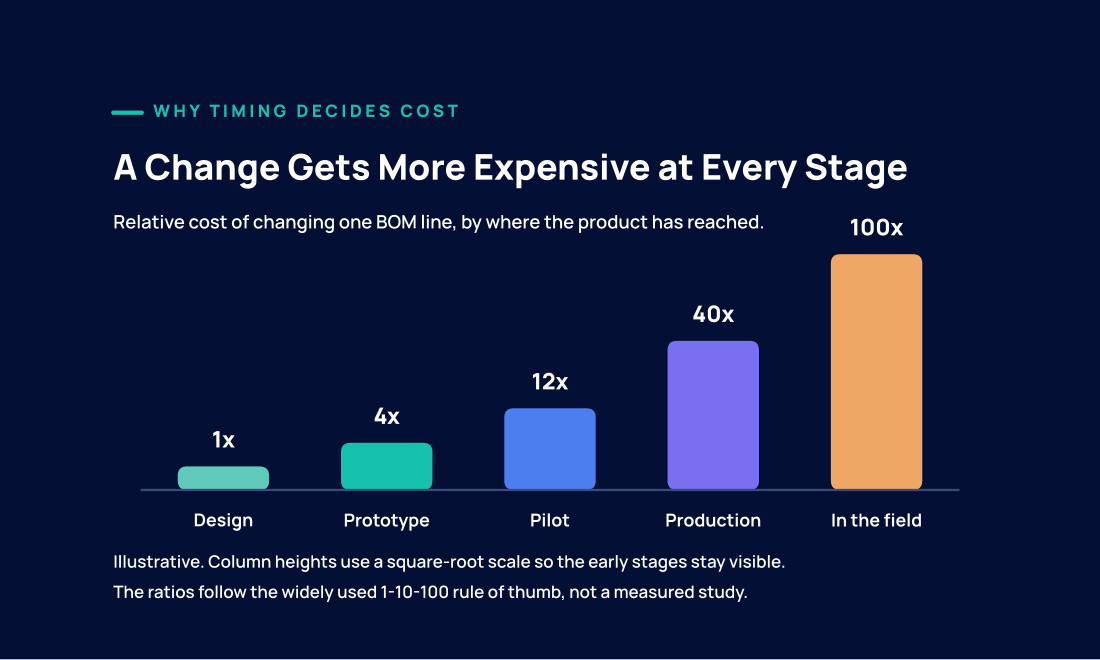
In design, changing a part means editing a document. In production, it can mean scrapping inventory, requalifying a supplier, and revising work instructions. Once units are in the field, it can mean a service bulletin or a retrofit.
The practical conclusion is not that changes are bad. It is that the cheapest place to apply procurement knowledge is in design, when a part is chosen, because that is the last moment the choice is nearly free. A part selected without checking lifecycle status or lead time is a cost committed years ahead of when it is paid.
Three habits move that knowledge earlier:
- Give engineers a preferred-parts list. A maintained list of components already qualified, in stock, and commercially sound removes most of the risky choices before they are made.
- Check status at design review, not at first buy. A part already marked NRND should rarely enter a new design, and that question costs nothing to ask early.
- Record a second source while the first is easy to get. Qualifying an alternate is cheap when nothing is wrong and expensive during a shortage.
Part Status: Reading a BOM for Risk
Every line on a BOM carries a lifecycle status, and the statuses that matter most are the ones that still let you buy the part today.
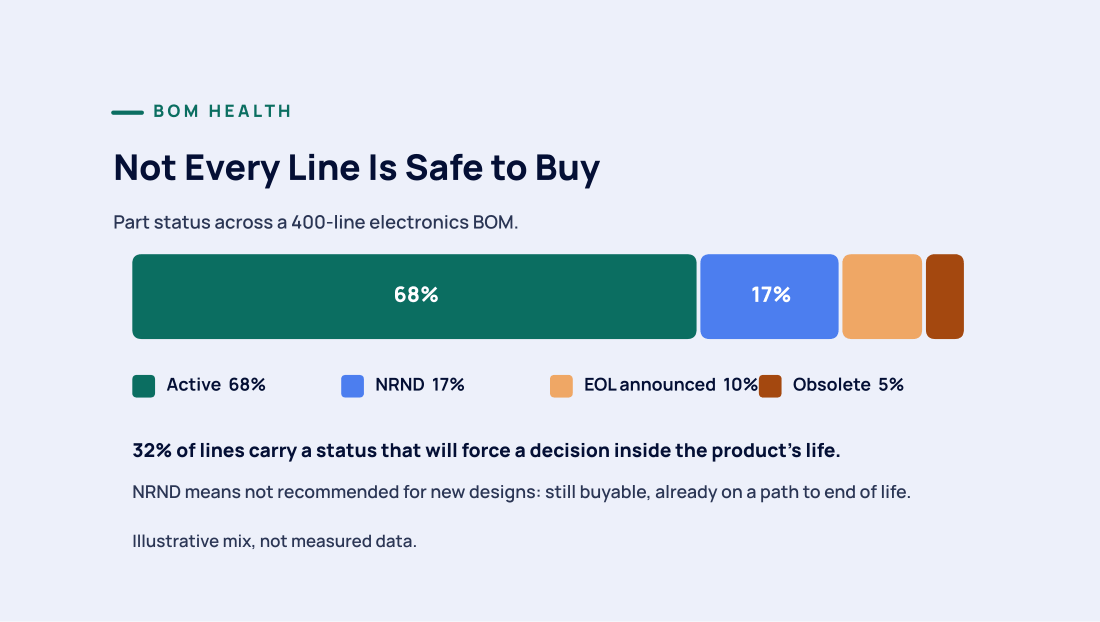
- Active. In full production, generally available. The status most of a healthy BOM should carry.
- NRND (not recommended for new designs). Still buyable, and the manufacturer has signaled it will not be forever. A warning, not a deadline.
- EOL announced. A discontinuation notice has been issued, with dates for the last order and the last shipment. This is a deadline.
- Obsolete. No longer available from the manufacturer. Remaining supply sits with distributors and the open market, where price and authenticity both become questions.
The useful exercise is not counting statuses but connecting them to volume. A part marked NRND that appears once in a low-volume product is a note. The same status on a part that appears in four products at high volume is a program risk.
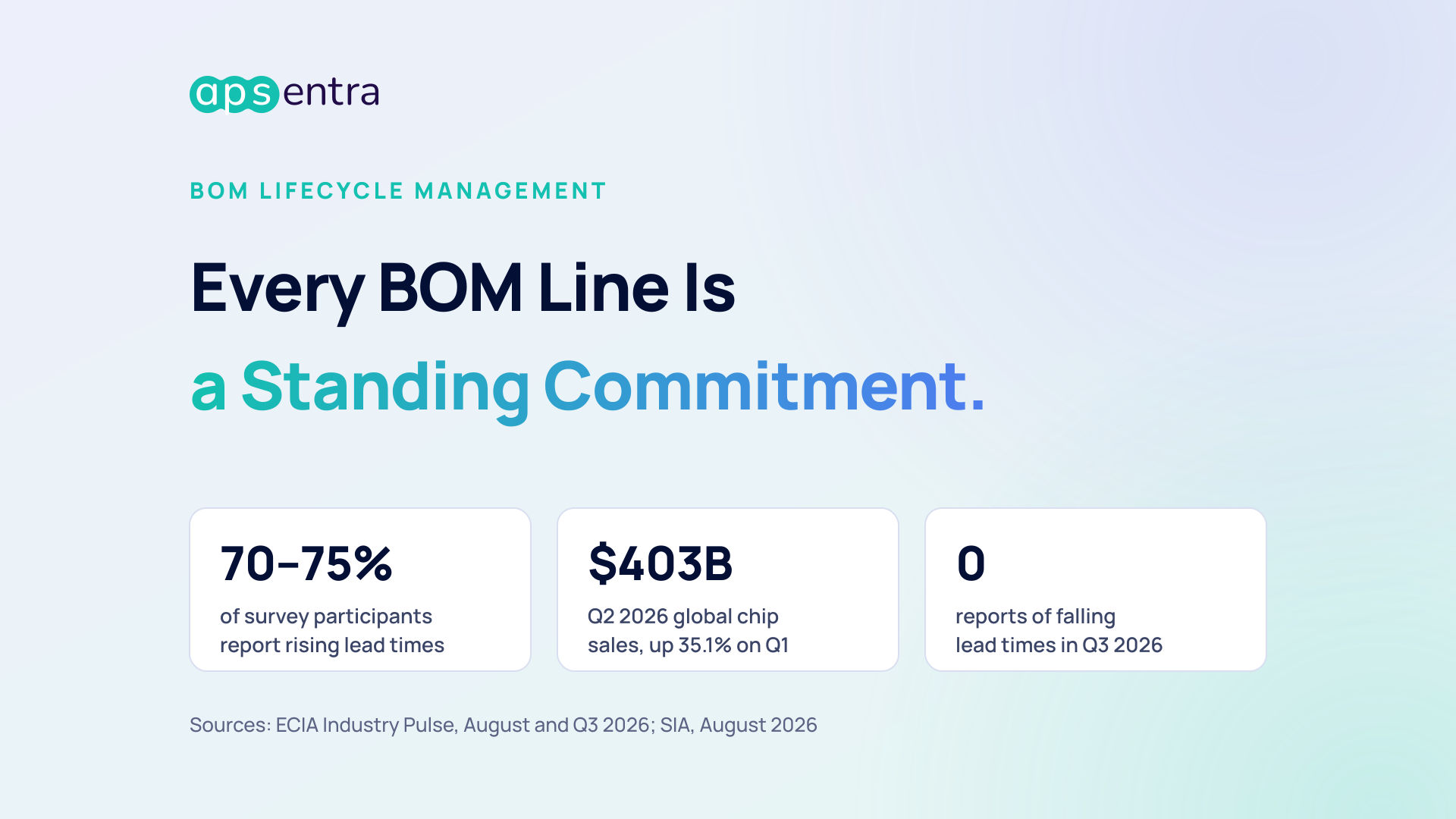
Component demand makes this harder in 2026. The Semiconductor Industry Association reported global chip sales of $403.3 billion in the second quarter of 2026, up 35.1 percent on the first quarter, with full-year sales expected to exceed $1.5 trillion. Strong demand keeps fabs focused on high-volume, current-generation parts, which is exactly the pressure that pushes older components toward discontinuation.
Engineering Changes and the Procurement Gap
An engineering change order is where BOM lifecycle management either works or quietly fails.
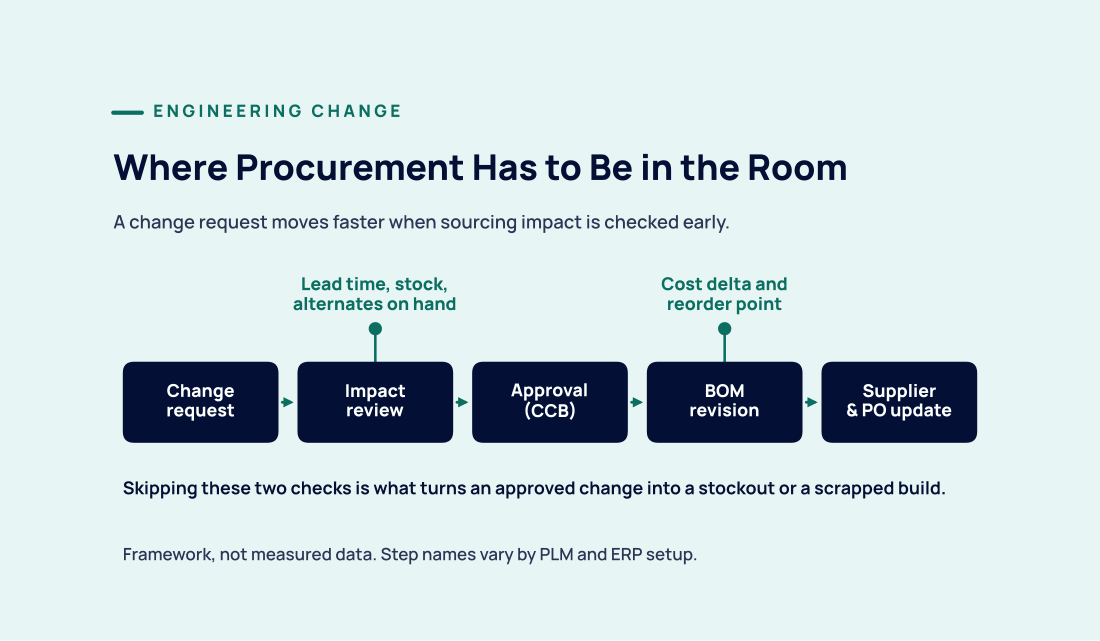
The process itself is standard: someone requests a change, its impact is reviewed, a board approves it, the BOM is revised, and the change takes effect. The failure is almost always in the second step, where impact is assessed as a technical question and not a sourcing one.
Two checks belong in that review, and both are quick:
- Can we get the new part, and when? Lead time, current stock, and whether an approved alternate already exists.
- What happens to what we already have? Existing inventory of the outgoing part, open purchase orders, and whether the change is effective immediately or at a cut-in point.
Effectivity is the detail that causes the most avoidable damage. A change that takes effect immediately can strand inventory that was ordered correctly a month earlier. A change tied to a serial number or a date lets the old stock run out first. Deciding that at approval, rather than afterward, is usually the difference between a clean transition and a write-off.
The broader point, that a negotiated price only survives if the purchasing process enforces it, is covered in procurement cost reduction strategies.
End-of-Life and the Last-Time-Buy Deadline
An end-of-life notice is the only BOM event that comes with a fixed date set by someone else.
A discontinuation notice names the parts being retired and gives two dates: a last-time-buy date, after which no further orders are accepted, and a last-time-ship date, after which the manufacturer stops delivering. The window between the notice and the last-time-buy date is the entire decision period, and it is usually months rather than years.
Inside that window there are only three real options:
- Buy the remaining lifetime demand. Accurate only if the forecast for the rest of the product’s life is accurate, and it ties up both cash and shelf space. Over-buying is expensive; under-buying means a redesign later anyway.
- Qualify an alternate. Cheapest in the long run and slowest to execute, since it needs engineering time and often requalification.
- Redesign the affected section. The most expensive option and sometimes the only one, particularly when no form-fit-function replacement exists.
Lead times make the first option harder than it looks. ECIA’s Industry Pulse survey for August and Q3 2026, published September 4, found 70 to 75 percent of participants reporting increasing lead times across all three major component categories, with no participants reporting decreasing lead times in any category. A last-time-buy placed into a market with lengthening lead times may not arrive before the line needs it.
This is why the deadline matters more than the quantity. The quantity can be revised. The date cannot.
What a Managed BOM Line Carries
Most BOMs hold a part number, a description, and a quantity. That is enough to build the product and not enough to buy it reliably.
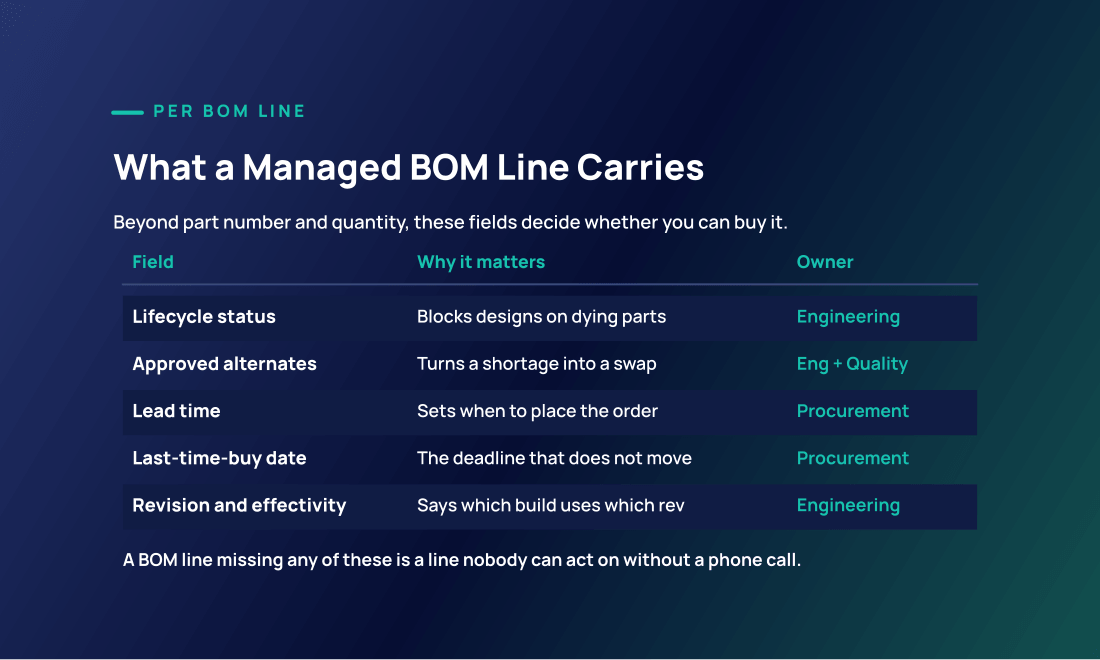
The ownership column matters as much as the fields. Lifecycle status and approved alternates are engineering decisions, often with quality involved. Lead time and last-time-buy dates are procurement’s to maintain. When nobody owns a field, it goes stale, and a stale lifecycle status is worse than none because it is trusted.
Keeping supplier data, lead times, and part status in one place rather than in separate engineering and purchasing files is the practical problem, and platform options are compared in best vendor management software.
Where PLM Ends and Procurement Begins
Most manufacturers hold the BOM in a PLM or engineering system and buy from an ERP or procurement system. Both are correct, and the handoff between them is where lifecycle management usually breaks.
PLM is built to answer what the product is: which revision, which parts, which change history. Procurement systems are built to answer what to buy: from whom, at what price, by when. Neither is designed to notice that a part on revision C went NRND last month and appears in three active products.
Four connections close most of the gap:
- Part status flows into purchasing. A status change should be visible wherever buying decisions are made, not only in the engineering record.
- Approved alternates travel with the part. A buyer facing a shortage needs the alternate list without filing an engineering request.
- Revisions carry effectivity. Purchasing needs to know which revision to buy for which build, especially during a transition.
- Lead time returns to engineering. Designers choosing parts should see current lead times, since that is the cheapest moment to avoid a constrained component.
The underlying discipline is the same one behind any spend decision: knowing what you buy, from whom, and under what terms, as covered in spend analytics consulting. Platform options are compared in best procurement software platforms, and for automotive, where BOM complexity and multi-tier exposure are highest, in auto procurement consulting.